Context
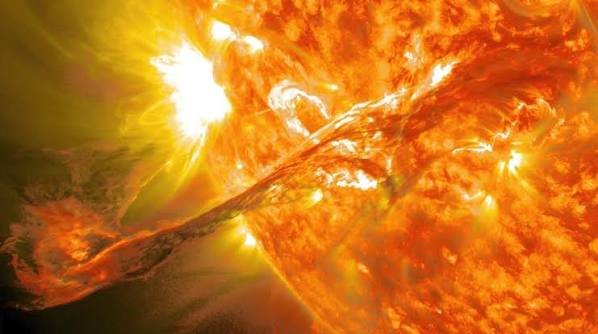
Indian researchers have reported new findings on the thermal evolution of Interplanetary Coronal Mass Ejections (ICMEs) as they travel from the Sun to the Earth, improving scientific understanding of these solar eruptions.
About Interplanetary Coronal Mass Ejections (ICMEs)
- Interplanetary Coronal Mass Ejections (ICMEs) are large expulsions of magnetized plasma released from the Sun’s outer atmosphere that travel through interplanetary space.
- Their occurrence is closely linked to the Sun’s 11-year solar cycle, with a higher frequency during the solar maximum
- When Earth-directed ICMEs interact with the Earth’s magnetic field, they can trigger severe geomagnetic storms.
- These storms can produce auroras in the Earth’s upper atmosphere and are responsible for some of the most intense geomagnetic disturbances affecting the Earth.
- Their vast plasma clouds serve as natural laboratories for studying plasma behaviour and other physical processes in space.
- Severe geomagnetic storms associated with ICMEs can disrupt satellite operations, GPS and radio communications, aviation routes, and power grids.