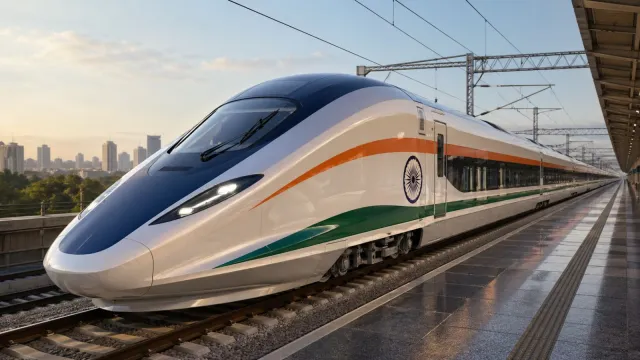
India’s First Indigenous Bullet Train (B28) and the Squeeze Test
Context
India is developing its first indigenously designed and manufactured high-speed trainset, B28, at BEML’s Bengaluru facility for initial use on the Mumbai–Ahmedabad High-Speed Rail corridor. The train recently underwent a squeeze test, highlighting India’s growing capability in high-speed rail manufacturing and structural safety validation.
What is the B28 High-Speed Train?
- Indigenous high-speed train: BEML is manufacturing two eight-car B28 trainsets under a contract from Integral Coach Factory, Chennai, creating domestic capability in high-speed rolling-stock design and production.
- Speed profile: The train has a maximum test speed of around 280 km/h and a planned operating speed of about 250 km/h, allowing it to support initial high-speed services.
- Passenger capacity: Each eight-car trainset is designed to carry about 557 passengers, including provisions for passengers with reduced mobility.
- Initial deployment: B28 is expected to support the first phase of operations on the Surat–Vapi section, while the wider Mumbai–Ahmedabad corridor is developed in stages.
What Does the Squeeze Test Establish?
- Structural validation: Controlled compressive and tensile loads are applied to the car body to test its strength, rigidity and dimensional stability, helping identify weaknesses before further integration.
- Safety relevance: The test checks whether the body shell can withstand prescribed structural loads without unacceptable deformation, strengthening confidence in passenger-compartment integrity.
- One stage of certification: The squeeze test does not make the train ready for service by itself; propulsion, braking, electronics, climatic and dynamic trials are still required before commercial operation.
Why India is Developing Trainsets Domestically
- Procurement flexibility: Delays and cost concerns associated with imported rolling stock created an incentive to develop a domestic alternative for initial operations.
- Technology capability: Local design and manufacturing build Indian expertise in high-speed train engineering, tooling, testing and systems integration, which can be reused for future corridors.
- Continued Japan partnership: Indigenous production does not replace India–Japan cooperation; Japan remains an important partner in financing, engineering and technology for the broader high-speed rail project.
Cost and Strategic Significance
- Potential cost advantage: Local sourcing, reusable tooling and larger future production runs may reduce dependence on expensive imports, though a complete life-cycle cost comparison is not yet established.
- Industrial deepening: Domestic production can expand demand for Indian component suppliers, precision manufacturing and specialised engineering, helping create a broader high-speed rail industrial ecosystem.
- Import-risk reduction: Building critical rolling-stock capability within India reduces dependence on a single foreign supplier and improves procurement resilience.
- Future scalability: Manufacturing and testing infrastructure created for B28 can support later trainsets and future high-speed corridors, improving the economics of subsequent production.
FAQs
Q1. What is B28?
India’s first indigenously designed and manufactured high-speed trainset.
Q2. Who is manufacturing it?
BEML, under a contract awarded by Integral Coach Factory, Chennai.
Q3. What is a squeeze test?
It is a structural test that applies compressive and tensile loads to check the train body’s strength and rigidity.
Q4. What is B28’s speed?
Its maximum test speed is about 280 km/h, with planned operation around 250 km/h.
Q5. Does the squeeze test mean the train is ready for commercial service?
No. It is only one stage in a broader testing and certification process.