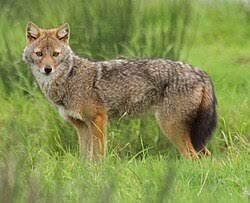
Golden Jackal
Context
The Tenkasi Forest Division (Tamil Nadu) plans to extend its Golden Jackal Ambassadors programme, which trains students in wildlife awareness and rescue work, to the Madras hedgehog (Mulleli) to promote wildlife conservation and ecological awareness.
About the Golden Jackal
- Identity & Family: Canis aureus is a medium-sized, wolf-like mammal of the dog family Canidae; also known as the common jackal or reed wolf.
- Geographic Distribution: Found in southeastern Europe, the Middle East, and South Asia up to Myanmar; India has four recognized subspecies stretching from the Himalayan foothills to the Western Ghats.
- Taxonomic Update: African populations are now classified separately as the African golden wolf (Canis lupaster).
- Habitat Adaptability: Thrives in valleys, riverbanks, grasslands, scrublands, coastal belts, mangroves, and near human settlements.
- Behaviour & Social Life: Exhibits nocturnal habits near human areas and lives in monogamous pairs, with both parents raising the pups.
- Reproduction: Has a gestation period of roughly 63 days, with pups born in secure burrows or rock crevices.
- Dietary Habit: Operates as an opportunistic omnivore, feeding on small animals, insects, fruits, and carrion.
Ecological Role, Threats & Conservation (Golden Jackal)
- Ecological Role & Population
- Ecological Role: Functions as a mesopredator (mid-level predator) and scavenger, controlling rodent numbers and removing animal carcasses.
- Population Estimate: Ranges between 1–3 lakh in India, though numbers are steadily declining across several regions.
- Major Threats
- Habitat Loss: Driven by infrastructure construction and rapid land-use changes.
- Accidents & Persecution: High mortality from roadkills (vehicle collisions) and direct human conflict near settlements.
- Grassland Degradation: Destruction of scrublands and grasslands, often wrongly diverted as wastelands.
- Conservation Status
- IUCN Red List: Listed as Least Concern (LC).
- CITES: Placed under Appendix III (enlisted at India’s request).
- WPA (Wildlife Protection Act, 1972): Upgraded to Schedule I (highest legal protection) via the 2022 Amendment (earlier Schedule II).
- Community-Based Conservation Model
- Approach: Engages local youth in wildlife monitoring, awareness campaigns, and rescue operations.
- Model Precedent: Inspired by the “Friends of Elephants” scheme, using villager alerts to mitigate Human-Wildlife Conflict (HWC).
- Key Activities: Hands-on training in species identification, sighting reports, and emergency wildlife rescue.
- Related Species Covered: Includes the Bengal fox (Vulpes bengalensis), an endemic species of the Indian subcontinent covered under Tamil Nadu’s project.
FAQs
Q1. What is the scientific name of the golden jackal?
Ans. Canis aureus, belonging to the family Canidae.
Q2. What is its IUCN status?
Ans. Least Concern, though its population is declining in parts of India.
Q3. What is its ecological role?
Ans. It acts as a mesopredator and scavenger, controlling rodents and clearing carcasses.