Why in the News?
- The India-Middle East-Europe Economic Corridor (IMEC), announced during the G20 Summit in 2023, was recently discussed in a meeting hosted by India’s National Security Council Secretariat with representatives from the U.S., UAE, Saudi Arabia, EU, and other stakeholders.
- The corridor, which aims to reduce shipping time between India and Europe by about 40%, faces a major hurdle due to the ongoing Israel–Gaza war.
- The conflict has altered the geopolitical stability that enabled the corridor’s conceptualisation, raising doubts over its near-term implementation.
Key Highlights
- Genesis and Vision of IMEC
- Conceived during a rare phase of Middle East stability in 2023, marked by rapprochement among Gulf states and growing Arab-Israel cooperation.
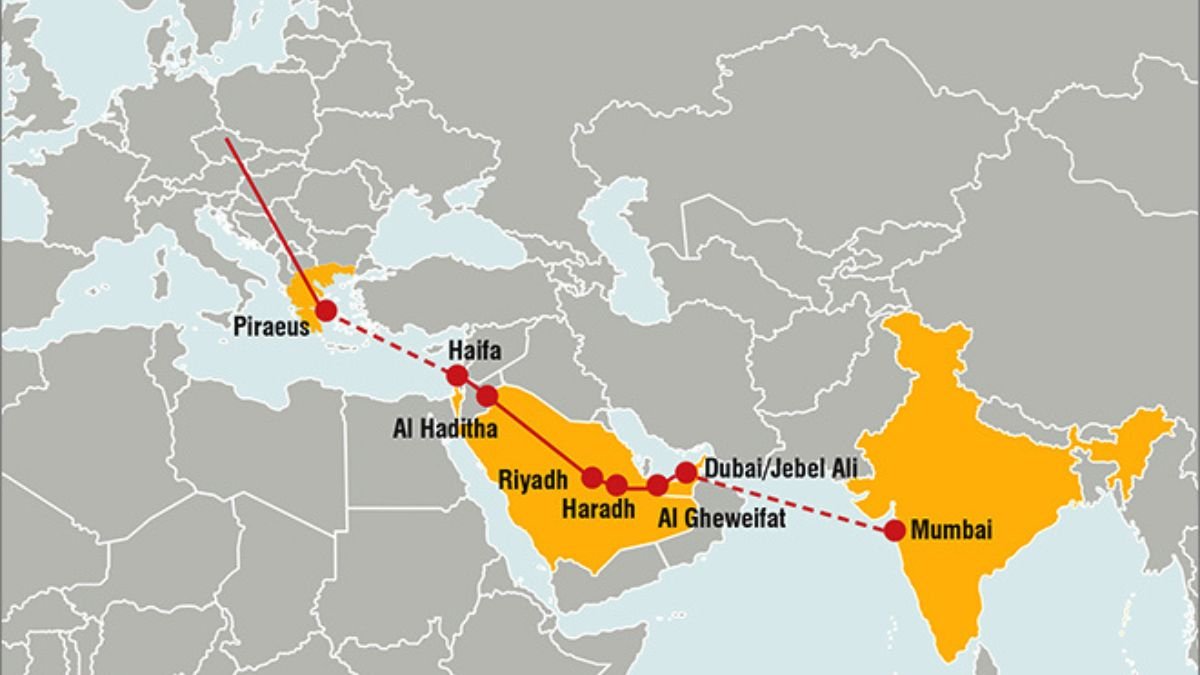
- Envisaged as a dual-route corridor: India-Gulf and Gulf-Europe.
- Beyond trade, planned for electricity and digital cables, clean hydrogen pipelines, and sustainable logistics.
- Structure of the Corridor
- Eastern leg: Connects India’s western ports to UAE by sea, then overland by high-speed freight railway through Saudi Arabia and Jordan to Haifa, Israel.
- Western leg: Ships goods from Haifa to ports in Greece and Italy, then uses Europe’s railway network for distribution.
- Economic Potential
- EU is India’s largest trading partner with FY 2023–24 trade at $137.41 billion.
- Non-oil trade between India, UAE, and Saudi Arabia has surged in recent years.
- IMEC promises reduced transit times, cost savings, increased efficiency, job creation, and lower greenhouse gas emissions.
- Initial Challenges Pre-Conflict
- Lack of corridor-wide tariff standardisation and financial integration.
- No unified insurance mechanisms and uneven port capacities.
- Underdeveloped cross-Saudi/UAE railway infrastructure.
- Impact of the Gaza War
- Collapse of Jordan–Israel relations and stalled Saudi–Israel normalisation.
- Rising security risks, higher insurance costs, and expanded regional conflicts (Lebanon, Yemen, Syria, Iraq, Iran).
- IMEC’s geopolitical foundation weakened, pushing it into a “day-after” conflict resolution category.
Implications
- For India’s Connectivity Ambitions
- The eastern leg can progress due to strong India–Arab ties, especially with UAE and Saudi Arabia.
- Strategic gains possible in trade facilitation, digital payments (UPI), and energy connectivity.
- For Middle East Geopolitics
- Without Palestinian statehood progress, Arab–Israel partnerships remain fragile.
- Regional stability remains a prerequisite for transnational connectivity projects.
- For Global Trade Routes
- IMEC offers an alternative to the Red Sea route, especially amid Houthi attacks.
- Yet instability along the Gulf-Europe section offsets these benefits.
- For Israel
- IMEC is central to its economic integration into the Arab world.
- War-driven diplomatic isolation hinders its ability to sustain the corridor.
- For Strategic Partnerships
- Gulf economic competition (Saudi vs. UAE) complicates corridor coordination.
- Need for consensus on trade modalities, tariffs, and customs policies.
Challenges and Way Forward
| Challenges | Way Forward |
| Geopolitical instability due to Gaza war and regional spillovers | Prioritise conflict resolution and revive Arab–Israel dialogue on Palestinian statehood |
| Breakdown of Jordan–Israel and Saudi–Israel ties | Use neutral mediators (e.g., EU, India) to rebuild trust between corridor partners |
| High insurance premiums for trade in conflict zones | Develop joint risk-sharing and insurance mechanisms among stakeholders |
| Gulf economic rivalry (Saudi vs. UAE) affecting corridor integration | Create a GCC-wide connectivity framework with harmonised tariffs and customs |
| Underdeveloped cross-Saudi/UAE railway | Mobilise joint infrastructure funds and attract private investment for rapid completion |
Conclusion
The IMEC was born out of an exceptional moment of stability in the Middle East in 2023, combining economic ambition with geopolitical cooperation. While the eastern leg can still move forward due to India’s strong ties with Arab states, the western leg’s future depends entirely on resolving the Gaza conflict and restoring Arab–Israel relations. Without addressing the core political fault lines — particularly Palestinian statehood — large-scale connectivity projects in the region will remain fragile and vulnerable to disruption.
| EnsureIAS Mains Question
Q. Discuss the strategic and economic significance of the India-Middle East-Europe Economic Corridor (IMEC) for India. In light of recent geopolitical tensions in West Asia, examine the challenges to its implementation. (250 Words) |
| EnsureIAS Prelims Question
Q. With reference to the India-Middle East-Europe Economic Corridor (IMEC), consider the following statements: 1. IMEC is a part of the G20 initiative announced in 2023. 2. The corridor aims to connect India with Europe via the Middle East through both rail and maritime routes. 3. All IMEC partner countries are members of BRICS. Which of the statements given above is/are correct? a. 1 and 2 only Answer: a |