Context
- Global trade is increasingly being influenced by environmental and climate–related regulations. Countries are no longer competing only on the basis of price and product quality; the carbon footprint and environmental sustainability of products are also becoming important.
- For example:
- The European Union (EU) has introduced the Carbon Border Adjustment Mechanism (CBAM) to put a carbon cost on certain imported goods. It has also introduced regulations to prevent products linked to deforestation from entering its market.
- Buyers and regulators are increasingly demanding information about the environmental impact of products.
- These developments create challenges for Indian exporters because cleaner production technologies often require higher initial investment.
- However, they also create an opportunity: India can develop cleaner industries, meet international standards and become a competitive supplier of green products.
What is Green Industrialisation?
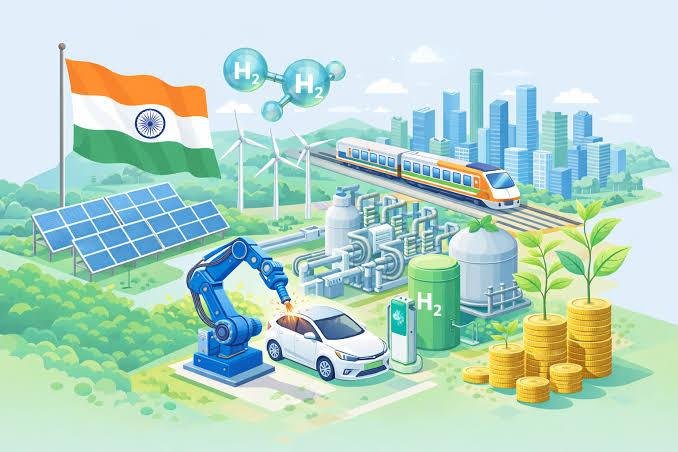
- Green industrialisation means developing industries to promote economic growth (producing more goods, creating jobs, increasing exports) while minimising environmental damage (less pollution and less greenhouse gas emissions).
- It involves using renewable energy, improving energy efficiency, adopting cleaner technologies, reducing carbon emissions, promoting recycling & circular economy, & developing industries such as green hydrogen, green steel, green ammonia & sustainable fuels.
Understanding Green Trade Regulations
- Green trade regulations are rules imposed by countries to ensure that imported products meet certain environmental and sustainability standards. Their objectives include reducing global emissions, preventing deforestation and promoting sustainable supply chains.
- However, they can also create trade barriers for developing countries that lack the technology, finance or infrastructure to comply.
Major examples include:
- Carbon Border Adjustment Mechanism (CBAM): CBAM is an EU mechanism that imposes a carbon-related cost on specified imported goods, based on their embedded emissions.
Why was it introduced?- European producers pay a carbon price for emissions from their factories, while foreign producers may not face an equivalent cost.
- This can make European products less competitive and encourage companies to shift production to countries with weaker climate regulations. This is known as carbon leakage.
- CBAM addresses this by requiring importers to account for the carbon emissions embedded in covered goods.
- EU Deforestation Regulation (EUDR): EUDR aims to prevent products linked to deforestation and forest degradation from entering or being exported from the EU market. It covers seven commodities: Cattle, cocoa, coffee, oil palm, rubber, soya and wood. Businesses must ensure that these products are deforestation-free, legally produced and supported by due diligence.
- Sustainability and product-level requirements: Foreign markets are increasingly asking companies to disclose information about:
- Carbon emissions during production.
- Energy and resource consumption.
- Origin of raw materials.
- Environmental impact across supply chains.
- Recyclability and product composition.
Why are these regulations a challenge for India?
India is still developing its industrial base, and several of its industries depend heavily on coal-based electricity and fossil fuels. This creates a cost disadvantage when exporting to markets that impose environmental requirements.
Major challenges
- Higher production costs: Cleaner technologies, renewable electricity and low-carbon raw materials may require substantial initial investment.
- Carbon–related costs: Indian exporters of covered goods may face additional costs when selling in markets with carbon-border mechanisms.
- Compliance burden: Small and medium enterprises may struggle with carbon accounting, environmental audits, traceability and certification.
- Technology gap: Developing countries may not have affordable access to advanced technologies such as green hydrogen-based steelmaking.
- Risk of green protectionism: Developed countries may frame domestic industrial protection as environmental regulation, while imposing standards that developing countries find difficult to meet.
- Unequal capabilities: Countries with greater financial and technological resources can adapt more quickly, potentially widening the competitiveness gap.
The strategic choice before India
India essentially has two options:
- Continue with carbon-intensive industrialisation
- Impacts: Lower initial investment, but greater exposure to carbon-related trade costs, risk of stranded fossil-fuel assets and declining competitiveness in green markets.
- Shift towards green industrialisation
- Impacts: Higher initial costs, but better readiness for future trade rules, development of cleaner industries and opportunities to attract investment and increase exports.
Sectoral opportunities for India
Green Ammonia:
- Ammonia (NH₃) is a compound of nitrogen and hydrogen, widely used in fertiliser production.
- Conventional ammonia uses hydrogen mainly produced from natural gas, resulting in significant carbon emissions. Green ammonia is produced using green hydrogen, obtained through renewable electricity-powered electrolysis of water.
- Why is it an opportunity for India?
- India’s solar and wind potential can support green hydrogen production.
- Green ammonia offers export opportunities in global low-carbon markets.
- Export demand can attract investment in production infrastructure.
- Large-scale production can reduce costs through economies of scale.
- Domestic production can reduce dependence on imported natural gas and conventional ammonia.
Sustainable Aviation Fuel (SAF)
- SAF is an alternative aviation fuel produced from sustainable sources and processes, such as agricultural & forestry residues, used cooking oil & other eligible waste oils, municipal solid waste & non-food biomass and renewable electricity & captured CO₂ (for synthetic fuels).
- It can be blended with conventional aviation fuel and used in existing aircraft engines within approved limits.
- Importance: Aviation is difficult to decarbonise because batteries are generally too heavy for most long-distance commercial flights. Therefore, SAF offers an important way to reduce aviation emissions.
- Opportunity for India
- The EU’s Aviation regulation mandates a minimum SAF share of 2% by 2025, 6% by 2030 and 70% by 2050. It also sets separate targets for synthetic aviation fuels. This creates an export opportunity for countries producing certified SAF at competitive prices.
- India can use agricultural residues and waste oils as feedstock. It can develop technologies to convert suitable alcohols, including ethanol, into aviation fuel.
- It can also attract investment in SAF refineries and infrastructure and develop certification systems to verify sustainability and lifecycle emissions.
Green Steel
- Traditional steel production uses coal or coke in blast furnaces to extract iron from iron ore, releasing large quantities of CO₂. Green steel refers to steel produced with substantially lower greenhouse gas emissions than conventional steel.
- Opportunity for India
- Carbon-related trade costs may make conventional steel less competitive in export markets.
- Indian steelmakers can invest in energy efficiency, scrap-based production and cleaner technologies.
- Green hydrogen-based steelmaking can be adopted gradually as technology and renewable energy become more affordable.
- Low-carbon steel can help Indian producers retain access to markets demanding cleaner materials.
Green Aluminium
- Aluminium production requires large amounts of electricity. When this electricity comes from coal, its carbon footprint increases significantly.
- To develop green aluminium, India can increase renewable electricity use in aluminium smelters, improve energy efficiency, promote recycling of aluminium scrap, adopt cleaner smelting technologies and improve emissions measurement and certification.
- Importance: Producing aluminium from recycled scrap generally requires much less energy than producing primary aluminium from bauxite. This reduces electricity consumption, emissions and production costs.
- Trade opportunity: As global manufacturers increasingly demand low-carbon materials, Indian producers of certified low-carbon aluminium can gain a competitive advantage in international markets.
- CBAM connection: Aluminium is among the sectors covered by the EU’s CBAM.
Electrification: A major industrial opportunity
- Electrification means replacing technologies that directly use fossil fuels with technologies powered by electricity. Examples: Electric vehicles replacing petrol and diesel vehicles, Electric heat pumps replacing some fossil-fuel-based heating systems, etc.
- As countries electrify their economies, they need a much larger electricity network and supporting equipment. Major benefitting industries include transformers, cables, switchgear, batteries and solar equipment.
- India’s Position in the Global Market
- The global electrical-equipment trade is worth around $500 billion across major product categories.
- China accounts for nearly 30% of global exports, while India’s share is less than 2%.
- This shows that India has significant scope to expand its presence in the global market.
- Opportunity for India
- If India does not expand its domestic manufacturing capacity, rising demand could increase dependence on imports.
- However, with the right industrial policies, India can turn this demand into a major export opportunity.
- India already supplies nearly 20% of the UK’s transformer imports from outside Europe, but its share in the wider European market remains very small.
- To increase its exports and compete globally, India needs to focus on:
- Manufacturing scale: Increase production capacity to meet global demand.
- Quality standards: Ensure products meet international standards.
- Competitive financing: Make loans and investment more affordable for manufacturers.
- Reliable power: Ensure uninterrupted electricity supply to industries.
- Research and Development (R&D): Improve technology and product quality.
- Global Value Chains: Integrate Indian manufacturers into international production and supply networks.
Compliance Infrastructure as a New Opportunity
- Why is it important?
- Green trade increasingly requires reliable & verifiable environmental data about products.
- Regulations such as carbon-border measures, deforestation rules and Digital Product Passports require information on product-level carbon emissions, along with independent verification.
- Opportunity for India
- India’s experience with Digital Public Infrastructure (DPI) shows that it can develop affordable digital systems that work on a large scale.
- India can use this capability to build affordable systems for:
- Carbon accounting – Measuring emissions generated during production.
- Traceability – Tracking a product throughout its supply chain.
- Verification – Checking whether environmental information is accurate.
- Certification – Providing official proof of compliance with environmental standards.
- This can reduce compliance costs for Indian exporters and create a new service industry around environmental data and certification.
Reforming India’s Carbon Market
- International green trade regulations can also encourage India to improve its domestic carbon market.
- India needs a meaningful carbon price of around $30–50 per tonne to encourage industries such as steel, hydrogen and fertilisers to reduce emissions.
- A stronger domestic carbon market can help India retain more carbon-related economic value instead of allowing overseas markets to capture it.
- India should also consider sector-level emission targets rather than setting targets separately for individual industrial plants, as the latter may potentially reward industries with higher initial emissions.
- This approach is similar to the European approach to emissions regulation.
Way Forward – From Defensive Diplomacy to Green Industrial Strategy
Instead of simply opposing foreign green trade regulations, India should use them as an opportunity to strengthen its domestic industries. India should:
- Seek transition periods: Give developing-country exporters more time to comply with new environmental regulations.
- Demand climate finance and technology transfer: Seek financial and technological support from developed countries.
- Challenge discriminatory measures: Use appropriate multilateral platforms to oppose unfair trade restrictions.
- Promote mutual recognition: Ensure that India’s carbon accounting, testing and certification systems are accepted by other countries.
- Include green objectives in trade agreements: Integrate environmental cooperation into bilateral trade and green partnership agreements.
- Support domestic industries: Help Indian businesses meet international environmental standards.
Conclusion
Green trade regulations create challenges such as protectionism, higher compliance costs and unequal standards. However, they also create new market opportunities for countries that can produce goods sustainably. India should therefore convert these regulatory pressures into opportunities to strengthen its manufacturing and export capabilities.
This can help India achieve multiple objectives like net-zero emissions by 2070, energy security, manufacturing growth, employment generation and greater integration into global value chains together.
Frequently Asked Questions (FAQs)
Q1. What is green industrialisation?
Green industrialisation involves developing industries that promote economic growth while minimising environmental damage through renewable energy, cleaner technologies, energy efficiency and reduced carbon emissions.
Q2. What is the EU’s Carbon Border Adjustment Mechanism (CBAM)?
CBAM imposes a carbon-related cost on specified imported goods based on their embedded emissions, aiming to prevent carbon leakage and ensure fair competition between domestic and foreign producers.
Q3. Why do green trade regulations pose challenges for Indian industries?
They increase production and compliance costs, require expensive cleaner technologies and create difficulties for MSMEs. Dependence on coal-based energy further reduces the competitiveness of Indian exports.
Q4. Which sectors offer major green industrialisation opportunities for India?
Major opportunities include green ammonia, sustainable aviation fuel (SAF), green steel, green aluminium and electrical equipment manufacturing, including transformers, cables, batteries and switchgear.
Q5. How can India turn green trade regulations into an industrial advantage?
India can invest in cleaner technologies, expand renewable energy, strengthen its carbon market, develop compliance infrastructure, improve manufacturing capabilities and seek climate finance and technology transfer.