Context
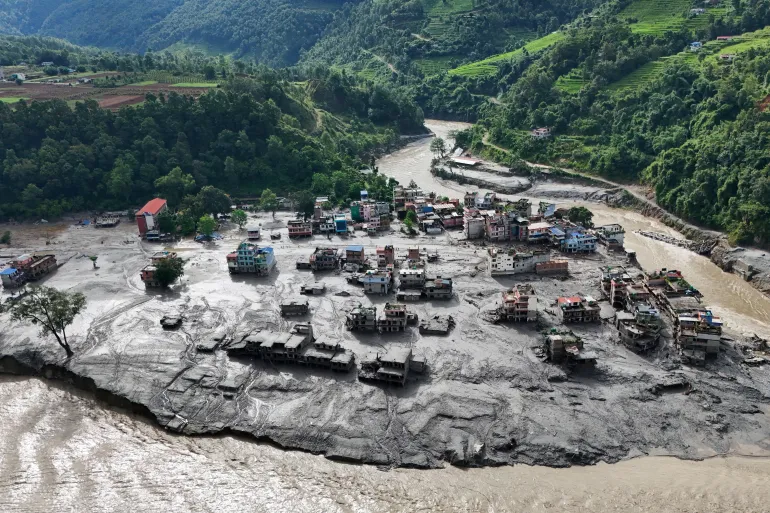
On 26 August 2026, a major flash flood struck Rasuwa district, Nepal, near the Nepal–China border. Preliminary investigations indicate that an ice–rock avalanche associated with glacial collapse entered the Lhende Khola, triggering a destructive flood downstream.
How Did a Glacial Collapse Led to Flood in Nepal?
- Glacial collapse: A large part of the glacier broke off at high altitude.
- Avalanche: The falling ice carried rocks and debris
- River blockage: The avalanche entered Lhende Khola and blocked the river.
- Water buildup: Water accumulated behind the blockage.
- Sudden release: The blockage broke, releasing a powerful flood of water and debris.
- Downstream flow: The flood moved through the Bhote Koshi–Trishuli river system.
- Flood impact: It caused severe flooding in Nepal and Tibet, China.
- Seismic signal: The collapse produced a ~5.2-magnitude seismic signal, which was initially mistaken for an earthquake.
Why Was the Impact So Severe?
- Steep terrain: The steep Himalayan slopes made the flow move rapidly downhill.
- Narrow valleys: Confined valleys concentrated the floodwater and debris.
- Heavy debris: Rocks, boulders and sediment increased the flood’s destructive force.
- River corridors: Settlements, roads and hydropower projects are concentrated along valleys.
- Sudden onset: The rapid collapse gave people very little time to respond.
- High exposure: Dense infrastructure in vulnerable valleys increased the overall damage.
How Is Climate Change Linked to Glacier Hazards?
- Glacier loss: Rising temperatures are accelerating glacier retreat and ice loss in the Himalayas.
- Slope instability: Warming can thaw permafrost, weakening frozen mountain slopes.
- Glacial lakes: Glacier retreat can create or enlarge glacial lakes, increasing GLOF risk.
- Changing hazards: Warming can alter the stability of glaciers, snow and mountain slopes.
Note: Event-specific caution: The direct role of climate change in this particular collapse remains unconfirmed. However, Climate change can increase the overall vulnerability and frequency of cryosphere-related hazards, without necessarily being the immediate trigger.
What Is Geographically Unique?
- The event illustrates a hazard cascade rather than a single disaster.
- A disturbance originating in the high-altitude cryosphere transformed into a downstream fluvial disaster.
- It demonstrates the strong interaction between glaciers, mountain slopes and river systems.
Implications for India and the World:
- Himalayan states: Similar risks exist in Uttarakhand, Himachal Pradesh, Sikkim, Arunachal Pradesh and Ladakh.
- Hydropower: Sudden floods threaten dams, roads and power infrastructure.
- River basins: Himalayan hazards can affect downstream Ganga and Brahmaputra systems.
- Water security: Long-term glacier loss can alter seasonal river flows.
Way Forward
- Satellite monitoring of glaciers, unstable slopes and glacial lakes.
- Real-time river gauges for rapid detection of abnormal discharge.
- Multi-hazard risk mapping of vulnerable Himalayan valleys.
- Community-level evacuation plans for downstream settlements.
- Cross-border data sharing on glaciers, lakes and river levels.
FAQs
Q1. What is an ice–rock avalanche?
ANS: A rapid downslope movement of ice, rock, snow and debris.
Q2. What is a GLOF?
ANS: A Glacial Lake Outburst Flood caused by sudden drainage of a glacial lake.
Q3. What is a debris flow?
ANS: A fast-moving mixture of water, mud, rocks and sediment.
Q4. What is the cryosphere?
ANS: The frozen component of Earth, including glaciers, snow, ice and permafrost.
Q7. Can climate change directly cause every glacier collapse?
ANS: No. It can increase background instability, but the trigger for each individual event must be scientifically established.
Q8. How is a GLOF Different from Glacial Collapse?
ANS: GLOF is the sudden release of water stored in a glacial lake, usually due to the failure of an ice or moraine dam, whereas glacial collapse is the sudden breaking and movement of a glacier or ice mass, which may trigger an avalanche, river blockage or flood.