Context
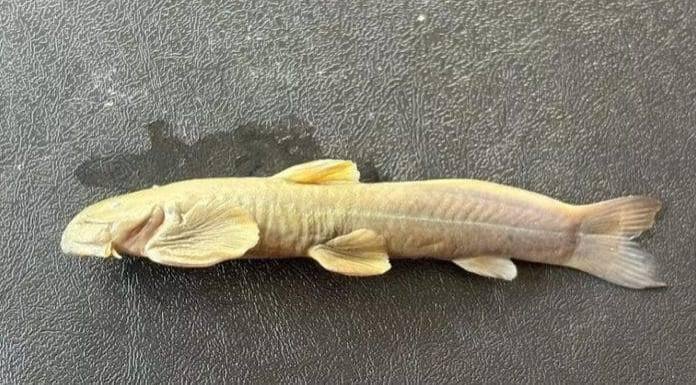
Scientists have identified a new species of rare glyptosternine catfish, named Exostoma nasibarbatum, in Manipur. It was discovered during a survey of the Bupal Stream, a tributary of the Dujang River in the Chindwin river system, near the Myanmar border.
Habitat and Adaptations
- The species inhabits fast-flowing streams with strong currents, boulders and rocky surfaces.
- It has special physical features that help it survive in turbulent waters:
- Flattened head and body: Help it remain stable in strong currents.
- Enlarged paired fins with adhesive striae: These are the enlarged fins on either side of the body. Their specialised surface structures help the fish grip rocky surfaces and resist strong water currents.
- Flattened maxillary barbels: These are flattened, whisker-like sensory structures near the mouth. They help the fish maintain contact with rocky surfaces and sense its surroundings.
Origin of the Name
- The species is named nasibarbatum after its prominent nasal barbel, which extends beyond the rear edge of the eye.
- The name combines two Latin words: Nasus – Nose and Barba – Beard.
- It refers to an elongated sensory organ near the nostril.
Taxonomic Classification
- It belongs to the genus Exostoma, a group of sisorid catfishes native to Asia.
- Sisorid catfishes are freshwater fish belonging to:
- Family: Sisoridae
- Order: Siluriformes
- Around 23 valid species are recognised under the genus Exostoma, distributed across major river systems of Southeast Asia and the Indian subcontinent.
- Of these, seven valid species are known from the Chindwin–Irrawaddy drainage system.
Frequently Asked Questions (FAQs)
Q1. Which new catfish species was discovered in Manipur?
Exostoma nasibarbatum, a rare glyptosternine catfish, was identified in the Bupal Stream.
Q2. Where was Exostoma nasibarbatum discovered?
In Bupal Stream, a tributary of the Dujang River in the Chindwin river system, near the Myanmar border.
Q3. What adaptations help this catfish survive strong water currents?
Its flattened body, enlarged paired fins with adhesive striae and flattened maxillary barbels help it grip rocky surfaces.
Q4. Why is the species named Exostoma nasibarbatum?
The name refers to its elongated nasal barbel, which extends beyond the rear edge of the eye.
Q5. To which taxonomic family and order does it belong?
It belongs to the family Sisoridae and order Siluriformes.