Context
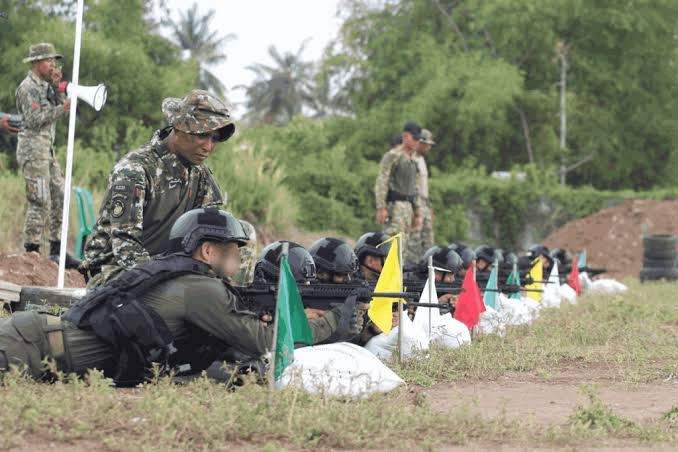
An Indian Army contingent from the Parachute Regiment (Special Forces) has arrived at Banyuwangi in East Java, Indonesia, for the 2026 edition of Exercise Garuda Shakti. Following Prime Minister Narendra Modi’s state visit to Indonesia in July 2026, this high-octane iteration serves as the primary bilateral mechanism to drill elite commando units in counter-insurgency and counter-terrorism operations. The training will focus on special operations in jungle terrain and will conclude with a validation exercise mimicking real-life conditions.
The Institutional Timeline
- November 2024 (9th Edition): Conducted at Cijantung near Jakarta, Indonesia.
- December 2025 (10th Edition): Hosted at Bakloh in Himachal Pradesh, India.
- October 2026 (Current Edition): Progressing at Banyuwangi, East Java, focused on adapting to dense tropical jungle warfare.
Strategic Significance of Garuda Shakti
- Geopolitical Chokepoints: Indonesia shares a close maritime boundary with India’s Andaman and Nicobar Islands and commands critical chokepoints connecting the Indian and Pacific Oceans.
- Act East Anchoring: The exercise serves as a key security pillar of India’s Act East Policy, deepening defence footprints within the largest ASEAN member state.
- Tactical Interoperability: Enhances the ability of both special forces to operate smoothly alongside each other during future joint counter-terrorism or disaster relief tasks.
- Maritime Security Synergies: Complements a broader defence matrix that includes coordinated naval patrols and coast guard agreements—highlighted by an Indian Coast Guard ship visiting Jakarta in October 2026.
Structural Challenges in Bilateral Cooperation
- Small Operational Scale: The exercise involves only a small number of niche special forces units, meaning it builds tactical rapport and trust rather than projecting large military power.
- Systemic Diversity: The two armies use different weapons platforms, training doctrines, and languages, which complicates real-time coordination during drills.
- Strategic Non-Alignment: Jakarta maintains a strict non-bloc foreign policy, carefully balancing its ties with China and the United States while refusing to join any exclusive military alliances.
- Slow Procurement Trade: Progress on defence sales, including high-level talks over Indian missile systems, remains slow and takes significant time to convert into active contracts.
- Terrain Adaptation: Indonesia’s tropical jungles differ significantly from India’s standard training environments, requiring both forces to constantly adapt their operational styles.
The Way Forward for India-Indonesia Ties
- Next-Gen Warfare: Expand future editions to heavily feature drone planning, counter-drone systems, and integrated cyber security matrices, building on the drone utilization lessons from past editions.
- Defence Industry Synergy: Transition the relationship from transactional exercises to joint military hardware production and wrap up pending commercial missile export negotiations.
- Tri-Service Expansion: Move beyond isolated special forces drills by increasing the frequency and scale of joint exercises across the Army, Navy, and Air Force.
- Real-Time Maritime Intelligence: Build robust information-sharing networks for shipping traffic, anti-piracy operations, and smuggling control to secure common sea routes.
- HADR Focus: Institutionalise joint drills for earthquakes, floods, and cyclones, providing a politically neutral avenue to solidify regional security ties.
- Respecting Strategic Autonomy: India must continue to build this defence partnership organically, respecting Indonesia’s non-bloc foreign policy without pressuring Jakarta to pick sides in great-power rivalries.
FAQs
Q1. What is Exercise Garuda Shakti?
Ans: It is a joint bilateral military exercise conducted between the special forces of India and Indonesia to enhance cooperation, tactical coordination, and mutual understanding.
Q2. Which military units represent the two nations in the 2026 exercise?
Ans: India is represented by elite commandos from the Parachute Regiment (Special Forces), while Indonesia deploys its premier special forces unit, Kopassus.
Q3. Where is the 2026 edition of the exercise taking place?
Ans: The 2026 edition is being hosted by Indonesia at Banyuwangi in East Java. The two nations host the exercise alternately.
Q4. What are the primary training objectives of this exercise?
Ans: The soldiers train for special operations under counter-insurgency and counter-terrorism scenarios within dense tropical jungle terrains. The curriculum includes combat shooting, air assault drills, obstacle crossing, and tactical mountaineering.
Q5. What does “interoperability” mean in the context of this joint drill?
Ans: Interoperability is the ability of two different military forces to operate together smoothly. This is achieved by aligning communication channels, sharing knowledge on weapons and equipment, and practicing compatible battlefield tactics.