Context
The Ministry of Road Transport and Highways (MoRTH) notified the Central Motor Vehicles (Amendment) Rules, 2026, recognising E100 (nearly pure ethanol) alongside E85 as an automotive fuel. This provides a legal basis for the certification of flex-fuel vehicles.
Ethanol and Blend Types
- Ethanol Definition: An alcohol-based biofuel produced through the fermentation of plant biomass like sugarcane, molasses, and maize.
- E-Classification System: Indicates the volume percentage of ethanol mixed into petrol:
- E10: 10% ethanol + 90% petrol.
- E20: 20% ethanol + 80% petrol.
- E85: Up to 85% ethanol.
- E100: Nearly pure ethanol.
- Engine Compatibility: Higher ethanol blends require specialized vehicle designs, modified fuel systems, and corrosion-resistant materials.
India’s Ethanol Blended Petrol (EBP) Programme
- Core Objectives: Aims to reduce crude oil imports, boost farmers’ income, promote domestic biofuels, and lower carbon emissions.
- Blending Targets: The National Policy on Biofuels (2018) originally set a 20% target by 2030, which was advanced to 2025–26, successfully reaching E20 in 2025.
- Nationwide E20 Mandate: OMCs (Oil Marketing Companies) were directed to supply E20 petrol (up to 20% ethanol, minimum RON 95—Research Octane Number) pan-India from 1 April 2026.
- Future Roadmap: Policy focus is shifting beyond E20 toward higher ethanol blends like E85 and E100.
- Feedstock Classification Framework:
- 1G (First Generation): Derived from edible sources like sugarcane juice, molasses, and food grains (maize, broken rice).
- 2G (Second Generation): Derived from non-edible agricultural residues (crop stubble, bagasse) supported under PM JI-VAN (Pradhan Mantri Jaiv Indhan-Vatavaran Anukool Fasal Awashesh Nivaran) Yojana.
- 3G (Third Generation): Derived from microalgae, cultivated on non-arable land without competing with food crops or freshwater reserves.
- 4G (Fourth Generation): Derived from genetically engineered crops and carbon-capture technology, converting captured emissions directly into bioenergy.
Flex-Fuel Vehicles (FFVs)
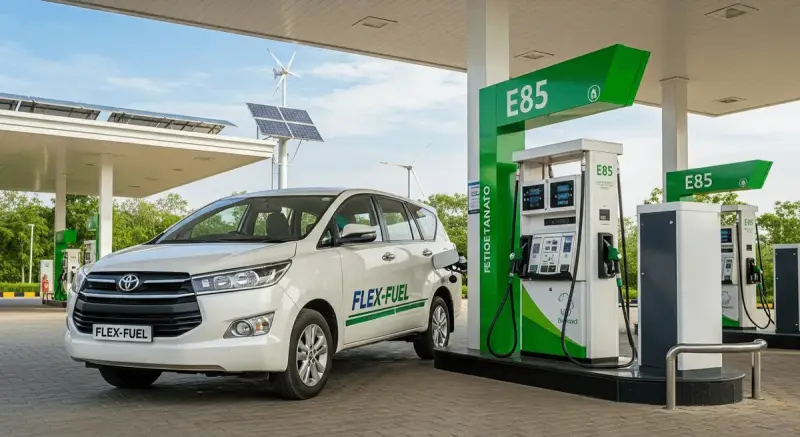
- Definition: Vehicles engineered to run on petrol, ethanol blends, or pure ethanol (E100) interchangeably.
- Global Adoption: Widely adopted in markets like Brazil and the United States.
- Domestic Industry: Major automakers like Toyota, Tata Motors, and Hyundai are developing FFVs (Flex-Fuel Vehicles) for India.
- Infrastructure Requirements: Deploying higher ethanol blends requires specialized, separate storage and dispensing facilities at fuel stations.
Key Provisions of the Amendment
- Rule 115 Update: Replaces E85 with “E85 or E100” in emission tables and formally recognizes E20 alongside E10.
- Rule 115E Correction: Amends technical references for E100 vehicles to align with Annexure SA.
- Restricted Usage: Permits E85 and E100 strictly in OEM (Original Equipment Manufacturer) designed FFVs (Flex-Fuel Vehicles).
- No Compulsory Retrofitting: Existing vehicle owners are not required to switch fuels or modify their vehicles.
- Fuel Compatibility: E10/E20 compatibility does not guarantee E85/E100 compatibility; owners must verify the vehicle sticker and owner’s manual.
- Homologation Standard: Enables certifying agencies like ARAI (Automotive Research Association of India) to test and certify E100 vehicles against safety and emission standards.
- Market Availability: Regulatory recognition does not guarantee the immediate availability of E85 or E100 at commercial retail outlets.
Challenges of Ethanol Blended Petrol (EBP)
- Vehicle Compatibility: Older vehicles risk corrosion and fuel-system damage, leading to higher maintenance costs.
- Mileage Efficiency Drop: Ethanol has lower energy density than petrol, causing a 3–5% drop in fuel economy for E20 blends.
- Moisture Contamination: Ethanol is hygroscopic (absorbs moisture), increasing contamination risks during storage and transport.
- High Procurement Costs: High feedstock costs (e.g., maize-based ethanol at ~₹71.86/litre) keep retail fuel prices high, prioritizing energy security over price reduction.
- Food vs. Fuel Dilemma: Diverting grain and land for feedstock threatens food security and accelerates groundwater depletion.
- Infrastructure Shortages: Higher blends (E85 and E100) demand dedicated storage tanks, pumps, and compatible FFVs (Flex-Fuel Vehicles).
Way Forward
- Promote Advanced Biofuels: Scale up 2G (Second Generation) ethanol derived from crop residues to mitigate food-versus-fuel conflicts.
- Expand Dispensing Infrastructure: Build dedicated storage tanks and fuel pumps to support high-blend E85 and E100
- Mandate Compatibility Labelling: Enforce explicit fuel-compatibility stickers and user guidelines to protect vehicle owners.
- Prioritise Sustainable Feedstocks: Shift toward water-efficient crops and agricultural wastes to preserve groundwater and soil health.
FAQs
Q1. Must existing vehicle owners switch to E85 or E100?
Ans. No, existing owners are not required to switch fuels or modify their vehicles.
Q2. Can an E20-compatible vehicle use E100?
Ans. No, E85 and E100 can be used only in OEM-designed flex-fuel vehicles.
Q3. What is homologation?
Ans. It is the official process by which agencies such as ARAI verify that a vehicle meets technical, safety and environmental standards.
Q4. What is the difference between 1G and 2G ethanol?
Ans. 1G ethanol is made from food-related feedstocks such as sugarcane and grain, while 2G ethanol is made from non-food biomass such as crop residue.