Context
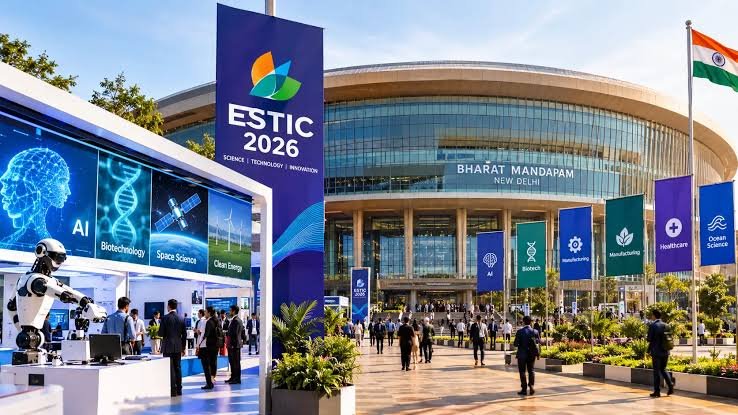
Prime Minister Narendra Modi inaugurated the Emerging Science, Technology and Innovation Conclave (ESTIC) 2026 at Bharat Mandapam, New Delhi, on 27 October 2026. The conclave focused on strengthening indigenous technological capability, research funding, commercialisation and measurable societal outcomes from science and innovation.
About ESTIC 2026
- ESTIC is a national platform bringing together scientists, researchers, policymakers, industry leaders and startups to discuss India’s priorities in emerging science and technology.
- It covers major frontier areas such as AI, semiconductors, advanced manufacturing, biotechnology, energy, healthcare, telecom and space technologies.
- Its central emphasis is to move from discussion towards measurable technologies, prototypes, products and practical applications.
Building Technological Self-Reliance
- Semiconductors: ESTIC highlighted India’s growing capabilities across chip design, fabrication, packaging and semiconductor technologies. This reflects the conclave’s emphasis on reducing dependence in technologies critical for manufacturing and digital infrastructure.
- Artificial Intelligence: Discussions on generative and autonomous AI, domestic models and computing capacity highlighted the need to combine indigenous AI development with practical and responsible applications.
- Space technology: India’s progress from Chandrayaan and Mangalyaan to satellite docking capability was cited as evidence that sustained research can create advanced domestic capability and strengthen technological autonomy.
- Nuclear technology: The indigenous 500 MWe Prototype Fast Breeder Reactor at Kalpakkam, which achieved first criticality in April 2026, illustrates India’s capacity to develop complex strategic technologies domestically.
- Advanced telecom: ESTIC discussions on AI-native networks, 6G and quantum-safe communication highlighted the need for secure and future-ready indigenous communication technologies.
Strengthening the Research and Innovation Ecosystem
- ANRF: ESTIC emphasised accelerating the role of the Anusandhan National Research Foundation in strengthening research capacity and supporting innovation across institutions.
- Research financing: The conclave highlighted a ₹1 lakh crore commitment for Research, Development and Innovation, recognising that frontier technologies often require long-term and patient capital.
- Broader research participation: Greater support for universities, laboratories and young researchers can widen the country’s research base, helping innovation move beyond a limited number of institutions.
- Outcome orientation: ESTIC encouraged researchers and innovators to identify specific technologies, prototypes and products they could deliver over the next three years, making research more accountable to measurable outcomes.
Bridging the Research-to-Market Gap
- Lab-to-market transition: ESTIC stressed that scientific breakthroughs generate wider value only when they move from laboratories into usable technologies and commercially scalable products.
- Public–private participation: At ESTIC 2026, the Prime Minister highlighted that about ₹12,000 crore of government commitments for market-ready technologies had been matched by an equal ₹12,000 crore from private investors. This showed a concrete public–private model for sharing the risk of moving technologies from laboratories towards commercial deployment.
- Industry–academia linkage: ESTIC 2026 created direct interaction among research institutions, startups, industry leaders, investors and policymakers. The exhibition featured 50 deep-tech startups, 13 departmental stalls and 10 departmental technologies, giving innovators opportunities to identify partners, applications and pathways for scale-up.
- Deep-tech startups: ESTIC provides a platform for emerging technology ventures to connect with researchers, investors and industry, strengthening the pathway from innovation to commercial application.
Responsible and Society-Oriented Innovation
- Science for society: ESTIC stressed that scientific progress should ultimately improve areas such as healthcare, agriculture, education, employment and disaster resilience.
- AI with scientific judgement: While AI can accelerate research, the conclave emphasised that scientists must verify AI-generated results and retain independent judgement.
- Safety in emerging technologies: Rapid advances in AI, biotechnology and autonomous systems require appropriate safety and security safeguards alongside technological development.
- Development orientation: ESTIC links technological progress with Viksit Bharat, implying that innovation should contribute not only to scientific capability but also to economic and social development.
Significance of ESTIC for India
- Technological self-reliance: Creates a common platform for strengthening domestic capability in strategically important technologies.
- Research reform: Pushes the ecosystem towards stronger funding, institutional collaboration and measurable research outcomes.
- Commercialisation: Encourages movement from research → prototype → product → market, addressing a persistent innovation gap.
- Development impact: Connects science and technology with broader national goals such as productivity, employment, public welfare and strategic autonomy.
FAQs
Q1. What is ESTIC 2026?
It is the Emerging Science, Technology and Innovation Conclave, a national platform for discussing India’s emerging technology and innovation priorities.
Q2. What role does ANRF play in the ESTIC context?
ANRF is expected to strengthen research capacity, funding and innovation across Indian institutions.
Q3. What major research commitment was highlighted at ESTIC 2026?
A ₹1 lakh crore commitment for Research, Development and Innovation.
Q4. Why does ESTIC emphasise lab-to-market transition?
Because research creates wider value when it becomes usable technologies, products and commercial applications.
Q5. What is the broader message of ESTIC 2026?
India should move from scientific capability towards indigenous, measurable and socially useful innovation.