Context
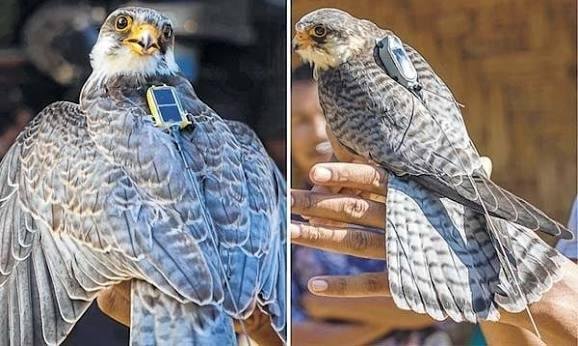
Two satellite-tagged Amur Falcons, Apapang and Alang, have returned to Manipur after completing a nearly 20,000-km migration across 23 countries in Asia and Africa.
About the Species
- Identity: A small migratory raptor (bird of prey) belonging to the falcon family, named after the Amur River (also called the Eastern Red-Footed Falcon).
- Migration: Regarded as the world’s longest-distance migrating raptor.
- Habitat: Inhabits open forests, grasslands, wetlands, and farmlands.
- Diet: Primarily insectivorous (feeding on termites, locusts, ants, and beetles), occasionally consuming small vertebrates.
- Ecological Role: Functions as a natural pest control agent and serves as an ecological indicator of wetland and agricultural ecosystem health.
Appearance
- Male: Dark sooty-grey body with reddish-brown thighs and vent; distinct white underwing coverts visible during flight.
- Female: Grey back with a pale, dark-spotted underside.
- Common Features: Bright orange-red eye-ring, cere, and feet, coupled with sharp eyesight for hunting prey.
Migration Route
- Breeding Grounds: South-eastern Siberia, Mongolia, and Northern China during the northern summer.
- Wintering Grounds: Southern and Eastern Africa (e.g., Somalia, Kenya, Mozambique, South Africa).
- Indian Stopover: Traverses India during October–November, forming massive congregations in Nagaland, Manipur, Assam, and Arunachal Pradesh to feed on termite swarms.
- Return Journey: Completes the loop back to breeding grounds by April–May.
Conservation and Regional Protection
- Nagaland (Falcon Capital of the World): Doyang Reservoir (Wokha district) and Pangti village host the world’s largest roosting gatherings. Community-led conservation—spearheaded by local tribes, scientists, and state agencies—successfully eliminated mass hunting (over 100,000 birds killed annually prior to 2012).
- Manipur: Tamenglong district enforces strict seasonal hunting bans and safeguards critical roosting sites.
- Satellite Telemetry Tracking: Tagging initiatives in 2019, 2024, and 2025 map exact trans-oceanic migration routes and stopover corridors for cross-border protection.
Legal & International Protection Status
- IUCN Red List: Least Concern (LC).
- CMS (Convention on Migratory Species / Bonn Convention, 1979): Appendix II (mandates international cooperation for migratory species with unfavourable conservation status).
- Wildlife (Protection) Act, 1972: Protected under Schedule IV (as per the amended WPA framework).
Threats
- Illegal Hunting & Poaching: Occasional trapping and killing along critical stopover corridors during peak migration.
- Habitat Degradation: Deforestation and loss of roosting trees and wetlands along stopover sites.
- Pesticide Overuse: Excessive agricultural chemical use reduces termite and insect prey availability.
- Climate Change Impact: Altered wind currents and weather extremes disrupt migration timing and survival during trans-oceanic sea crossings.
Way Forward
- Community-Led Conservation: Deepen grassroots participation, eco-tourism incentives, and local stewardship (building on the Pangti model).
- Habitat Preservation: Declare and safeguard critical stopover sites and roosting zones as protected corridors.
- Transboundary Flyway Cooperation: Strengthen international coordination under CMS (Convention on Migratory Species) across the East Asian-Australasian and Central Asian Flyways.
- Scientific Research & Telemetry: Expand satellite tagging and habitat mapping to monitor flyway threats and population health.
FAQs
Q1. Why do Amur Falcons gather in north-east India?
Ans. They stop to feed on insects, especially termites, and build fat reserves for their long sea crossing.
Q2. Why is Nagaland called the “Falcon Capital of the World”?
Ans. Because huge flocks roost near Pangti village at Doyang Reservoir, where community-led efforts have helped protect them from hunting.
Q3. What is the conservation status of the Amur Falcon?
Ans. It is Least Concern (IUCN), listed under Appendix II of CMS and Schedule IV of the Wildlife (Protection) Act, 1972.