Context
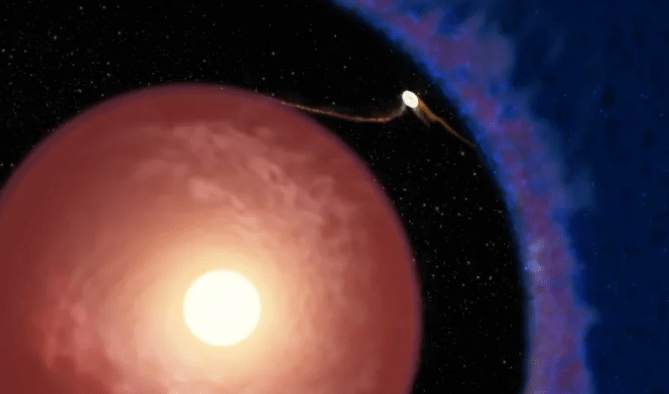
Astronomers have identified Elias 2-24 b, an exoplanet estimated to be less than one million years old, making it the youngest confirmed planet known so far.
The planet lies within the gas-and-dust disk surrounding the young star Elias 2-24, giving astronomers a rare opportunity to study giant-planet formation at a very early stage.
About Elias 2-24 b
- It is a young gas-giant exoplanet orbiting the star Elias 2-24.
- The system is located about 450 light-years from Earth.
- The planet is estimated to have a mass of roughly a few times that of Jupiter.
- It orbits at about 55 astronomical units (AU) from its host star.
- 1 AU is the average distance between Earth and the Sun.
- It is substantially younger than previously known very young planets such as those around PDS 70 and WISPIT 2.
How Was It Detected?
Young planets are difficult to observe because the bright host star and surrounding disk can hide them.
Astronomers used high-resolution observations and coronagraphic imaging.
A coronagraph suppresses the bright light of a star so that much fainter nearby objects can be detected.
The planet was located within a gap in the surrounding protoplanetary disk, strengthening the case that the gap is associated with a forming planet.
Why Is the Discovery Important?
- Faster Giant-Planet Formation
A massive planet already existing in a system younger than one million years suggests that giant planets can assemble very rapidly under some conditions.
This places stronger constraints on models of planetary formation.
- Wide-Orbit Formation Puzzle
Elias 2-24 b orbits roughly 55 AU from its star.
At such large distances, disk material is more dispersed and orbital periods are longer, making rapid planet formation more difficult to explain.
- Evidence for Disk–Planet Interaction
Young stars are often surrounded by disks containing rings and gaps.
The presence of Elias 2-24 b inside such a gap strengthens the idea that some disk gaps are produced when forming planets gravitationally disturb and redistribute surrounding material.
- Advances in Observational Astronomy
The discovery shows how improved imaging techniques and re-analysis of earlier observations can reveal planets hidden within dense protoplanetary environments.
What Are Exoplanets?
Exoplanets are planets that orbit stars outside our Solar System.
They vary widely in:
- size;
- mass;
- composition;
- temperature;
- orbital distance.
They may include:
- rocky Earth-like planets;
- super-Earths;
- Neptune-like worlds;
- gas giants larger than Jupiter.
Major Methods of Detecting Exoplanets
Transit Method
Detects the small reduction in a star’s brightness when a planet passes in front of it.
Radial Velocity Method
Measures the slight motion or “wobble” of a star caused by the gravitational pull of an orbiting planet.
Direct Imaging
Attempts to detect light from the planet itself after suppressing the much brighter light of its host star.
For very young planets such as Elias 2-24 b, direct imaging is especially valuable because they may still be warm and luminous from formation.
FAQs
Q1. What is Elias 2-24 b?
It is an extremely young gas-giant exoplanet orbiting the star Elias 2-24.
Q2. How old is Elias 2-24 b?
It is estimated to be less than one million years old.
Q3. How far is the Elias 2-24 system from Earth?
About 450 light-years.
Q4. Why is its 55-AU orbit scientifically important?
Because forming a massive planet rapidly at such a large distance is difficult to explain using conventional formation models.
Q5. What is a coronagraph?
An instrument that blocks or suppresses bright starlight so that faint nearby objects, such as exoplanets, can be observed.