Context
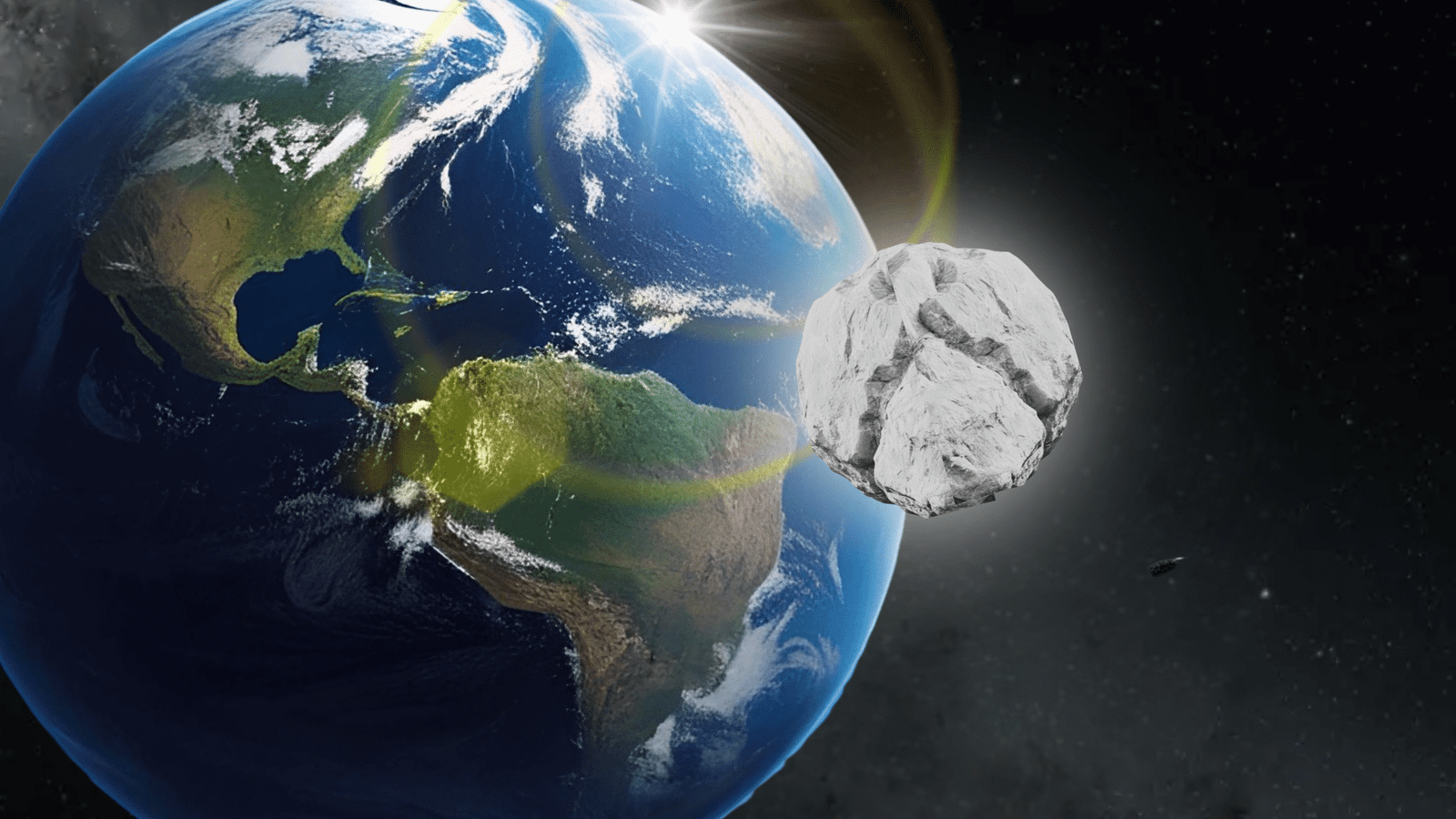
Earth temporarily captured a tiny near-Earth asteroid, 2026 QQ8, which is behaving as a temporary natural satellite or “mini-moon.” Orbital calculations indicate that the object entered temporary capture in 2026 and is expected to eventually return to an orbit around the Sun.
What is 2026 QQ8?
- Small near-Earth asteroid: 2026 QQ8 is estimated to be only about 1–2 metres wide; its tiny size makes it scientifically interesting rather than a major impact threat.
- Natural object: Follow-up observations identified it as a natural asteroid rather than artificial space debris, allowing astronomers to study its temporary interaction with Earth.
- Temporary satellite: Its motion became temporarily gravitationally bound to Earth; hence, it can be described as a temporarily captured object (TCO).
- Not a permanent second Moon: “Mini-moon” is an informal term; unlike Earth’s Moon, such objects remain bound only for a limited period.
How Does Temporary Capture Occur?
- Earth-like heliocentric orbit: Small asteroids moving around the Sun on trajectories similar to Earth can approach the planet with relatively low velocity.
- Low relative speed: A sufficiently slow encounter allows Earth’s gravity to reduce the object’s geocentric orbital energy enough for temporary capture.
- Earth’s Hill sphere: Capture occurs within the region where Earth’s gravitational influence is significant relative to the Sun, extending roughly 1.5 million km.
- Result: The asteroid temporarily begins moving under stronger Earth-centred gravitational influence instead of simply passing by.
Why Does the Capture End?
- Weak gravitational binding: Unlike the Moon, a mini moon is only loosely bound to Earth, making its orbit sensitive to external gravitational forces.
- Solar and lunar perturbations: Gravity from the Sun and Moon gradually alters the asteroid’s trajectory; therefore, its temporary Earth-bound orbit eventually becomes unstable.
- Return to solar orbit: Once the object gains enough orbital energy, it escapes Earth’s temporary capture and resumes orbiting the Sun.
Mini-Moon vs Earth’s Permanent Moon
- Scale: Earth’s Moon is about 3,475 km in diameter, whereas 2026 QQ8 is only a few metres across.
- Origin: The Moon is believed to have formed around 4.5 billion years ago following a giant impact involving early Earth and a Mars-sized body.
- Orbital stability: The Moon has remained gravitationally bound to Earth over geological timescales; mini moons have short-lived and dynamically unstable captures.
Scientific and Planetary-Defence Significance
- Small-body dynamics: Mini-moons help scientists understand how near-Earth asteroids interact with the complex Earth–Moon–Sun gravitational system.
- Detection capability: Their faintness and small size make them difficult to observe; improved surveys can therefore strengthen detection of other near-Earth objects.
- Planetary defence: 2026 QQ8 itself is not a significant threat, but tracking such objects improves techniques used to identify potentially hazardous asteroids.
- Deflection research: NASA’s DART mission demonstrated kinetic-impact deflection by altering the orbit of Dimorphos, showing that an asteroid’s trajectory can potentially be modified deliberately.
FAQs
Q1. What is 2026 QQ8?
A small near-Earth asteroid temporarily captured by Earth’s gravity.
Q2. What is a mini-moon?
A natural object that becomes temporarily gravitationally bound to a planet.
Q3. Is a mini-moon the same as Earth’s Moon?
No. Earth’s Moon has a long-term stable orbit, whereas a mini-moon remains captured only temporarily.
Q4. What is Earth’s Hill sphere?
It is the region around Earth where its gravity can significantly influence nearby objects relative to the Sun.
Q5. Why are mini-moons important for planetary defence?
Studying and detecting them improves understanding and tracking of near-Earth objects, including potentially hazardous asteroids.