Context
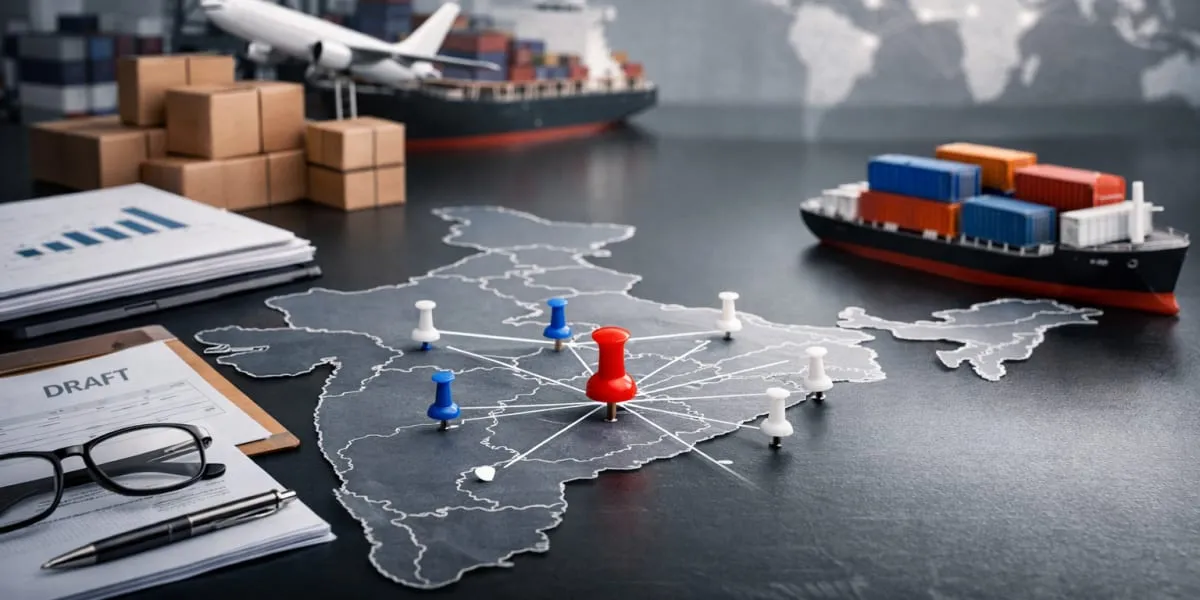
- The Districts as Export Hubs (DEH) Initiative seeks to widen India’s export base by making districts active units of export planning and promotion.
- From 1 June 2026, the initiative entered a more focused and outcome-oriented phase covering priority districts across 27 States and Union Territories, with support from DGFT regional authorities and partner agencies.
- The shift is important because India is trying to move beyond export concentration in a few industrial centres and integrate MSMEs, farmers, artisans and local producers into global markets.
What Is the Districts as Export Hubs Initiative?
- District-led export strategy: The initiative identifies goods and services with export potential at the district level and supports their entry into international markets.
- Implementing agency: It is anchored by the Directorate General of Foreign Trade (DGFT) under the Department of Commerce, Ministry of Commerce and Industry.
- Core objective: It seeks to convert local economic strengths into export opportunities by addressing gaps in logistics, standards, market access and exporter capacity.
- Decentralised approach: Export promotion is taken closer to the district level so that local administrations, producers and industry bodies participate directly in export planning.
- Policy linkage: The initiative forms part of the Foreign Trade Policy 2023 framework.
How Does the Initiative Work?
The initiative broadly follows this process:
Identify export potential → Prepare district export plan → Remove bottlenecks → Build exporter capacity → Connect with global markets
- Identification of Export Potential
Districts identify products and services that can compete internationally, including:
- agricultural products;
- Geographical Indication (GI) products;
- handicrafts;
- toys;
- manufactured goods;
- services.
Export potential has been identified in 734 districts across the country.
- District Export Action Plans
A District Export Action Plan (DEAP) provides a district-specific export roadmap.
It generally identifies:
- major exportable products and services;
- logistics and infrastructure gaps;
- supply-chain constraints;
- skill and training requirements;
- market-access barriers;
- policy or regulatory bottlenecks;
- measurable export targets.
Thus, a DEAP converts local economic potential into a practical export strategy.
- Institutional Architecture
DEH operates through a Centre-State-district coordination structure.
Department of Commerce
Provides overall policy direction and links the initiative with India’s broader export strategy.
Directorate General of Foreign Trade
DGFT anchors implementation, coordinates stakeholders and supports districts through its Regional Authorities.
State Export Promotion Committees
SEPCs guide implementation at the State/UT level and facilitate coordination among departments.
District Export Promotion Committees
DEPCs work at the district level to identify opportunities, resolve local constraints and coordinate with producers, exporters and industry bodies.
They also play a key role in preparing and implementing District Export Action Plans.
Why Is the Initiative Important?
- Wider geographical participation
DEH can reduce the concentration of export activity in a few major industrial regions by bringing smaller towns and districts into global trade.
- MSME and producer integration
Small firms, farmers and artisans often lack knowledge of standards, documentation, finance and foreign markets. District-level support can help them enter formal export networks.
- Local jobs and value addition
Export-oriented production can generate employment, income and processing activity within districts, supporting more balanced regional development.
- Export diversification
District-specific products such as GI goods, agricultural produce, handicrafts and niche manufacturing can broaden India’s export basket.
- Greater export resilience
A wider product and geographical base reduces overdependence on a limited number of sectors or export centres and strengthens India’s ability to absorb external shocks.
DEH and One District One Product
The two initiatives are related but not identical.
| Basis | One District One Product | Districts as Export Hubs |
| Main focus | Promotion of distinctive district products | Building an export ecosystem at district level |
| Scope | Primarily product-oriented | Goods, services, logistics and market access |
| Objective | Branding and value addition | Sustained export growth |
| Approach | Product-centric | District export-planning centric |
In simple terms, ODOP promotes local products, while DEH builds the wider ecosystem needed to export them successfully.
Key Challenges
Export readiness
Many local producers lack knowledge of quality standards, certification, packaging and export documentation.
Logistics constraints
Remote and landlocked districts may face high transport, warehousing and connectivity costs.
Scale and consistency
Small producers may find it difficult to meet the volume and quality requirements of foreign buyers.
Market intelligence
First-generation exporters often lack information about overseas demand, buyers and changing global standards.
Coordination gaps
Effective implementation requires sustained cooperation between district administrations, State governments, DGFT, financial institutions and industry.
Way Forward
- Build exporter capability: Expand district-level training on standards, documentation, finance, digital commerce and international marketing.
- Improve logistics convergence: Align DEAPs with transport, warehousing and logistics programmes to address infrastructure bottlenecks.
- Use digital trade platforms: Help small producers access foreign buyers through e-commerce and digital marketplaces.
- Monitor outcomes: Measure success through export value, number of new exporters, market diversification and producer income rather than only meetings or plans prepared.
Prelims Focus
- Districts as Export Hubs is anchored by the Directorate General of Foreign Trade.
- DGFT functions under the Department of Commerce, Ministry of Commerce and Industry.
- DEH is linked with the Foreign Trade Policy 2023.
- SEPC: State-level coordination mechanism.
- DEPC: District-level coordination mechanism.
- DEAP: District-specific export action plan.
- Export potential has been identified in 734 districts.
- The focused implementation phase began from 1 June 2026.
Districts as Export Hubs FAQs
Q1. What is the main aim of the Districts as Export Hubs Initiative?
It seeks to identify district-level goods and services with export potential and help local producers access international markets.
Q2. Which organisation anchors the initiative?
The Directorate General of Foreign Trade under the Department of Commerce anchors its implementation.
Q3. What is the role of a District Export Action Plan?
A DEAP identifies export opportunities, infrastructure gaps, market barriers and actions needed to improve a district’s export performance.
Q4. What is the role of District Export Promotion Committees?
DEPCs coordinate district-level export planning, resolve local bottlenecks and work with producers, exporters and government agencies.
Q5. Why is DEH important for India’s export strategy?
It can widen the geographical and product base of exports while integrating MSMEs, farmers, artisans and smaller districts into global value chains.