Context
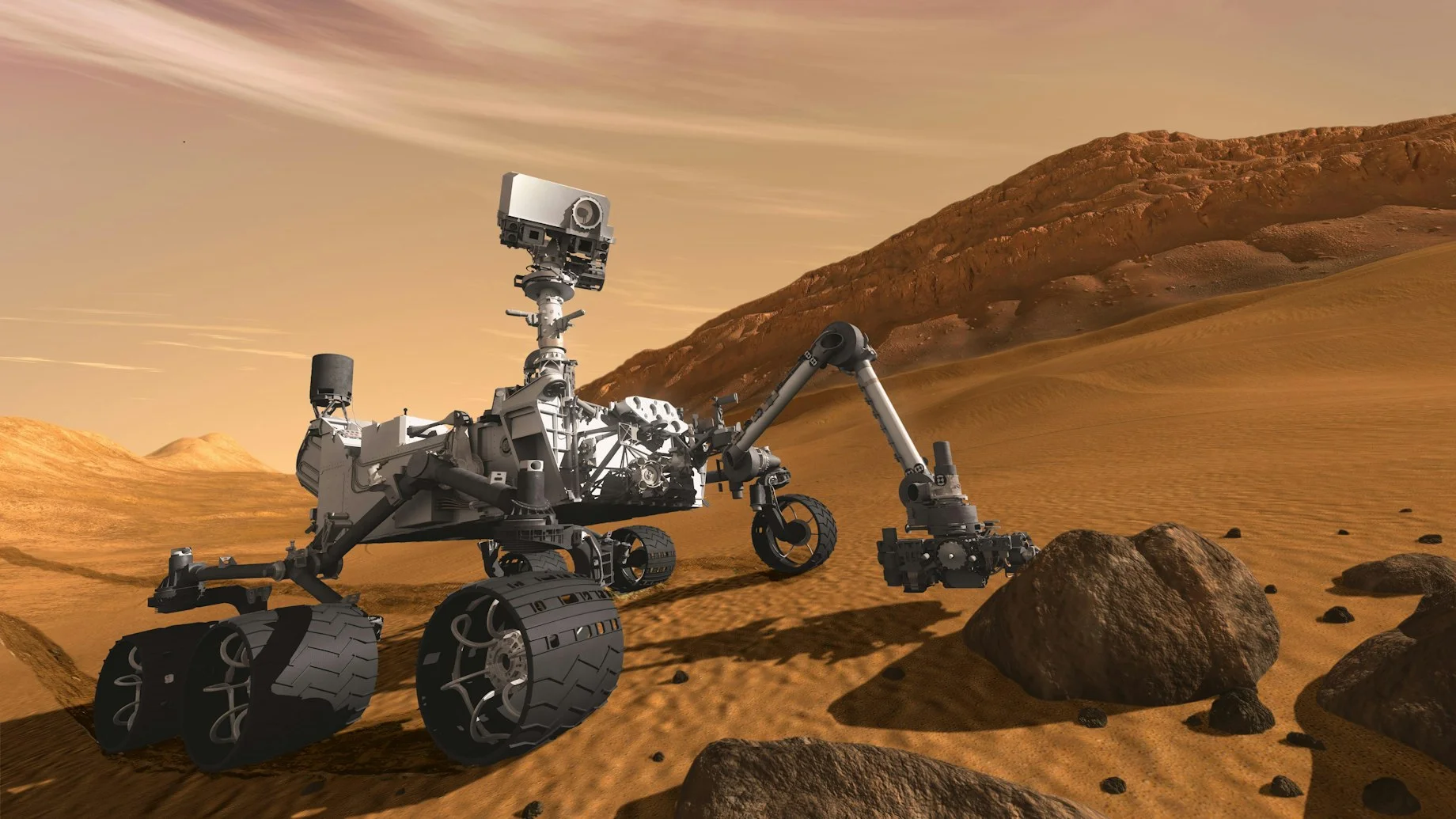
NASA’s Mars Science Laboratory mission rover Curiosity has recently detected organic molecules on Mars, indicating important clues about past conditions.
About Curiosity Rover
- The Curiosity Rover is a robotic exploration vehicle developed by NASA to study the Martian surface and environment in detail.
- It was launched on November 26, 2011, aboard the Atlas V rocket from Florida and successfully landed on Mars on August 5, 2012.
- Since landing, the rover has been exploring the Gale Crater and the slopes of Mount Sharp, studying rock formations and surface features.
- The mission introduced an innovative landing technique where the spacecraft used a parachute followed by a rocket-powered “sky crane” system to gently lower the rover onto the Martian surface.
- In terms of design, the rover is about 3 metres in length and weighs around 900 kg, and it generates power using a radioisotope thermoelectric generator that converts heat from radioactive decay into electricity.
- The rover’s scientific objectives include determining whether Mars ever supported life, understanding its climate history, analysing its geological structure, and collecting insights to support future human missions.
Conclusion
Through continuous exploration and data collection, Curiosity contributes to expanding knowledge about Mars’ habitability and evolution, making it a key mission in planetary science.