Context
The Government has relaxed the sugar stockholding limit for bulk consumers from 15 days to 30 days of consumption.
However:
- sugar purchased from the domestic market can still be held only up to 15 days;
- stock held for the additional 15 days must come from sugar imported under the Advance Authorisation Scheme (AAS) or Tariff Rate Quota (TRQ).
The policy aims to give industrial users greater supply flexibility without increasing pressure on domestic sugar availability.
What Is the Advance Authorisation Scheme?
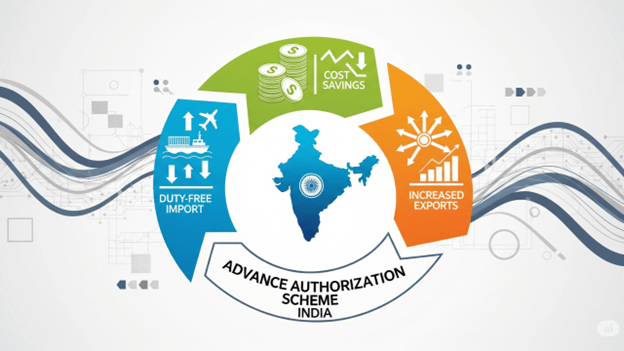
The Advance Authorisation Scheme is an export-promotion mechanism under India’s Foreign Trade Policy.
It allows eligible exporters to import inputs duty-free, provided those inputs are used to manufacture goods that are subsequently exported.
The scheme is implemented by the Directorate General of Foreign Trade (DGFT).
What Inputs Are Covered?
Advance Authorisation can cover:
- raw materials physically incorporated into the export product;
- packaging material;
- fuel;
- oil;
- catalysts used during production.
The permitted quantity of inputs is usually determined through Standard Input Output Norms (SION) or other approved norms.
Who Can Use the Scheme?
Manufacturer Exporters
Firms that manufacture goods and export the final product.
Merchant Exporters
Trading firms can also use the scheme when linked with a supporting manufacturer.
Thus, the scheme supports both direct manufacturers and export-oriented trading arrangements.
What Is the Export Obligation?
Duty-free imports are allowed only against an export obligation.
The authorization holder must export the prescribed quantity or value of the resultant product within the specified period.
Therefore:
Duty exemption is conditional on export performance
This prevents the scheme from becoming a general duty-free import route for the domestic market.
Which Duties Are Exempted?
Eligible imports may receive exemption from applicable customs-related duties, including:
- Basic Customs Duty;
- Certain additional duties;
- Integrated GST;
- Compensation Cess;
- Safeguard or anti-dumping duties where permitted.
Where Can Advance Authorisation Be Used?
It can generally be issued for:
- Physical exports;
- Intermediate supplies;
- Specified deemed exports;
- Supply of stores to foreign-going vessels or aircraft, subject to relevant norms.
Why Was It Linked to the Sugar Stockholding Relaxation?
The policy addresses a specific supply-management problem.
Bulk consumers such as food-processing and beverage companies need adequate sugar stocks for uninterrupted production.
At the same time, allowing them to accumulate larger quantities from the domestic market could tighten local availability.
The Government has therefore created a controlled arrangement:
15-day domestic stock + Additional imported stock = Greater industrial flexibility without extra domestic pressure
Why Is the Measure Significant?
- Supply-Chain Stability
Bulk consumers can maintain larger inventories, reducing the risk of production disruption during periods of high demand.
- Domestic Market Protection
The additional stock must come from imported sources, which limits the impact of higher industrial inventory on domestic sugar supply.
- Export Competitiveness
Where sugar is imported under AAS, duty-free access can reduce input costs for eligible export-oriented users.
- Targeted Liberalisation
The Government has not removed stock limits completely. It has relaxed them only with a sourcing condition.
AAS and TRQ: Important Difference
Advance Authorisation Scheme
Allows duty-free import of inputs against an export obligation.
Tariff Rate Quota
Allows a specified quantity of imports at a lower tariff rate.
The distinction is important because both reduce import cost, but they operate through different policy mechanisms.
Key Safeguard
Bulk consumers remain subject to stock reporting and monitoring requirements.
This is necessary to ensure that imported sugar is used for the intended purpose and does not create:
- speculative hoarding;
- diversion;
- artificial scarcity.
Thus:
Greater flexibility must be matched by traceability
FAQs
Q1. What is the Advance Authorisation Scheme?
It allows eligible exporters to import inputs duty-free for producing goods meant for export.
Q2. Who implements the scheme?
The Directorate General of Foreign Trade (DGFT).
Q3. What is the key condition under AAS?
The importer must fulfil a specified export obligation.
Q4. Who can obtain an Advance Authorisation?
Manufacturer exporters and eligible merchant exporters linked with supporting manufacturers.
Q5. Why was AAS linked with the recent sugar-stock relaxation?
To allow larger industrial inventories through imported sugar without increasing pressure on the domestic market.