Context
A recent study found that during the severe 2020–2022 drought, the Upper Colorado River Basin lost more groundwater than the Lower Basin, despite normally receiving greater natural recharge. The finding highlights changing groundwater–surface water interactions across the Colorado River Basin.
Geographic Profile
- The Colorado River is a major river of southwestern North America.
- It originates near the Continental Divide in Rocky Mountain National Park, Colorado, and flows southwest towards the Gulf of California in Mexico.
- Its basin extends across seven U.S. states—Arizona, California, Colorado, Nevada, New Mexico, Utah and Wyoming—and parts of Mexico.
- Major tributaries include the Green, Gunnison, San Juan, Little Colorado, Virgin and Gila rivers.
- The river carved the Grand Canyon, a major example of fluvial erosion and a UNESCO World Heritage Site.
Major Reservoirs and Water Importance
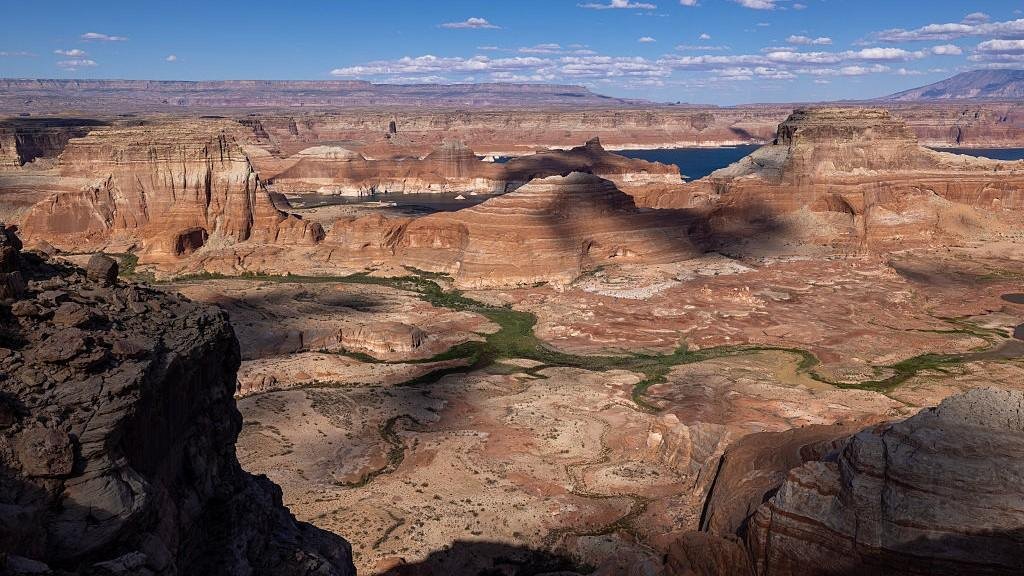
- Glen Canyon Dam forms Lake Powell, while Hoover Dam forms Lake Mead.
- These reservoirs support irrigation, urban water supply, hydropower and drought management across the arid American Southwest.
- The river is an important water source for the seven basin states and Mexico, giving it major interstate and international significance.
- Water sharing with Mexico is governed partly by the 1944 U.S.–Mexico Water Treaty.
Groundwater Stress
- Upper Basin: Snowmelt normally recharges aquifers, but the 2020–22 drought caused an unusually sharp groundwater decline.
- Lower Basin: Groundwater depletion began earlier and has remained more persistent, partly because extraction can continue even when surface-water availability is limited.
- Thus, the basin shows two different pressures: drought-sensitive groundwater loss in the Upper Basin and more sustained depletion in the Lower Basin.
Significance
- River–aquifer linkage: Groundwater helps sustain streamflow, so falling aquifer storage can affect future river flows.
- Drought vulnerability: Even relatively better-recharged headwaters can lose groundwater rapidly during prolonged drought.
- Water security: The river supports agriculture, cities, hydropower and international water commitments.
- Integrated management: The study supports managing surface water and groundwater together, since the two systems are closely connected.
FAQs
Q1. Where does the Colorado River originate?
Near the Continental Divide in Rocky Mountain National Park, Colorado.
Q2. Which two countries share the Colorado River Basin?
The United States and Mexico.
Q3. Which major reservoirs are associated with the Colorado River?
Lake Powell and Lake Mead.
Q4. Which is an important tributary of the Colorado River?
The Green River.
Q5. What was unusual during the 2020–22 drought?
The Upper Basin lost more groundwater than the Lower Basin, despite normally having greater natural recharge.