Context
- India’s expanding solar capacity is increasing pressure on land, encouraging technologies that use existing infrastructure for renewable-energy generation.
- The Pradhan Mantri Surya Sarovar Yojana (PM-SSY), approved in 2026, targets 5,000 MW of floating solar PV with 10,000 MWh of co-located storage. Though focused on floating solar, it reflects growing policy interest in land-neutral solar deployment.
- Separately, the Punjab Energy Development Agency (PEDA) invited bids in September 2025 for 40 MW of canal-top solar projects, renewing attention on Canal-Top Photovoltaics.
What Are Canal-Top Photovoltaics?
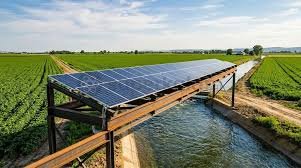
- Canal-Top Photovoltaics (CTPV) are solar PV systems installed on elevated structures above irrigation canals while allowing water to flow normally underneath.
- They differ from floating solar, where PV modules are mounted on platforms floating directly on water.
- Panels may span narrower canals, while wider canals can use alternative configurations, including vertical bifacial modules, which generate electricity from light falling on both sides.
Why Does CTPV Matter?
- Land-use efficiency
- CTPV converts the unused space above canals into an energy asset, reducing competition between solar projects and agriculture, habitation or other land uses. Existing canal-top installations in Punjab have demonstrated land savings of nearly 100 acres.
- Water-energy synergy
- Panels shade portions of the canal surface and thereby reduce evaporation losses. A 2024 assessment indicated potential water savings of around 9 million litres per MW annually, although actual savings vary with local conditions.
- Solar performance
- The relatively cooler micro-environment above water can help reduce panel temperatures under some conditions. Since solar PV efficiency generally declines as module temperature rises, this can provide a site-dependent performance advantage.
Thus, CTPV can create a useful water-energy nexus by obtaining additional value from existing irrigation infrastructure.
India’s Experience and Potential
- India was an early adopter, commissioning a 1 MW canal-top project on the Narmada Canal in Gujarat in 2012. Subsequent projects were developed in Gujarat and Punjab, including those supported under an earlier MNRE pilot programme.
- A 2024 GIZ–MNRE–CSTEP–EY–Fraunhofer assessment estimated around 131 GW of combined canal-top and canal-bank solar technical potential in India.
- This figure represents technical potential under specified assumptions, not capacity that can necessarily be deployed economically.
- The assessment identified Uttar Pradesh, Bihar, Karnataka, Andhra Pradesh and Punjab among states with substantial potential.
Why Has Deployment Remained Limited?
High project cost
- Unlike conventional solar parks, CTPV requires specialised elevated structures, foundations and access systems. The 2024 assessment estimated indicative capital costs of around ₹6.2–6.8 crore/MW, depending on configuration.
Site-specific engineering
- Structures must withstand wind loads, preserve canal integrity and avoid interfering with water flow or irrigation operations. Variations in canal width and direction make standard project design difficult.
Maintenance constraints
- Cleaning, inspection and replacement become more complicated when modules are positioned above operational canals, increasing lifecycle costs.
Grid-connectivity mismatch
- A canal may be technically suitable for solar generation but located far from an appropriate substation, making power evacuation expensive.
Therefore, CTPV’s principal challenge is not technological feasibility but achieving competitive project economics at suitable locations.
Policy Response and Way Forward
MNRE’s earlier pilot-cum-demonstration scheme provided financial assistance of up to ₹3 crore/MW for canal-top projects, or 30% of project cost, whichever was lower. Yet pilot deployment did not translate into rapid nationwide scaling.
Future expansion should therefore focus on:
- Site prioritisation: Map canals using solar irradiation, land scarcity, nearby demand and substation distance.
- Standardised engineering: Develop common specifications for structural safety, maintenance access and compatibility with irrigation operations.
- Targeted financing: Use viability-gap funding or concessional finance for commercially promising projects where high initial structural costs remain a barrier.
- Institutional coordination: Create clear approval mechanisms between renewable-energy agencies, DISCOMs and irrigation departments.
CTPV need not replace rooftop, floating or ground-mounted solar. Its value lies in adding renewable capacity where land constraints make conventional solar development difficult.
FAQs
Q1. What is the defining feature of CTPV?
Solar panels generate electricity above an operational canal without requiring substantial additional land.
Q2. How can CTPV support water conservation?
Panel shading can reduce evaporation from exposed canal surfaces.
Q3. Is the estimated 131 GW potential entirely deployable?
No. It represents technical potential; economic viability depends on site conditions, costs and grid connectivity.
Q4. Why is CTPV more expensive than conventional solar?
It requires specialised elevated structures, foundations and more complex installation and maintenance.
Q5. What is CTPV’s larger significance for India?
It demonstrates how existing water infrastructure can support renewable-energy expansion while reducing additional land requirements.