Context
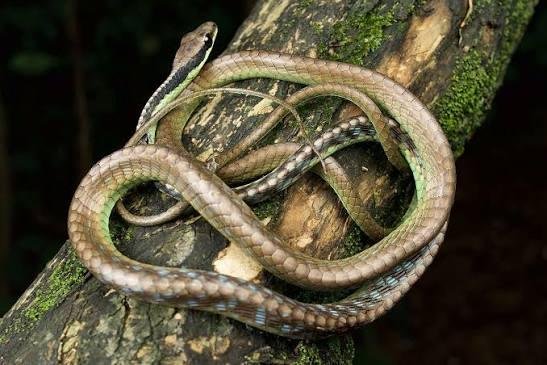
Scientists recently identified Beddome’s bronzeback (Dendrelaphis beddomei), a new tree snake species from the Western Ghats, resolving longstanding taxonomic confusion with the large-eyed bronzeback.
About Beddome’s Bronzeback
- Scientific Name & Family: Dendrelaphis beddomei; belongs to the family Colubridae.
- Etymology (Naming): Named after Colonel Richard Henry Beddome (1830–1911) for his work on Western Ghats biodiversity.
- Appearance: Has a red or pink tongue, white side stripes or spots, and occasional black patches on the back.
- Scale Traits: Shows a relatively longer loreal scale (between eye and nostril) and a smaller second postocular scale (behind the eye).
- Habitat: Found in secondary forests, riverine forests, and plantations (especially rubber and areca nut).
- Range & Elevation: Found along the western windward slopes of the Western Ghats at 44–1,038 m elevation, with likely habitats between Puttur and Jog Falls (Karnataka) and possibly from Wayanad (Kerala) to Uttara Kannada (Karnataka).
Beddome’s Bronzeback vs. Large-Eyed Bronzeback
| Feature | Beddome’s Bronzeback | Large-Eyed Bronzeback |
| Scientific Name | Dendrelaphis beddomei | Dendrelaphis grandoculis |
| Tongue Colour | Red or pink | Black or dark grey |
| Body Markings | White side markings; occasional black patches | Such markings absent |
| Subcaudal Scales | Up to 168 | Fewer than 133 |
| Altitude | 44–1,038 m | 300–1,260 m |
| Habitat | Secondary forests, riverine forests, and plantations | Evergreen and semi-evergreen rainforests |
Ecological Significance
- Biodiversity Value: Underscores the high species richness of the Western Ghats–Sri Lanka Biodiversity Hotspot.
- Taxonomy & Conservation: Clear species identification aids range mapping, population tracking, and conservation planning.
- Role of Modified Landscapes: Occurrence in plantations and secondary forests shows these spaces can help sustain native wildlife alongside natural forests.
FAQs
Q1. What distinguishes Beddome’s bronzeback from the large-eyed bronzeback?
Ans. Differences in tongue colour, body markings, scale structure, scale count and habitat preferences.
Q2. What is the preferred habitat of Beddome’s bronzeback?
Ans. Secondary forests, riverine forests and agricultural plantations along the western slopes of the Western Ghats.
Q3. What are secondary forests?
Ans. Forests that regenerate naturally or through human intervention after disturbance or clearance of original vegetation.