Context
The Bar-headed Goose, a migratory bird known for flying over the Himalayas at high altitudes, was recently sighted at Nandur Madhmeshwar Wildlife Sanctuary, Maharashtra, after a gap of nearly 8–10 years.
About the Bird
- Scientific Name: Anser indicus.
- Family: Anatidae (family of ducks, geese, and swans).
- Key Characteristic: One of the world’s highest-flying migratory birds, capable of crossing the Himalayas under low-oxygen conditions.
- Social Behaviour: Generally forms monogamous breeding pairs; males are slightly larger than females.
Habitat and Distribution
- Breeding Grounds: High-altitude lakes and wetlands of Central Asia, including the Tibetan Plateau and Mongolia.
- Wintering Grounds: South Asia, particularly India, extending into parts of peninsular India.
- Preferred Habitat: High mountain lakes during breeding; freshwater lakes, rivers, reservoirs, and wetlands during winter.
- Migration Route: Migrates annually between Central Asia and South Asia across the Himalayan mountain system.
- Flight Adaptation: Can fly at altitudes of around 25,000 feet (7,600 metres) using efficient respiratory and blood-circulation systems adapted to low oxygen.
Physical Features
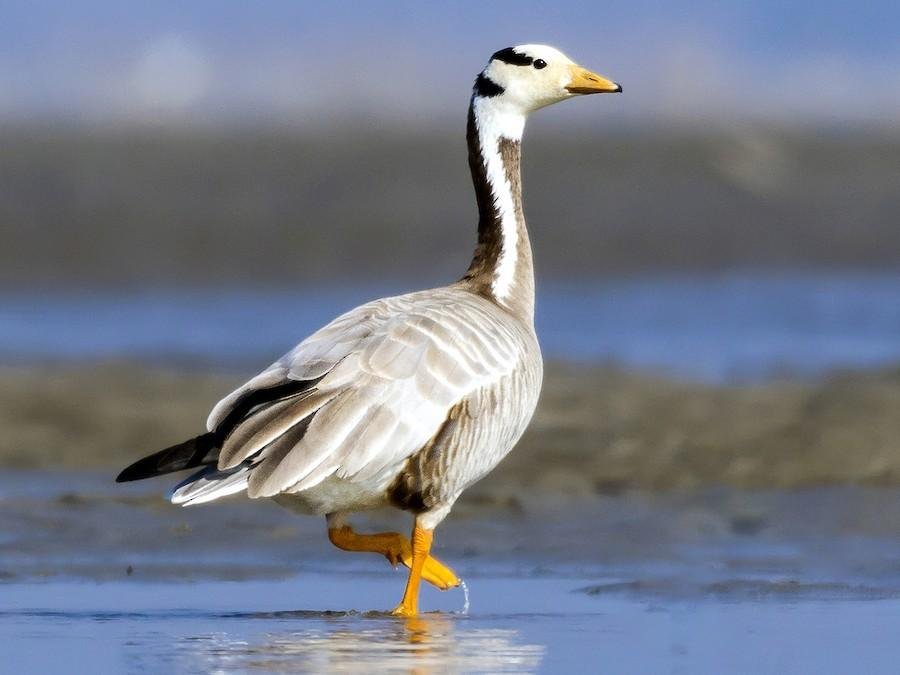
- Head Markings: Two distinctive dark, curved bars (bands) on the back of its white head.
- Body Colour: Pale grey body with a lighter neck and underparts.
- Bill and Legs: Yellowish-orange in colour.
- Sexual Dimorphism: Both sexes look similar in plumage, though males are generally larger.
Conservation Status
- IUCN (International Union for Conservation of Nature) Red List: Least Concern (LC).
- Wildlife (Protection) Act, 1972: Schedule II.
- Major Threats: Wetland degradation, human disturbance, and changes in water availability.
FAQs
Q1. Where does the Bar-headed Goose breed and spend the winter?
Ans. It breeds in high-altitude lakes of Central Asia and winters in South Asia, including India.
Q2. Why is the Bar-headed Goose known for high-altitude migration?
Ans. It can cross the Himalayas at altitudes of around 25,000 feet, despite low oxygen levels and extreme cold.
Q3. What is the IUCN conservation status of the Bar-headed Goose?
Ans. Least Concern (LC).