Context
External Affairs Minister S. Jaishankar visited Baku in October 2026 as India and Azerbaijan sought to improve bilateral ties after a period of diplomatic strain. Discussions focused on trade, investment, energy, connectivity and regional developments.
Geographical Profile
- Azerbaijan is located in the South Caucasus, at the junction of Eastern Europe and Western Asia.
- The Caspian Sea lies to its east, while it shares land borders with Russia, Georgia, Armenia and Iran.
- Its Nakhchivan Autonomous Republic, separated from mainland Azerbaijan by Armenian territory, also shares a short border with Türkiye.
- The Greater Caucasus Mountains extend across northern Azerbaijan, while the Kura-Aras Lowland forms an important central plain.
- Mount Bazardüzü, about 4,466 metres high, is Azerbaijan’s highest point.
- Major rivers include the Kura and Aras.
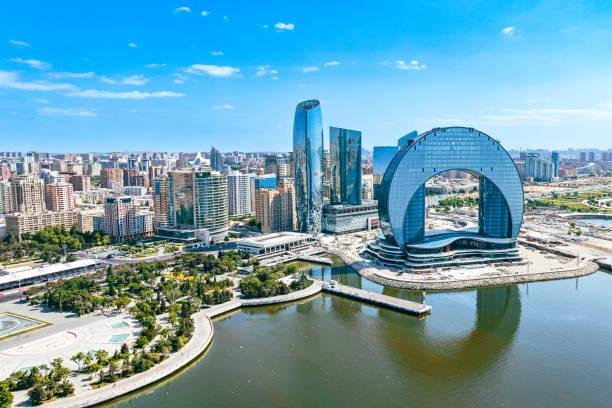
- Baku, the capital, lies on the Absheron Peninsula along the Caspian coast and, at about 28 metres below sea level, is the world’s lowest-lying national capital.
Political and Economic Profile
- Official name: Republic of Azerbaijan.
- Capital: Baku.
- Currency: Azerbaijani manat (AZN).
- Official language: Azerbaijani, a Turkic language.
- Azerbaijan declared independence in 1918, came under Soviet control in 1920, and regained independence in 1991 following the dissolution of the Soviet Union.
- Its economy is strongly dependent on oil and natural gas, which remain major sources of exports and government revenue.
- Its Caspian location and energy infrastructure also give it an important role in supplying hydrocarbons to markets beyond the region.
India–Azerbaijan Relations
- India recognised Azerbaijan after the breakup of the Soviet Union, and the two countries established diplomatic relations in 1992.
- Bilateral engagement covers trade, energy, pharmaceuticals, information technology, education and investment.
- Azerbaijan is relevant to India’s Eurasian outreach because of its position near important north-south and east-west transport routes.
- India and Azerbaijan have discussed cooperation related to the International North-South Transport Corridor (INSTC).
Armenia–Azerbaijan Regional Context
- Azerbaijan and Armenia were involved in a prolonged dispute over Nagorno-Karabakh, internationally recognised as part of Azerbaijan but historically populated largely by ethnic Armenians.
- A durable settlement is important because the dispute has long affected regional security, transport links and economic connectivity across the South Caucasus.
FAQs
Q1. Where is Azerbaijan located?
In the South Caucasus, between Eastern Europe and Western Asia.
Q2. Which water body lies to the east of Azerbaijan?
The Caspian Sea.
Q3. What is the capital of Azerbaijan?
Baku.
Q4. What are Azerbaijan’s major natural resources?
Petroleum and natural gas.
Q5. Which autonomous region of Azerbaijan borders Türkiye?
The Nakhchivan Autonomous Republic.