Context
The AGM-114 Hellfire missile gained attention following its use by the United States during a maritime interdiction operation linked to tensions with Iran, highlighting its significance as a precision-guided weapon in modern military operations.
About AGM-114 Hellfire missile
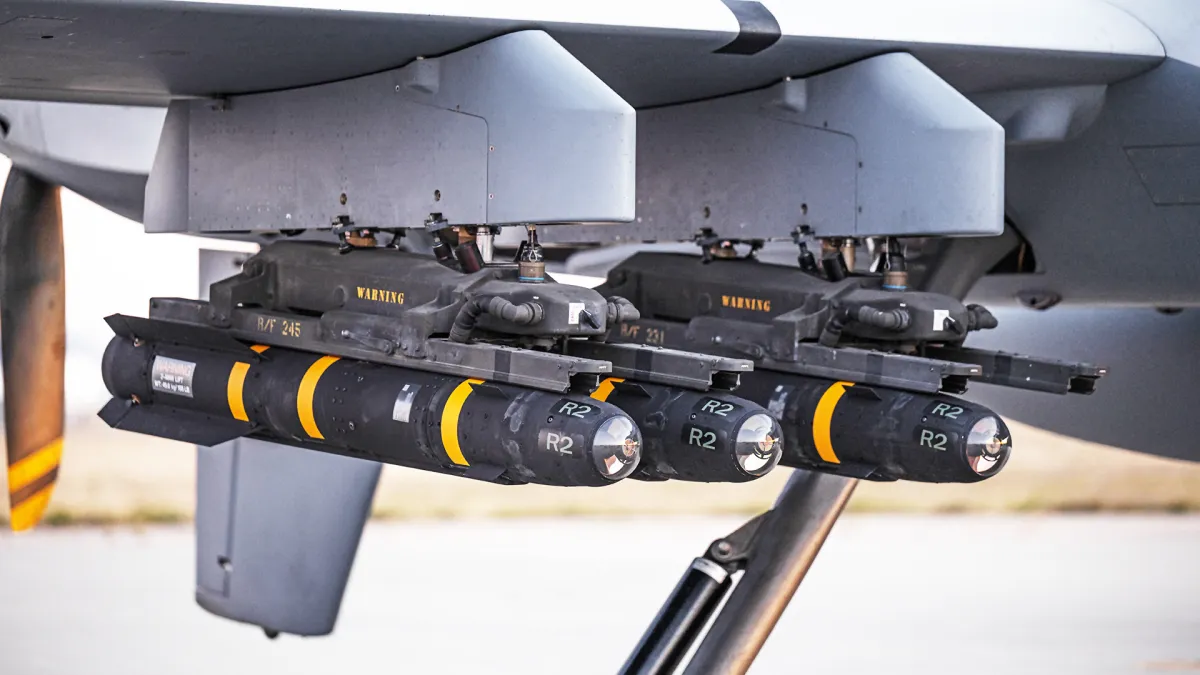
- The AGM-114 Hellfire is a short-range, subsonic, precision-guided air-to-ground missile developed in the United States and manufactured by Lockheed Martin.
- The AGM-114 Hellfire was introduced in 1984 as an anti-tank missile and can be used to attack tanks, aircraft, bunkers, radar systems, and small ships.
- The missile can be launched from a variety of platforms, including helicopters, drones, fighter aircraft, and ground-based launchers.
- The missile family includes variants such as the basic Hellfire series, Hellfire II, Anti-Ship Missile (AShM), and Longbow Hellfire.
- It has an operational range of 7–11 km, carries a payload of 8–11 kg, and can attain speeds of up to Mach 1.3.
- It is powered by a single-stage solid-fuel rocket motor and uses laser, radar, and imaging infrared (IIR) guidance systems for accurately tracking and striking targets.
- Its modular warheads include high-explosive anti-tank (HEAT), fragmentation, and thermobaric payloads, enabling it to engage a diverse range of military targets.