Context
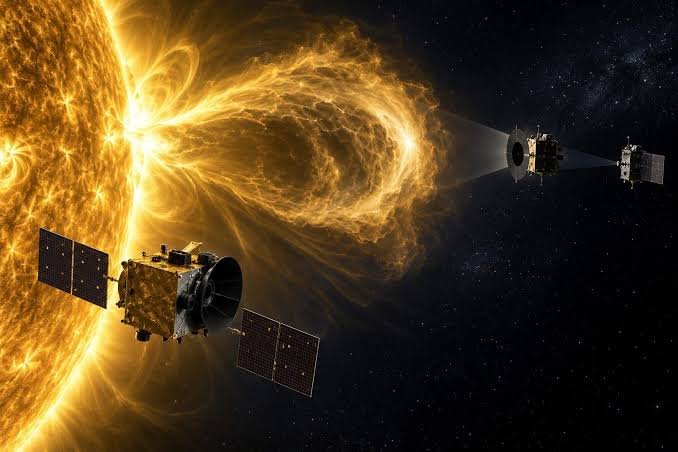
- Scientists from the Indian Institute of Astrophysics (IIA) and international collaborators have jointly analysed observations from India’s Aditya-L1 and ESA’s Proba-3 to study coronal mass ejections close to the Sun.
What are Coronal Mass Ejections?
- Coronal Mass Ejections (CMEs) are large eruptions of magnetized plasma and embedded magnetic fields from the Sun’s corona into interplanetary space.
- CMEs are different from solar flares, which are sudden bursts of electromagnetic radiation, although both may occur during the same solar event.
- Earth-directed CMEs can interact with the magnetosphere, producing geomagnetic storms and sometimes visible auroras.
- Strong space-weather events can disrupt satellite operations, navigation, communication systems and power infrastructure.
- Studying CMEs close to their origin helps scientists understand how their speed, density, mass and energy evolve before they move through interplanetary space.
Aditya-L1 and its Role
- Aditya-L1 is India’s first dedicated space-based solar observatory, launched by PSLV-C57 on 2 September 2023 from Satish Dhawan Space Centre, Sriharikota.
- It operates in a halo orbit around the Sun–Earth L1 point, about 1.5 million km from Earth towards the Sun.
- The L1 location provides an almost continuous and unobstructed view of the Sun, making it suitable for monitoring solar activity and space weather.
- Its Visible Emission Line Coronagraph (VELC) observes the solar corona and studies the dynamics and physical properties of CMEs.
- Other important payloads include SUIT, SoLEXS, HEL1OS, ASPEX, PAPA and Magnetometer, which study solar radiation, plasma, energetic particles and magnetic fields.
Proba-3 and Joint Solar Observations
- Proba-3 is a mission of the European Space Agency (ESA) and the world’s first precision formation-flying mission.
- It consists of two spacecraft flying about 150 metres apart during precision formation operations.
- One spacecraft blocks the bright solar disk and casts a controlled shadow on the other, creating an artificial solar eclipse.
- This enables the ASPIICS coronagraph to observe the faint inner solar corona through white-light and coronal-line imaging.
- Proba-3 was launched aboard PSLV-XL from Sriharikota on 5 December 2024.
- Joint VELC spectroscopy and ASPIICS imaging help constrain CME shape, dynamics, mass, density and energetics in the inner corona.
Key Findings of the Joint Study
- Scientists jointly examined CMEs observed on 14 and 16 September 2025.
- The 14 September CME travelled at about 645 km/s, while the 16 September event was much slower at around 145 km/s.
- Independent estimates of mass and thermal energy from VELC and ASPIICS showed good agreement.
- The observations revealed differences in the distribution of kinetic, thermal and magnetic energy between the two CME events.
- Together, the missions provide a more detailed and complementary view of CME evolution in the inner corona, improving understanding of space-weather processes.
FAQs
Q1. What is a coronal mass ejection?
A CME is a large eruption of magnetized plasma and embedded magnetic fields from the Sun’s corona.
Q2. Where is Aditya-L1 located?
It operates in a halo orbit around the Sun–Earth L1 point, about 1.5 million km from Earth.
Q3. Which Aditya-L1 instrument studies the solar corona and CMEs?
The Visible Emission Line Coronagraph (VELC) studies the solar corona and CME dynamics.
Q4. How does Proba-3 observe the solar corona?
Its two spacecraft create an artificial solar eclipse, allowing ASPIICS to observe the faint inner corona.
Q5. Why are Aditya-L1 and Proba-3 observations complementary?
VELC provides spectroscopic observations, while ASPIICS provides white-light and coronal-line imaging, together improving the study of CME structure and energetics.