Context
Agriculture is the Cornerstone of the Indian Economy offering livelihood to nearly half of India’s population and contributing about 18% to GDP. AI is no longer a luxury but a strategic necessity for ensuring national food security and farmer prosperity.
What are the core applications of AI in modern Indian farming?
- Precision Farming and Soil Health: By utilizing Deep Learning algorithms to analyze satellite imagery and drone data, farmers receive localized advisories. The Nationwide Soil Resource Mapping project by SLUSI helps in mapping soil profiles to optimize fertilizer use.
- Climate-Responsive Advisory: AI models analyze historical and real-time weather data to predict rainfall patterns and temperature variations, allowing farmers to adjust sowing dates and crop choices.
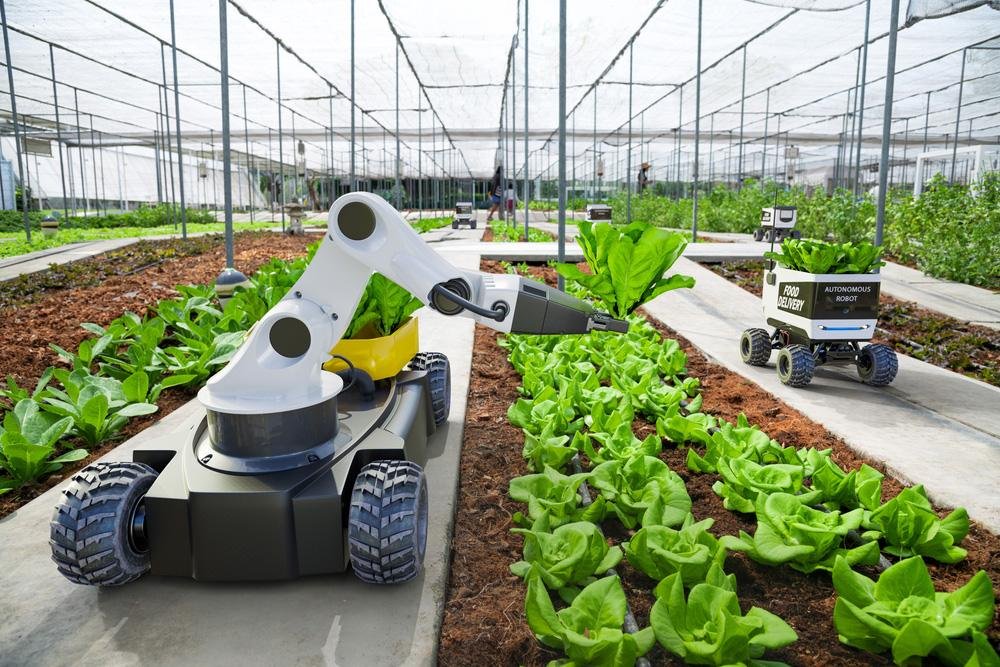
- Automated Surveillance and Mechanization: AI-based systems provide 24/7 surveillance of high-value crops, detecting early signs of stress or nutrient deficiency, which reduces labor dependency and optimizes input costs.
- Price Discovery and Market Intelligence: Predictive analytics leverage datasets from e-NAM and AGMARKET to forecast price movements, enabling farmers to decide the best time to sell their produce for maximum realization.
What are the key government initiatives driving the Digital Agriculture Mission?
The Government of India has shifted toward a “Data-Driven Governance” model, creating a unified digital ecosystem for the farmer.
- Digital Agriculture Mission (2024): This serves as the umbrella framework for delivering farmer-centric digital solutions.
- AgriStack and Farmer ID: A unique digital ID is provided to farmers, linked to land records, ensuring that subsidies and services reach the intended beneficiaries directly.
- Kisan e-Mitra: A voice-enabled AI chatbot that provides instant answers to farmer queries in multiple Indian languages.
- Krish-DSS (Decision Support System): A comprehensive GIS-based platform that integrates satellite data with ground truth for better crop estimation and planning.
- Bharat-VISTAAR (Budget 2026-27): The Virtually Integrated System to Access Agricultural Resources will integrate AgriStack with AI systems to provide end-to-end support from “seed to market.”
How does AI-Tech enhance the Pradhan Mantri Fasal Bima Yojana (PMFBY)?
The use of technology in crop insurance has moved from manual estimation to high-tech verification, reducing claim settlement times and disputes.
- The Yield Estimation System based on Technology uses satellite and weather data to provide more accurate yield assessments.
- WINDS: The Weather Information and Network Data System creates a hyper-local weather station network for precise climate monitoring.
- CROPIC: This involves the collection of real-time observations and photographs of crops to verify losses on the ground.
- National Pest Surveillance System: An AI-powered tool for early detection of pest infestations, allowing for preventive sprays rather than reactive chemical use.