- In April 2025, amid growing military tensions, India intercepted and recovered a PL-15 long-range air-to-air missile launched by the Pakistan Air Force (PAF).
- The missile interception and retaliation are part of a broader strategy under Operation Sindoor, which began as a response to the Pahalgam terror attack on April 22, 2025.
- The missile landed intact and unexploded in Hoshiarpur, Punjab.
- The recovery is seen as a major intelligence breakthrough and a milestone in India’s aerial defense preparedness.
What is the PL-15 Missile?
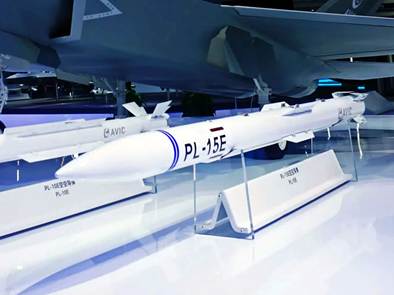
-
The PL-15 is a Chinese radar-guided long-range air-to-air missile, used by both China and Pakistan’s air forces.
- Key Specs:
- Range: Up to 200 km (export version: 145 km)
- Speed: Over Mach 5
- Length: 4 meters | Diameter: 200 mm
- Guidance: Inertial + Satellite Navigation + Active Radar + Datalink
- Propulsion: Dual-pulse solid-fuel rocket motor
- Developed by China Airborne Missile Academy (CAMA); entered Chinese service in 2015.
- Seen on platforms like JF-17 (Pakistan), J-10C, J-16, J-20 (China).
- JF-17 Thunder is a 4th-generation, multi-role combat aircraft developed in a joint effort between the Pakistan Aeronautical Complex (PAC) and China’s Chengdu Aircraft Corporation (CAC)
Key Points from the Incident
- Missile Recovery and Significance
- Fired from a PAF JF-17 fighter jet, the missile was recovered intact by Indian security forces.
- Its unexploded condition allows:
- Reverse engineering
- Trajectory analysis
- Insight into Pakistan’s targeting intent and operational strategy
- Missile Neutralization
- India’s air defense intercepted all incoming missiles from Pakistan during this episode.
- Pakistani strikes targeted military sites in J&K, Punjab, Rajasthan, and Gujarat but were fully thwarted.
- Confirms high operational readiness of India’s air defense infrastructure.
India’s Air Defense Capabilities
- India has developed a multi-layered air defense network, including:
- S-400 Triumf Systems (acquired from Russia)
- Akash Surface-to-Air Missiles
- Barak-8 interceptors
- Integrated Counter-UAS Grid
- DRDO Anti-Drone Systems
- S-400 Deployment
- Operational since 2018
- 3 of 5 S-400 squadrons are deployed along the China-Pakistan border
- Enables interception of high-speed, long-range threats
Indian Response: Strategic Counterattacks
- India retaliated with precision strikes in Pakistani territory.
- Targets hit: Chinese-supplied HQ-99 air defense unit in Lahore, key radar installations.
- Weapons used: SCALP cruise missiles, HAMMER smart bombs, loitering munitions
- Demonstrated ability to carry out surgical, high-impact countermeasures.
Strategic Significance
- The PL-15 interception signals a new chapter in India–Pakistan conflict dynamics.
- Reflects India’s:
- Improved missile defense systems
- Intelligence-led operational readiness
- Firm policy on cross-border terrorism
- Highlights growing use of drones and precision missiles in regional conflict.