Context
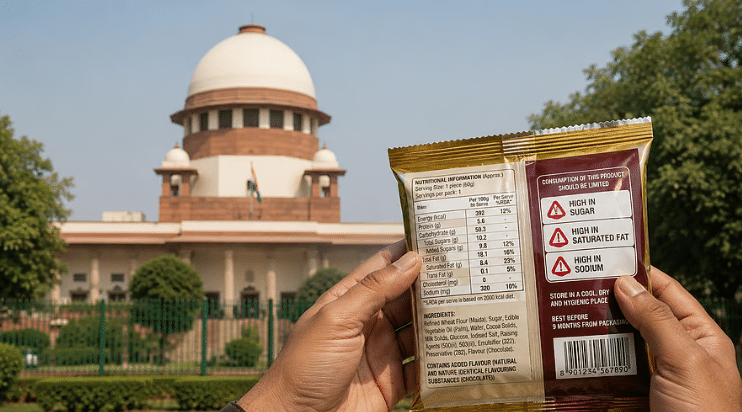
On 26 November 2026, the Supreme Court directed the Food Safety and Standards Authority of India (FSSAI) to strengthen Front-of-Package Nutrition Labelling (FoPNL) rules by introducing separate pictorial warnings for packaged foods high in sugar, saturated fat or salt, instead of general nutritional ratings.
Concept & Evolution of FoPNL in India
1. Meaning & Purpose: FoPNL (Front-of-Package Nutrition Labelling) puts clear nutrition info on the front of packaged food so buyers can spot HFSS (High Fat, Sugar, and Salt) items and make informed food choices.
2. Nodal Body: Led by FSSAI (Food Safety and Standards Authority of India)—a statutory body under the Food Safety and Standards Act, 2006 and Ministry of Health and Family Welfare.
3. Types of Labels:
- Interpretive Labels: Use symbols, colours, warnings, or ratings to show nutritional quality.
- Non-Interpretive Labels: Show plain nutrient numbers or % RDA (Recommended Dietary Allowance) without judging health quality.
4. Evolution in India:
- 2022 – INR (Indian Nutrition Rating): Proposed a star rating on overall nutrition, sparking concern that unhealthy foods could get positive ratings.
- 2025 – % RDA Approach: Proposed nutrient percentages without clear excess-intake warnings.
- 2026 – Hexagonal Warnings: FSSAI proposed red warning hexagons, followed by Supreme Court directions for separate pictorial warnings and science-based thresholds.
Need for Warning Labels & Global Experience
- Rising NCDs & Unhealthy Diets: WHO (World Health Organization) estimates NCDs (Non-Communicable Diseases)—including heart disease, diabetes, and cancer—cause around 63% of deaths in India, worsened by high HFSS intake and obesity.
- Easy Choices & Child Health: Simple front warnings help consumers, parents, and children spot excess fat, sugar, or salt quickly across age and literacy levels.
- Constitutional Backing: Article 21 covers health, food, and informed choice, while Article 47 guides the State to improve public health.
- Global Lessons:
| Country | Labelling System |
| Chile | Black warning symbols (2016); a study saw a 23.7% drop in high-sugar drink buys vs. trend after broader food rules. |
| United Kingdom | Traffic-light labels in red, amber, and green. |
| Australia & New Zealand | Health Star Rating showing overall nutritional score. |
| Mexico | Prominent warning symbols for items crossing nutrient limits. |
Supreme Court Ruling & Implementation Timeline (2026)
- Separate Warning Hexagons: Foods crossing limits must carry separate hexagons with pictograms and text (“High Fat”, “High Sugar”, or “High Salt”) rather than one combined hexagon.
- Total Nutrients & Science-Based Cut-Offs: Must look at total sugars, saturated fat, and salt (not just added sugar or added fat) and fix evidence-based thresholds to avoid false relief or label fatigue.
- Size, Exemptions & Anti-Misuse Rules: Each hexagon should cover at least 4–5% of the front panel (with legible text), sweetened drinks below cut-offs cannot copy warning hexagons, exemptions must be narrow and justified, and additives/preservatives cannot be used to dodge rules.
- Timeline & Monitoring: FSSAI has ~4 months to finalise rules (10-week progress report), followed by a 365-day transition window for food businesses without undue delays or misuse.
Key Challenges
- Setting Fair Nutrient Cut-Offs: Balancing scientific limits with Indian diets so thresholds are neither too loose nor too broad.
- Industry Pushback & Lobbying: Managing commercial resistance during rule-making and rollout.
- Loopholes & Fake Reformulation: Stopping unjustified exemptions, copycat/lookalike labels, or minor recipe tweaks that evade warnings.
- Enforcement & Testing Gaps: Monitoring thousands of packaged items and small units across States within the 365-day window.
- Low Nutrition Awareness: Reaching low-literacy and rural buyers who rely on familiar brands or price.
- School & Ad Environment: Curbing HFSS marketing and unhealthy snacks around children and schools.
Way Forward
- Independent & Transparent Thresholds: Use independent nutrition science to fix clear, verifiable cut-offs for total sugar, saturated fat, and salt.
- Tight Exemption & Anti-Evasion Rules: Publish a clear, reasoned exemption list and close loopholes around additives, lookalike symbols, and reformulation.
- Strict Timelines & Compliance: Meet the 4-month and 10-week milestones, and enforce the 365-day transition strictly without extensions for non-compliance.
- Stronger Lab & Field Checks: Upgrade food testing labs and State–Centre coordination for regular market checks.
- School & Public Awareness: Run simple public campaigns and school nutrition programmes to build healthy eating habits.
- Better Alternatives: Encourage genuinely healthier food options and balanced diets alongside front-pack warnings.
FAQs
Q1. Which nutrients must be considered under the revised warning system?
Ans. Total sugars, saturated fat and salt, rather than only added sugar and added fat.
Q2. What is the minimum size prescribed for warning symbols?
Ans. Each warning hexagon should generally cover at least 4–5% of the principal display panel, subject to justified exceptions.
Q3. What is the difference between interpretive and non-interpretive food labels?
Ans. Interpretive labels use symbols, colours or ratings, while non-interpretive labels provide numerical nutritional information.
Q4. Which constitutional provisions are associated with food safety and nutritional labelling?
Ans. Article 21 protects the right to health and informed choice, while Article 47 directs the State to improve nutrition and public health.