Context
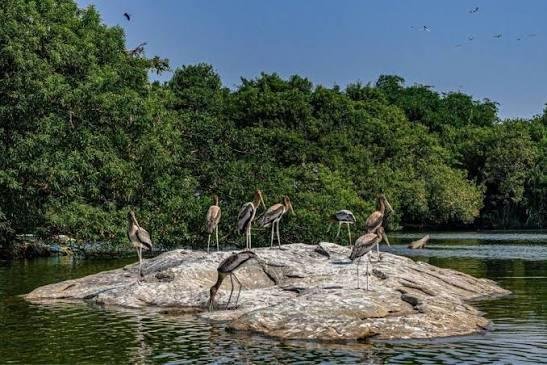
Migratory birds have begun arriving at Ranganathittu Bird Sanctuary, Karnataka, nearly two weeks earlier than their usual December breeding season.
About Ranganathittu Bird Sanctuary
- Location & Area: Near Srirangapatna, Mandya district, Karnataka, along the Cauvery River, covering around 0.67 sq. km across several riverine islands.
- Popular Name: Known as Pakshi Kashi of Karnataka for its rich birdlife.
- Establishment & Origin: Declared a bird sanctuary in 1940 after efforts by ornithologist Salim Ali; its islands formed after an embankment was built across the Cauvery during the 17th-century reign of Kanteerava Narasimharaja Wadiyar.
- Ramsar Recognition: Designated on 15 February 2022 as Karnataka’s first Ramsar Site (wetland of international importance).
- Habitat: Comprises freshwater wetlands, riverine islands, reed beds, and dense vegetation ideal for bird nesting and breeding.
Flora and Fauna
- Flora: Dominated by Arjun (Terminalia arjuna), bamboo, and Pandanus (screw pine) trees along the riverbanks and islands.
- Birds: Hosts around 170 bird species, including painted storks, Asian openbills, black-headed ibises, Eurasian spoonbills, Oriental darters, spot-billed pelicans, cormorants, and herons.
- Mammals: Supports bonnet macaques, smooth-coated otters, flying foxes, common palm civets, and Indian grey mongooses.
- Reptiles: Home to mugger crocodiles (Crocodylus palustris) and monitor lizards.
FAQs
Q1. Which river flows through Ranganathittu Bird Sanctuary?
Ans. The Cauvery (Kaveri) River, forming several small riverine islands within the sanctuary.
Q2. Which ornithologist played an important role in establishing Ranganathittu Bird Sanctuary?
Ans. Salim Ali (Birdman of India), who helped secure its protection in 1940.
Q3. Which crocodile species is prominently found in Ranganathittu Bird Sanctuary?
Ans. The mugger crocodile (marsh crocodile).