Context
Astronomers recently identified J1602+4228AB, the oldest known compact quasar pair, using the James Webb Space Telescope (JWST) and Gemini North Telescope, providing new insights into the formation and rapid growth of supermassive black holes in the early universe.
About Quasars
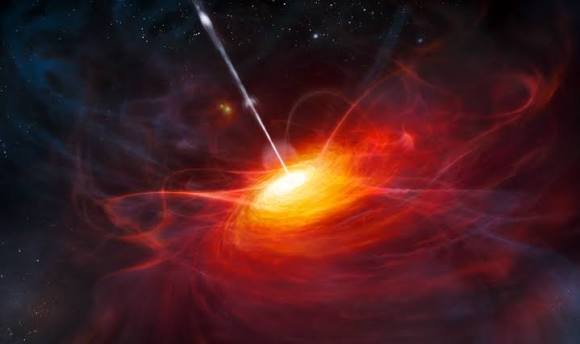
- Full Form & Meaning: Quasars (Quasi-Stellar Radio Sources) are extremely bright space objects that form a powerful class of AGN (Active Galactic Nuclei).
- Discovery: First spotted in 1963 as distant, star-like points giving off strong electromagnetic radiation.
- Location: Sit at the centres of active galaxies, often billions of light-years away from Earth.
- Power Source: Driven by gas and matter falling into supermassive black holes that weigh millions to billions of times the mass of the Sun.
- Extreme Brightness: Can shine brighter than the entire galaxy around them, making them visible across huge cosmic distances.
How Quasars Produce Energy
- Swirling Accretion Disk: Gas, dust, and debris get pulled toward the supermassive black hole and spiral around it like water going down a drain, forming a fast-spinning accretion disk.
- Friction & Heat Release: Strong gravity and friction squeeze and heat this swirling material to millions of degrees, turning gravitational energy into intense electromagnetic radiation (before the matter crosses the black hole’s boundary).
- Wide Radiation Output: This superheated disk shines across the spectrum, releasing visible light, UV (ultraviolet) radiation, X-rays, and radio waves.
- Active Feeding Phase: A galaxy hosts a quasar only when enough gas and matter actively feed its central black hole; once the fuel runs out, the quasar fades into a quiet galaxy.
Key Findings of the Recent Discovery
- Twin Quasar Pair: J1602+4228AB (nicknamed Nāpōwawāʻenakaulua) is a pair of two actively feeding supermassive black holes close to each other.
- Early-Universe Age: Seen as it existed around 900 million years after the Big Bang.
- Massive Size & Gap: The two black holes weigh roughly 1.5 billion and 400 million solar masses (times the Sun’s mass) and sit about 18,100 light-years apart.
- Why It Puzzles Scientists: Finding such enormous black holes so early in cosmic history challenges current models of how fast black holes can form and grow.
Other Important Facts & Scientific Significance
- Brightest Known Quasar: J0529-4351 (identified in February 2024) shines with energy equal to over 500 trillion Suns.
- Related AGN Types: Other AGN (Active Galactic Nuclei) include Blazars (which shoot high-speed particle jets almost directly toward Earth), Seyfert Galaxies, and Radio Galaxies.
- Scientific Value: Because light from distant quasars takes billions of years to reach Earth, they act like cosmic lighthouses to study the early universe, galaxy growth, and supermassive black hole formation.
FAQs
Q1. What causes the extraordinary brightness of quasars?
Ans. Intense radiation from hot matter in an accretion disk surrounding a supermassive black hole.
Q2. Which quasar is more than 500 trillion times as luminous as the Sun?
Ans. J0529-4351, identified in 2024, with a luminosity exceeding 500 trillion times that of the Sun.
Q3. What is the difference between a quasar and a blazar?
Ans. Both are Active Galactic Nuclei (AGN), but a blazar has a relativistic jet directed towards Earth, producing highly variable radiation.