Context
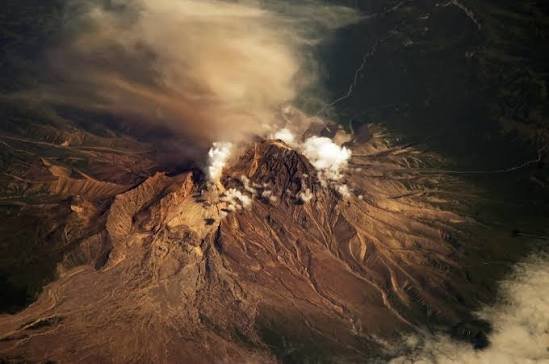
A recent satellite image showed a growing lava dome at Russia’s Shiveluch Volcano, highlighting its ongoing volcanic activity and the risks posed by explosive eruptions and ash emissions to aviation safety.
About Shiveluch Volcano
- Location: Lies on the Kamchatka Peninsula in the Russian Far East; it is the northernmost active volcano on the peninsula.
- Type & Elevation: A stratovolcano (composite volcano) built from alternating layers of lava, ash, and rock fragments, rising to about 3,283 metres above sea level.
- Age & Structure: Roughly 60,000–70,000 years old, featuring a 9-km-wide caldera that holds an active lava dome complex.
- Eruptive History: Recorded around 60 major eruptions over the past 10,000 years, with continuous activity since August 1999.
- Nature of Eruptions: Known for explosive eruptions, lava dome growth, heavy ash plumes, debris avalanches, and pyroclastic flows.
- Tectonic Setting: Sits along the Pacific Ring of Fire, where the Pacific Plate sinks (subducts) beneath the Okhotsk Plate.
- Aviation Risk: High-altitude volcanic ash clouds can damage aircraft engines and disrupt air routes between Asia and North America.
About Kamchatka Peninsula
- Location: Located in eastern Russia, bordered by the Sea of Okhotsk to the west, the Pacific Ocean to the east, and the Bering Sea to the northeast.
- Tectonic Belt: Forms part of the Kuril–Kamchatka volcanic arc, shaped by the Pacific Plate subducting along the Kuril–Kamchatka Trench.
- Major Volcanoes: Shiveluch, Klyuchevskoy, Bezymianny, Karymsky, and Avachinsky.
- Global Heritage Status: The Volcanoes of Kamchatka were listed as a UNESCO (United Nations Educational, Scientific and Cultural Organization) World Heritage Site in 1996 (expanded in 2001).
Important Volcanic Landforms & Processes
- Lava Dome: A steep-sided mound created when thick, slow-moving (viscous) lava piles up around a volcanic vent.
- Caldera: A large bowl-shaped hollow formed when the ground collapses inward after magma empties from below.
- Pyroclastic Flow: A fast-moving, scorching current of hot gases, ash, and rock fragments racing down volcano slopes.
- Debris Avalanche: A sudden, rapid landslide of volcanic rocks and soil triggered when a volcano slope or lava dome collapses.
FAQs
Q1. What is a lava dome?
Ans. A steep-sided mound formed by the accumulation of highly viscous lava around a volcanic vent.
Q2. What is the Pacific Ring of Fire?
Ans. A horseshoe-shaped belt around the Pacific Ocean characterised by frequent earthquakes and volcanic activity along tectonic plate boundaries.
Q3. Which water bodies surround the Kamchatka Peninsula?
Ans. The Sea of Okhotsk to the west, Pacific Ocean to the east and Bering Sea to the northeast.