Context
The Pradhan Mantri Bhartiya Janaushadhi Pariyojana (PMBJP) faces challenges of low public awareness, irregular medicine availability and concerns over generic medicine quality, highlighting the need to strengthen its reach and effectiveness despite its expansion.
About PMBJP (Pradhan Mantri Bhartiya Janaushadhi Pariyojana)
- Launch & Revamp: Started in 2008 and revamped in 2015 to provide affordable generic medicines.
- Nodal Ministry: Ministry of Chemicals and Fertilisers, through the Department of Pharmaceuticals.
- Implementing Agency: PMBI (Pharmaceuticals and Medical Devices Bureau of India).
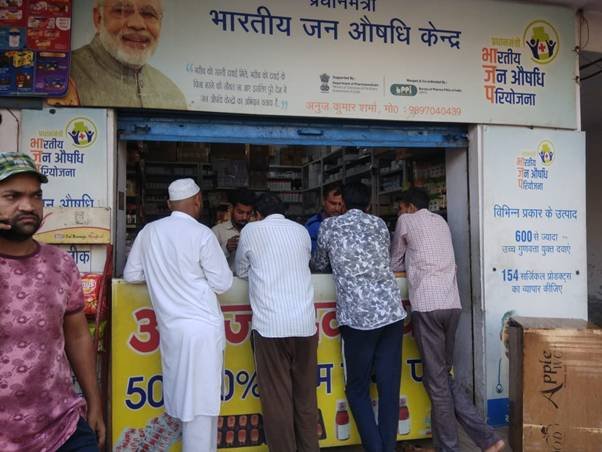
- Core Objective: Supply quality generic medicines at low prices through JAKs (Jan Aushadhi Kendras).
- Generic Medicines: Medicines with the same active salt/ingredients, strength, and quality as branded drugs, sold without brand mark-ups.
Progress Under PMBJP
- Store Network: Expanded from 17,990 Kendras (December 2025) to 20,547 Kendras (July 2026), targeting 25,000 by March 2027.
- Product Range: Covers 2,110 medicines and 315 surgical items, medical consumables, and devices.
- Daily Reach: Serves around 10–12 lakh visitors daily.
- Sales & Annual Savings: Recorded ₹2,252 crore in sales in FY 2025–26, saving citizens about ₹9,000 crore.
- Total Savings: Saved citizens roughly ₹45,000 crore over 12 years.
- Price Relief: Medicines cost 50–80% less than comparable branded versions.
Significance for Public Healthcare
- Lower OOPE (Out-of-Pocket Expenditure): Low-cost drugs reduce direct medical spending by families—the biggest cause of health-related financial distress.
- Advancing UHC (Universal Health Coverage): Improves access to essential medicines without financial hardship.
- Bridging Public Spending Gaps: Government health spending stood at 1.43% of GDP (Gross Domestic Product) in 2023–24, below the National Health Policy 2017 target of 2.5% by 2025.
- Reducing Household Burden: With OOPE at 42.7% of total health expenditure in 2023–24, affordable generics are vital for household financial protection.
Key Challenges
- Low Awareness: Limited public awareness—a Port Blair study of 200 outpatients found only one-third knew about the scheme.
- Limited Reach: 20,547 Kendras are far fewer than India’s 12 lakh private pharmacies, limiting last-mile access.
- Quality Doubts: Public distrust of generics persists, despite lower sample failure rates (0.34% for Jan Aushadhi medicines vs. 3.70% in the open market, though testing methods differ).
- Medicine Shortages: Irregular stock availability hurts patient trust and disrupts ongoing treatment.
- Brand-Name Prescriptions: Doctors rarely prescribe generic names; the NMC (National Medical Commission) 2023 rules mandating generic prescriptions were put on hold (abeyance).
Way Forward
- National Survey: Conduct a countrywide survey to track awareness, store access, prescribing habits, and stock gaps.
- Strict Quality Checks: Source only from WHO-GMP (World Health Organization – Good Manufacturing Practices) certified makers, test in NABL (National Accreditation Board for Testing and Calibration Laboratories) accredited labs, and publish quality reports publicly.
- Digital Stock Tracking: Use real-time inventory monitoring and auto-replenishment to prevent shortages.
- Generic Prescribing: Encourage doctors to prescribe generics and build trust in bioequivalence (proven equal effectiveness of generic and branded drugs).
- Outreach & App Upgrade: Promote JAKs for all citizens and update the Jan Aushadhi Sugam App with live stock updates.
- Rural Expansion: Open more Kendras in rural, remote, and underserved areas.
FAQs
Q1. When was the Jan Aushadhi Scheme launched?
Ans. Introduced in 2008 and revamped in 2015 to improve access to affordable generic medicines.
Q2. Which organisation implements PMBJP?
Ans. Pharmaceuticals and Medical Devices Bureau of India (PMBI) under the Department of Pharmaceuticals.
Q3. How is the quality of Jan Aushadhi medicines ensured?
Ans. Through WHO-GMP-compliant manufacturers and batch-wise testing in NABL-accredited laboratories.
Q4. What is the Jan Aushadhi Sugam App?
Ans. A mobile app to locate Jan Aushadhi Kendras, search medicines and compare generic and branded medicine prices.