Context
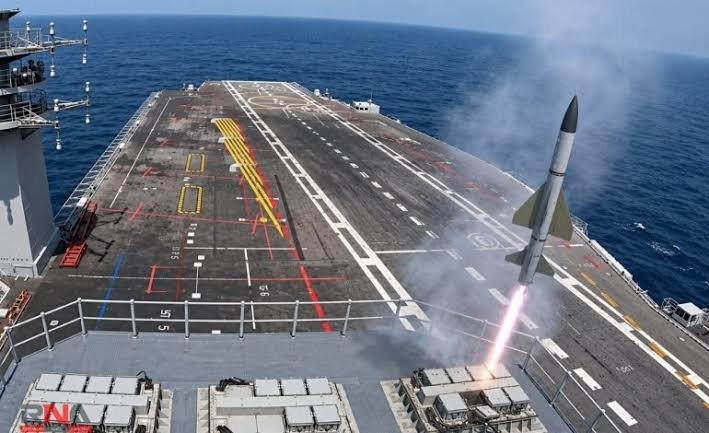
The Ministry of Defence (MoD) signed a ₹1,976.40 crore contract with Israel Aerospace Industries (IAI) to upgrade the Barak Point Defence Missile System on Indian Navy warships and replace obsolete components.
About Barak Point Defence Missile System (Barak-1)
- Nature: A ship-based SAM (Surface-to-Air Missile) system that gives close-range protection against incoming air attacks.
- Developer: Jointly built by IAI (Israel Aerospace Industries) and Rafael Advanced Defense Systems (Israel).
- Induction: Known as Barak-1, inducted into the Indian Navy in 2000.
- Warship Deployment: Fitted on INS Vikramaditya, Delhi-class destroyers, and Shivalik- and Brahmaputra-class frigates.
- Future Replacement: Will be gradually replaced by DRDO’s (Defence Research and Development Organisation) indigenous VL-SRSAM (Vertical Launch Short Range Surface-to-Air Missile).
Key Features of Barak-1
- Point Defence Role: Point defence means protecting a single warship, base, or small area from immediate close-range threats (unlike area defence, which shields a wider zone or fleet).
- Operational Range: Around 10–12 km (minimum range ~500 m).
- Speed & Weight: Travels above Mach 2 (over twice the speed of sound); weighs 98 kg with a 22 kg warhead.
- Targets Intercepted: Anti-ship missiles, low-flying sea-skimming missiles, enemy aircraft, and UAVs (Unmanned Aerial Vehicles).
- Automated Vertical Launch: Fired straight upward from a VLS (Vertical Launch System) for 360-degree threat coverage, using ship radars to detect, track, and destroy targets automatically.
Key Features of Barak-8
- Joint Development: Co-developed by DRDO (Defence Research and Development Organisation) and IAI (Israel Aerospace Industries).
- Propulsion & Agililty: Uses a dual-pulse rocket motor and TVC (Thrust Vector Control) for sharp mid-air turns against fast-moving targets.
- Smart Guidance: Uses a two-way data link and an active radar seeker to lock onto targets in the final phase.
- Multi-Target Engagement: Linked with advanced MF-STAR (Multi-Function Surveillance, Track and Guidance Radar) to hit multiple air threats at once.
- Variants: Naval LRSAM (Long Range Surface-to-Air Missile) and land-based MRSAM (Medium Range Surface-to-Air Missile) for the Indian Army and IAF (Indian Air Force).
Difference Between Barak-1 and Barak-8
| Parameter | Barak-1 | Barak-8 |
| Developer | Israel (IAI & Rafael) | India–Israel joint development (DRDO & IAI) |
| Category | Short-range SAM | Medium/Long-range SAM |
| Operational Range | ~10–12 km | 70–100 km (up to 150 km in Barak-8ER extended-range version) |
| Speed | Above Mach 2 | ~Mach 2 |
| Missile & Warhead Weight | 98 kg missile; 22 kg warhead | 275 kg missile; 60 kg warhead |
| Primary Role | Close-range point defence (single ship) | Wide area air defence (fleet/base shield) |
| Target Engagement | Close-range incoming threats | Multiple simultaneous threats across wider airspace |
About Indigenous VL-SRSAM
- Developer: DRDO (Defence Research and Development Organisation).
- Nature: An indigenous, canisterised, vertically launched short-range SAM built for Indian Navy warships (and land-based air defence).
- Key Capability: Equipped with an indigenous RF (Radio Frequency) seeker to destroy fast, low-altitude sea-skimming missiles and UAVs across 360 degrees.
- Strategic Significance: Boosts Atmanirbhar Bharat in naval air defence, cuts reliance on foreign imports, and supports layered air defence alongside Barak-8 (LRSAM).
FAQs
Q1. Which organisations developed Barak-1?
Ans: Israel Aerospace Industries (IAI) and Rafael Advanced Defense Systems of Israel.
Q2. What is the operational range of Barak-1?
Ans: Approximately 10 km.
Q3. Which indigenous missile system is expected to replace Barak-1?
Ans: The Vertical Launch Short Range Surface-to-Air Missile (VL-SRSAM), developed by DRDO.
Q4. Which countries jointly developed Barak-8?
Ans: India and Israel.