Context
The Supreme Court, in Sri Sujit Das & Ors. v. Union of India (5 November 2026), ruled that the 24-hour limit under Article 22(2) begins from actual detention, not formal arrest. The ruling strengthens personal liberty, judicial oversight and protection against illegal custody.
Case Background
- Case: Sri Sujit Das & Ors. v. Union of India (5 November 2026), involving the alleged seizure of methamphetamine (Yaba) tablets under the NDPS (Narcotic Drugs and Psychotropic Substances) Act, 1985, in Tripura.
- Detention vs. Arrest: The accused were detained at 2:00 PM on 29 September 2025, but formally arrested around 11:00 AM on 30 September 2025.
- Production: They were produced before a magistrate at 4:45 PM on 30 September, exceeding 24 hours from actual detention.
- Legal Issue: Authorities delayed formal arrest while completing investigation and seizure procedures.
- Verdict: The Court found violations of Article 22(2) and Section 58 BNSS, set aside the Tripura High Court’s order and directed release on bail through the Special Court, subject to appropriate conditions.
Arrest vs Detention: Supreme Court’s Interpretation
| Arrest | Detention |
| Taking a person into custody under legal authority | Restraining a person’s freedom of movement |
| Ordinarily accompanied by formal arrest procedures | May occur before formal arrest is recorded |
| Involves deprivation of personal liberty | May amount to custodial deprivation of liberty |
Supreme Court’s Clarification: For Article 22(2), the terms arrest and detention are treated as equivalent when a person’s liberty is effectively curtailed in criminal custody. The constitutional clock cannot be delayed through procedural distinctions.
Important: Voluntary questioning without actual restraint does not, by itself, constitute custodial detention.
Constitutional Framework
- Article 21: Protects the right to life and personal liberty, except by procedure established by law.
- Article 22(1): Gives the right to know the grounds of arrest and consult a lawyer of choice.
- Article 22(2): Requires bringing an arrested person before the nearest magistrate within 24 hours, excluding necessary travel time; further custody needs court approval.
Relevant Provisions of BNSS (Bharatiya Nagarik Suraksha Sanhita), 2023
- Section 36: Prescribes arrest procedures, including preparation of an arrest memorandum.
- Section 38: Right to meet a lawyer during questioning, though not throughout the entire interrogation.
- Section 47: Right to know the grounds of arrest and right to bail (in bailable offences).
- Section 48: Police must inform a relative, friend, or nominated person about the arrest.
- Section 58: Bans holding a person arrested without a warrant beyond a reasonable time, and never past 24 hours (excluding travel time), without a magistrate’s order.
- Section 187: Provides for magisterial authorisation of further detention when investigation cannot be completed within 24 hours.
Key Supreme Court Holdings (2026)
- Actual Restraint Starts the Clock: The 24-hour clock starts the moment personal liberty is restricted, no matter when the formal arrest is written down.
- No Artificial Distinction: Officials cannot separate informal detention/enquiry from formal arrest to bypass constitutional rules.
- Strict Travel-Time Exclusion: Only necessary travel time to the court can be excluded — not hours spent on search, questioning, or paperwork.
- Reasonable Custody Rule: Under Section 58 of BNSS, even custody within 24 hours must be reasonable.
- Judicial Check: Magistrates must verify the exact time of initial restraint and can refuse remand if detention was unreasonable.
- Mandatory Release: Keeping someone past the legal limit without court production requires immediate release.
Exceptions under Article 22(3)
- Enemy Aliens: Protections under Articles 22(1) and 22(2) do not apply to citizens of an enemy country.
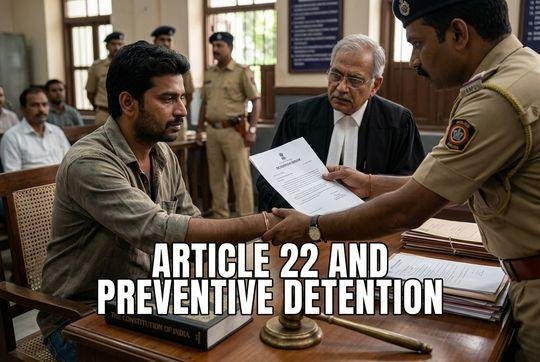
- Preventive Detention: These rules also do not apply to preventive detention laws, which have separate safeguards under Articles 22(4) to 22(7).
Safeguards and Remedies Against Illegal Detention
- D.K. Basu Guidelines (1997): Mandatory rules against custodial abuse, including arrest memos, informing relatives, and medical checks.
- Paramvir Singh Saini v. Baljit Singh (2020): Directed CCTV surveillance with audio-video recording in police stations and relevant investigation offices.
- Writ of Habeas Corpus: Legal remedy against illegal custody in the Supreme Court (Article 32) and High Courts (Article 226).
- Free Legal Aid: Provided to eligible people under the LSA (Legal Services Authorities) Act, 1987, fulfilling Article 39A.
- Compensation: Rudul Sah (1983) and Nilabati Behera (1993) established judicial remedies, including monetary compensation in appropriate cases involving violations of fundamental rights.
Significance of the Ruling
- Curbs “Informal Custody”: Stops police from keeping suspects off-the-record before showing formal arrest just to get extra questioning time.
- Protects Liberty Under Strict Laws: Clarifies that even in tough laws like the NDPS (Narcotic Drugs and Psychotropic Substances) Act, 1985, Article 22 safeguards cannot be bypassed.
- Ensures Judicial Accountability: Strengthens the magistrate’s role in preventing illegal detention and custodial abuse.
Way Forward
- Digital Time-Stamping: Make real-time, tamper-proof entry of detention time mandatory on CCTNS (Crime and Criminal Tracking Network & Systems) and ICJS (Inter-Operable Criminal Justice System).
- Strict CCTV Monitoring: Enforce the Supreme Court’s Paramvir Singh Saini (2020) rules for working CCTV (Closed-Circuit Television) cameras with audio in all police stations and lock-ups.
- Mandatory Remand Checklist: Require magistrates to verify a standard checklist (exact detention time, medical check, lawyer access, and family notice) before granting custody.
- Officer Accountability & Victim Compensation: Take disciplinary action against erring officers and grant monetary compensation for illegal custody.
- Police Training: Regularly train officers on BNSS (Bharatiya Nagarik Suraksha Sanhita), 2023 custody timelines and human rights duties.
FAQs
Q1. What did the Supreme Court hold in Sujit Das v. Union of India?
Ans. The 24-hour limit begins from actual detention, not formal arrest; violation without judicial authorisation requires release.
Q2. What does Article 22(2) provide?
Ans. Production before the nearest magistrate within 24 hours of arrest, excluding necessary travel time.
Q3. What time can be excluded from the 24-hour period?
Ans. Only the necessary travel time from the place of arrest to the magistrate’s court.
Q4. To whom do Article 22(1) and (2) not apply?
Ans. Enemy aliens and persons detained under preventive detention laws, as provided under Article 22(3).