Context
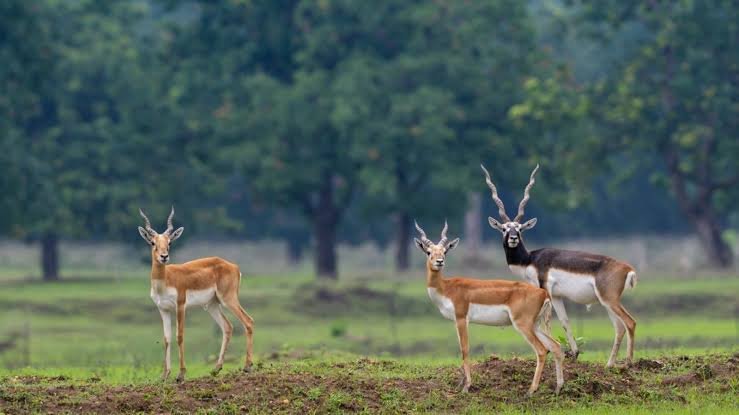
Chhattisgarh has approved the reintroduction of 50 blackbucks from Barnawapara Wildlife Sanctuary to Gomarda Wildlife Sanctuary, where the species became locally extinct in the 1970s due to hunting, poaching and habitat loss.
About Gomarda Wildlife Sanctuary
- Location: Situated in Sarangarh-Bilaigarh district, Chhattisgarh (formerly part of Raigarh district).
- Establishment: Notified as a wildlife sanctuary in 1975, named after Gomarda village located inside its boundary.
- Area: Covers approximately 278 sq. km.
- Terrain: Gently undulating, rocky land with boulders, making it largely unsuitable for farming.
- Rivers: Drained by the Laat and Manai rivers, which provide vital water during the summer season.
- Vegetation: Features Tropical Dry Deciduous Forests dominated by sal, bija, tendu, bamboo, and open grasslands.
- Major Fauna: Supports chital, chinkara, sambar, gaur, chousingha (four-horned antelope), barking deer, sloth bear, dhole (wild dog), tiger, and leopard.
- Conservation News: Its open grasslands and water supply make it ideal for the reintroduction of 50 blackbucks (shifted from Barnawapara Wildlife Sanctuary) after more than five decades.
About Blackbuck
- Scientific Name: Antilope cervicapra — the only living species of the genus Antilope (family Bovidae).
- Distribution: Native to the Indian subcontinent, with roughly 90% of its global population found in India.
- Habitat: Prefers open grasslands, dry scrublands, and thorn forests.
- Major States: Widely found in Rajasthan, Gujarat, Madhya Pradesh, Tamil Nadu, and Odisha.
- State Animal: Declared the State Animal of Punjab, Haryana, and Andhra Pradesh.
- Famous Habitats: Velavadar Blackbuck National Park (Gujarat), Point Calimere Wildlife Sanctuary (Tamil Nadu), and Tal Chhapar Sanctuary (Rajasthan).
- Physical Features (Sexual Dimorphism): Adult males have dark brown-to-black coats and long spiral horns (never shed), whereas females are yellowish-brown (lighter) and usually hornless.
- Behaviour: Diurnal (active by day), fast-running, and social (gregarious) animals that live in herds.
Conservation Status of Blackbuck
- IUCN (International Union for Conservation of Nature) Red List: Least Concern (LC).
- Wildlife (Protection) Act, 1972: Schedule I (highest legal protection in India).
- CITES (Convention on International Trade in Endangered Species of Wild Fauna and Flora): Appendix III (listed for the Nepal population).
- Major Threats: Habitat loss, conversion of grasslands into farmland, habitat fragmentation, poaching (illegal hunting), and stray dog predation.
- Ecological Role: Acts as a vital grassland indicator species that helps maintain healthy open-grassland ecosystems.
Wildlife Reintroduction: Process and Significance
1. Core Concepts: Reintroduction means releasing a species back into its historic habitat where it became locally extinct, while translocation is the planned physical movement of animals from one location to another.
2. Key Requirements:
- Habitat Suitability: Adequate native grasses (food), water, and safe shelter.
- Health Screening: Mandatory disease checks and quarantine before moving animals.
- Soft Release: Keeping animals in a fenced enclosure for gradual acclimatisation (getting used to the new area) before full release into the wild.
- Monitoring: Tracking survival rates, breeding, and poaching risks post-release.
3. Significance:
- Biodiversity Restoration: Revives locally extinct wildlife populations.
- Ecological Balance: Restores natural grazing and food-chain functions in grassland ecosystems.
- Genetic Conservation: Strengthens small populations and improves genetic diversity when scientifically managed.
FAQs
Q1. Where is Gomarda Wildlife Sanctuary located?
Ans. Sarangarh-Bilaigarh district, Chhattisgarh (formerly Raigarh district).
Q2. What is its legal status?
Ans. Schedule I under the Wildlife (Protection) Act, 1972; Least Concern (LC) on the IUCN Red List.
Q3. Which states have declared the blackbuck their state animal?
Ans. Punjab, Haryana and Andhra Pradesh.
Q4. What is the difference between translocation and reintroduction?
Ans. Translocation is moving animals between locations; reintroduction is restoring a species to an area where it became locally extinct.