Context
The Union Environment Ministry (MoEFCC) issued a draft notification proposing a uniform 1 km Eco-Sensitive Zone (ESZ) around the Bherjan-Borajan-Padumoni Wildlife Sanctuary in Tinsukia, Assam, under the Environment (Protection) Act, 1986, inviting public objections before finalisation.
About the Sanctuary
- Location: Near Tinsukia town in the Brahmaputra Valley of eastern Assam.
- Status: Notified as a wildlife sanctuary on 13 October 1999, mainly for primate conservation.
- Area: About 7.2 sq km, making it a small protected area.
- Three Blocks: Bherjan, Borajan, and Padumoni—three separate forest patches divided by tea gardens and settlements.
- Terrain & Climate: Flat plains with scattered hillocks and a humid subtropical climate with heavy rainfall.
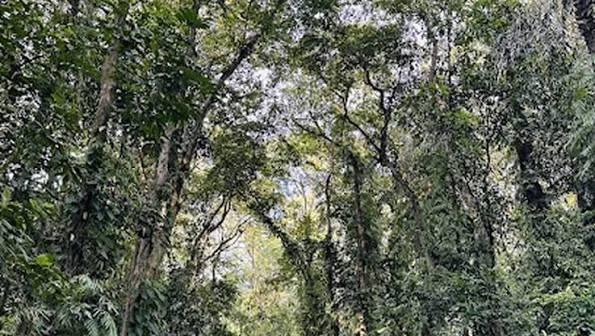
- Vegetation: Assam Valley tropical wet evergreen, semi-evergreen, and eastern seasonal swamp forests.
Biodiversity
- Primates (7 Species): Western hoolock gibbon, slow loris, Assamese macaque, pig-tailed macaque, capped langur, stump-tailed macaque, and rhesus macaque.
- Other Mammals: Leopard, golden jackal, wild pig, barking deer, and giant flying squirrel.
- Birds (80+ Species): Includes Indian pied hornbill, lesser adjutant stork, crested serpent eagle, and green magpie.
Proposed Eco-Sensitive Zone (ESZ)
- Draft Notification: MoEFCC (Ministry of Environment, Forest and Climate Change) proposed a uniform 1 km ESZ around the sanctuary.
- Total Area (32.01 sq km): Covers Bherjan (8.48 sq km), Borajan (14.80 sq km), and Padumoni (8.73 sq km).
- Prohibited Activity: New commercial construction.
- Permitted Activities (with conditions): Local residential housing, traditional livelihoods, road improvement, basic civic facilities, and non-polluting small and cottage industries.
- Governance:
- A Zonal Master Plan within two years of final notification.
- A Monitoring Committee headed by the Tinsukia District Commissioner.
About Eco-Sensitive Zones (ESZs)
- Definition & Purpose: ESZs, also called EFAs (Ecologically Fragile Areas), are buffer zones around Protected Areas (National Parks, Wildlife Sanctuaries, Tiger Reserves, and Biosphere Reserves) that act as shock absorbers between wildlife habitats and human development.
- Legal Provision: Notified by MoEFCC (Ministry of Environment, Forest and Climate Change) under Section 3 of the Environment (Protection) Act, 1986.
- Extent: Generally extends up to 10 km around National Parks and Wildlife Sanctuaries, though actual width varies based on local ecological conditions and specific directions.
- Activity Categories:
- Prohibited: Commercial mining, sawmills, polluting industries, major hydroelectric projects, and commercial use of firewood.
- Regulated: Tree felling, hotels and resorts, changes in farming practices, and electrical/cable infrastructure.
- Permitted: Ongoing farming and horticulture, organic farming, rainwater harvesting, renewable energy, and green technologies.
- Key Principle: ESZs regulate development to reduce ecological harm rather than banning all human activities.
Conservation Challenges
- Habitat Fragmentation: Three isolated forest patches restrict wildlife movement.
- Human Pressure: Encroachment and infrastructure growth threaten forest habitats.
- Genetic Risks: Isolation of primate groups increases the risk of inbreeding and local extinction.
Way Forward
- Effective ESZ Implementation: Regulate development while involving local communities.
- Wildlife Corridors: Connect the three forest patches through tree planting and habitat restoration.
- Regular Monitoring: Track wildlife populations and habitat health regularly.
FAQs
Q1. Which law is used to notify an ESZ?
Ans. Section 3 of the Environment (Protection) Act, 1986.
Q2. Where is the sanctuary and when was it notified?
Ans. Near Tinsukia town in eastern Assam; it was notified on 13 October 1999.
Q3. What forest types are found in the sanctuary?
Ans. Assam Valley tropical wet evergreen, semi-evergreen and eastern seasonal swamp forests.