Prakasam Barrage
Context
All 70 gates of the Prakasam Barrage were recently opened after heavy rainfall associated with Cyclone Murasu increased inflows in the Krishna basin. The event highlighted the barrage’s continuing importance for irrigation regulation and flood discharge management in the Krishna Delta.
Historical Evolution and Location
- Location: Built across the Krishna River at Vijayawada, Andhra Pradesh.
- Historical origin: It replaced the Krishna Anicut (1852–55) associated with Sir Arthur Cotton after the old structure was damaged in the 1952 floods.
- Modern barrage: The present structure was built during 1954–57 and named after Tanguturi Prakasam, the first Chief Minister of Andhra State.
Structure and Irrigation Network
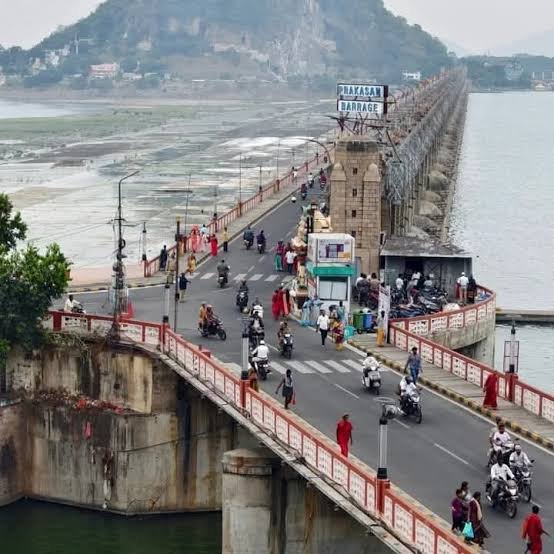
- Regulating structure: The barrage is about 1.2 km long and has 70 gates, which regulate river flows and maintain the water level required for canal diversion.
- Delta irrigation: It supports irrigation across roughly 13 lakh acres in the Krishna Delta, sustaining one of Andhra Pradesh’s major agricultural regions.
- Canal system: Water is distributed through important canals such as the Bandar, Eluru and Ryves canals, extending Krishna water to agricultural and urban areas.
- Navigation linkage: The irrigation network historically connected with the Buckingham Canal system, developed primarily for inland navigation and later used for irrigation and drainage functions.
Economic and Regional Significance
- Agricultural base: Reliable canal irrigation supports intensive cultivation in the Krishna Delta, especially paddy, strengthening farm incomes and regional food production.
- Water distribution: The barrage maintains the head needed to divert Krishna water into canal networks, improving irrigation access across the delta.
- Transport linkage: The road over the barrage connects both banks near Vijayawada, adding mobility value to the irrigation structure.
- Urban-tourism value: The barrage backwaters and Bhavani Island contribute to Vijayawada’s recreational and tourism landscape.
Flood-Management Relevance
- Flow regulation: During high inflows, opening the gates allows excess river water to pass downstream, helping prevent dangerous upstream accumulation.
- Operational limitation: Because the barrage has limited storage, it cannot absorb floods like a large reservoir; its role is mainly regulated discharge, not long-term flood storage.
- Downstream risk: Large releases can raise water levels below the barrage, making forecasting, warnings and embankment monitoring essential.
- Basin coordination: Extreme rainfall increases the need to synchronise upstream reservoir releases with barrage operations, reducing the risk of sudden downstream flood peaks.
FAQs
Q1. Across which river is Prakasam Barrage built?
The Krishna River.
Q2. Where is Prakasam Barrage located?
At Vijayawada in Andhra Pradesh.
Q3. How many gates does the barrage have?
It has 70 gates.
Q4. What is its main function?
Its primary role is irrigation-water regulation and canal diversion, along with flood discharge management.
Q5. Which earlier structure did it replace?
It replaced the Krishna Anicut, built in the 19th century.