Context
The Rhine’s recovery after the 1986 chemical disaster offers lessons for tackling persistent river pollution in India, particularly in the Ganga and Yamuna, highlighting the need for effective pollution control and governance.
The Rhine Case: Transboundary River Basin Management
- Geographical & Economic Profile: Originates in the Swiss Alps and drains into the North Sea across six riparian countries; sustains the Rhine-Ruhr industrial belt and supplies drinking water to ~30 million people.
- Trigger Event (1986): A major fire at the Sandoz chemical plant (Basel, Switzerland) released hazardous chemicals into the river, causing massive aquatic life mortality.
- Institutional Response:
- ICPR (International Commission for the Protection of the Rhine) (est. 1950) formulated the Rhine Action Programme (1987).
- Institutionalized time-bound pollution mitigation goals through inter-state riparian cooperation.
- Targets & Environmental Outcomes:
- Industrial Pollution Abatement: Cut toxic effluent discharges and reduced BOD (Biochemical Oxygen Demand) and COD (Chemical Oxygen Demand)
- Ecosystem Restoration: Launched the Salmon 2000 Programme, successfully reintroducing Atlantic salmon and restoring aquatic biodiversity.
- Water Resource Security: Maintained drinkable water quality parameters and ensured adequate ecological minimum flows.
- Emerging Pollutants: Integrated real-time tracking for micropollutants and pharmaceutical residues.
- Key Lessons for River Governance:
- Need for a permanent River Basin Organisation (RBO) to manage multi-state water resources.
- Implementation of measurable targets, public disclosure, and transparent monitoring.
- Strict enforcement of industrial discharge standards, the PPP (Polluter Pays Principle), and automated early-warning spill detection systems.
Status of Rivers in India
- CPCB Assessment: Identified 296 polluted river stretches across 271 rivers in 32 States/UTs, showing a marginal decline from 351 (2018) and 311 (2022).
- Pollution Severity:
- Priority I Stretches: 37 most polluted stretches identified (reduced from 46).
- State-wise Distribution: Maharashtra recorded the highest number of polluted stretches (54).
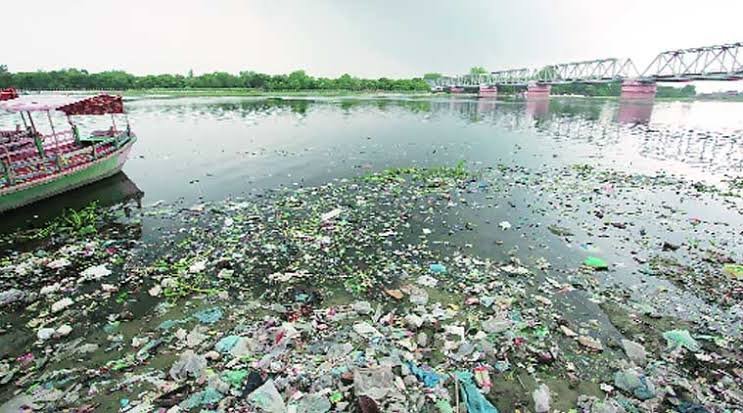
- Yamuna Hotspot: The Delhi stretch (Palla–Asgarpur) remains categorized under Priority I, recording a peak BOD (Biochemical Oxygen Demand) of 83 mg/L.
- Pollution Criteria: The CPCB (Central Pollution Control Board) classifies a stretch as polluted when BOD exceeds 3 mg/L (bathing water standard) at two or more monitoring sites.
- Water Quality Trend: Overall recovery remains slow, with locations unfit for bathing dropping only marginally from 815 to 807.
Policy Framework for River Governance
- Statutory Framework:
- Water Act, 1974: Created the CPCB and SPCBs (State Pollution Control Boards) for water pollution regulation.
- Environment (Protection) Act, 1986: Provides central statutory powers for nationwide environmental management.
- Historical River Action Programmes:
- Ganga Action Plan (1986): India’s pioneer river basin cleanup initiative.
- Yamuna Action Plan (1993): Dedicated sub-basin cleaning drive.
- Ganga Rejuvenation Architecture:
- NMCG (National Mission for Clean Ganga): Formed in 2011 as the main execution agency for basin restoration.
- Namami Gange (2014): Flagship umbrella programme integrating sewage treatment infrastructure, riverfront development, and aquatic biodiversity.
- NGC (National Ganga Council): Chaired by the Prime Minister, constituted in 2016 under the EPA (Environment Protection Act), 1986, replacing the NGRBA (National Ganga River Basin Authority).
Analysis: Why India Lags in River Governance
- Sewage Treatment Deficit: Insufficient STP (Sewage Treatment Plant) capacity, with existing units running under-utilized.
- Enforcement Gaps: Lax monitoring of industrial discharge standards by pollution control boards.
- Fragmented Governance: Divided mandates across Centre, state, and local bodies, combined with irregular top-level oversight like infrequent NGC (National Ganga Council) meetings.
- Compromised River Flow: Excessive damming and extraction reduce ecological flows, weakening the river’s natural dilution capacity.
- Infrastructure Bias: Focus remains heavily on building treatment plants rather than stopping pollution at the source.
Way Forward
- Unified Basin Management: Empower River Basin Authorities for unified planning and regular high-level progress reviews.
- At-Source Pollution Control: Enforce strict industrial effluent norms and ensure mandatory sewage treatment before river entry.
- Measurable Goals: Set time-bound targets for BOD (Biochemical Oxygen Demand) and DO (Dissolved Oxygen) alongside public data tracking.
- Mandatory Ecological Flows: Enforce statutory minimum river flows downstream of all dams and barrages.
- Smart Monitoring: Deploy real-time water quality monitoring to track industrial waste and micropollutants.
FAQs
Q1. What do BOD and COD measure?
Ans. BOD measures oxygen used by microbes to decompose organic matter, while COD measures oxygen required to chemically oxidise pollutants. Higher values indicate greater pollution.
Q2. What is a polluted river stretch under CPCB norms?
Ans. A stretch where BOD exceeds 3 mg/L at two or more locations.
Q3. Who heads the National Ganga Council?
Ans. The Prime Minister.
Q4. What is the main lesson from the Rhine for India?
Ans. Adopt basin-wide coordination, measurable targets and strict industrial discharge controls instead of fragmented, project-based efforts.