About Tides
- Definition: Periodic rise and fall of sea levels driven primarily by the combined gravitational pull of the Moon and the Sun, alongside Earth’s rotation.
- Flood Tide (High Tide): Stage when sea levels rise and water advances towards the coastline.
- Ebb Tide (Low Tide): Stage when sea levels recede and water retreats away from the coast.
- Tidal Range (amplitude): The vertical height difference between consecutive high tide and low tide levels.
- Occurrence Beyond Oceans: Tides also affect the atmosphere, large lakes, rivers, and solid Earth crust, though they are most pronounced in oceans.
- Global Extreme: Bay of Fundy (Canada) records the highest tidal range (~16 m) due to its funnel-shaped bay geometry that traps and amplifies incoming water.
- Tidal Potential in India: Large tidal ranges in the Gulf of Khambhat, Gulf of Kutch, and Sundarbans make them key prospective sites for tidal energy
Forces Causing Tides & Tidal Formation Dynamics
- Distance-Force Law: The tide-generating force is inversely proportional to the cube of the distance () from the attracting celestial body, whereas standard gravitational attraction follows the inverse-square law ().
- Moon vs. Sun Influence: The Moon exerts a much stronger tidal effect than the Sun due to its close proximity to Earth; the Sun’s tidal force is only about 46% of the Moon’s.
- Earth-Moon Barycentre: Earth and Moon revolve around a common centre of mass called the barycentre, located inside Earth’s mantle about 4,700 km from its centre.
- Formation of Tidal Bulges: Differential gravitational pull creates the tide-generating force, producing two opposing horizontal water bulges:
- Direct Tide: The bulge facing directly towards the Moon.
- Indirect Tide: The bulge forming on the opposite side of Earth.
- Role of Earth’s Rotation: Earth’s daily rotation carries different locations through these static tidal bulges, producing alternating high and low tides.
- Tidal Timing & Delay: Successive high tides occur approximately 12 hours and 25 minutes apart, shifting about 50 minutes later each day due to the Moon’s orbital movement.
Factors Causing Complex Tides
- Moon’s Orbital Motion: The Moon’s revolution around Earth causes the timing of high and low tides to shift daily.
- Sun-Earth-Moon Alignment: Changing relative positions of the celestial bodies continuously modify tidal ranges and patterns.
- Uneven Land-Water Distribution: The irregular global configuration of continents and oceans obstructs and disrupts uniform tidal flow.
- Ocean Basin Characteristics: Local coastline shapes, water depth, and seafloor topography create significant regional differences in tides.
- Theoretical Limitations: While Newton’s Equilibrium Theory provided the first baseline explanation using gravitation, no single theory completely accounts for all complex local tidal anomalies.
Spring and Neap Tides
- Combined Gravitational Effect: Tides result from the combined gravitational pull of the Moon and the Sun.
- Spring Tides: Produce the largest tidal range, featuring exceptionally higher high tides and lower low tides.
- Cause (Syzygy): Caused by constructive interference when the Earth, Moon, and Sun align in a straight line.
- Occurrence: Takes place twice a month during the new moon and full moon
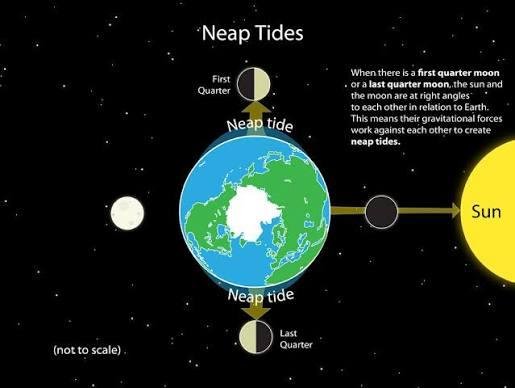
- Neap Tides: Produce the smallest tidal range, featuring lower high tides and higher low tides.
- Cause (Quadrature): Caused by destructive interference when the Sun and Moon are at right angles relative to Earth.
- Occurrence: Takes place twice a month during the first and third (last) quarter phases of the Moon.
- Lunar Distance Effect (Perigee & Apogee): Tidal ranges are enhanced when the Moon is at perigee (closest to Earth) and diminished when it is at apogee (farthest from Earth).
FAQs
Q1. Which place has the highest tidal range in the world?
Ans. The Bay of Fundy, Canada, with a tidal range of about 16 m, due to its funnel-shaped coastline.
Q2. Why do partly enclosed bays have higher tides?
Ans. Their narrow shape confines incoming seawater, causing the water level to rise.
Q3. What is the barycentre of the Earth–Moon system?
Ans. The common centre of mass around which both Earth and the Moon revolve; it lies about 4,700 km from Earth’s centre, inside Earth.
Q4. What is the immediate cause of tidal bulges?
Ans. The tidal force, arising from differences in the Moon’s gravitational pull across Earth, produces the tidal bulges.
Q5. When do spring tides occur?
Ans. At new moon and full moon, when the Sun, Moon and Earth are aligned.