Context
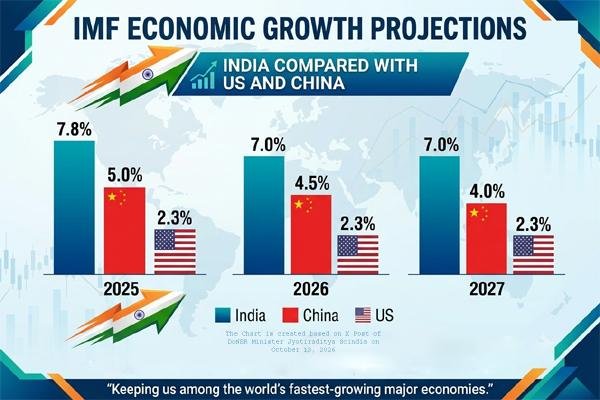
The International Monetary Fund (IMF) has projected strong economic growth for India, at around 7%. This reflects the expansion of India’s economic output. However, a high GDP growth rate does not automatically mean that all sections of society are experiencing better living conditions. For example, an economy may grow rapidly while income inequality remains high and unemployment persist.
Understanding GDP and Development
- Gross Domestic Product (GDP) is the total monetary value of all final goods and services produced within a country’s geographical boundaries during a given period. It is used to measure the size and growth of an economy.
| What does GDP tell us?
1. Whether economic output is increasing or decreasing. 2. The overall size of the economy. 3. The pace of economic growth. 4. Changes in production across different sectors. |
What does GDP not directly tell us?
1. How income is distributed among people. 2. Whether enough quality jobs are being created. 3. Whether people can afford essential goods and services. 4. Whether healthcare and education are improving. 5. Whether economic growth is environmentally sustainable. |
- Development is a broader concept that refers to improvements in people’s economic, social and overall well–being.
- It includes higher and more secure incomes, better employment opportunities, access to quality education and healthcare, reduction in poverty and inequality, gender equality, social justice, better living conditions and environmental sustainability.
Why Does High GDP Growth Not Always Mean Development?
- Rising GDP and Persistent Inequality: Economic growth does not guarantee that its benefits are equally distributed. This can be showcased by K-shaped Economy.
- K-shaped economy refers to a situation where different sectors or sections of society experience unequal economic recovery or growth. The upward arm of the K represents sectors or groups experiencing rapid growth. The downward or weaker arm represents groups experiencing stagnation or decline.
- Growth–Employment Disconnect: Economic growth does not always generate sufficient employment. Even when jobs are created, they may be low-paying, temporary, without social security or without adequate job protection. Therefore, the quality of employment is as important as the number of jobs created.
- Informalisation of Employment: It refers to work that generally lacks adequate formal arrangements, such as written employment contracts, social security etc. It affects development as people working in this sector have uncertain income, limited access to health & retirement benefits, poor working conditions & greater vulnerability to economic shocks.
- Jobless Growth and Widening Inequality: Jobless growth refers to a situation where GDP increases without a corresponding increase in employment. This can widen inequality because the benefits of growth may accrue disproportionately to business owners, capital holders and highly skilled workers.
- High GDP Growth but Weak Welfare Outcomes: Economic growth may not translate into better living standards if the cost of essential goods and services rises faster than people’s incomes. Therefore, development must be assessed through real purchasing power, access to public services and overall well-being, rather than income or GDP growth alone.
Other Factors Affecting Development
- Productive Investment
- It refers to investment that increases an economy’s productive capacity, improves efficiency and generates sustainable economic benefits.
- Importance: India needs investment that creates a virtuous cycle.
- Productive investment à Higher productivity and employment à Higher wages and household incomes à Stronger consumption and domestic demand à Sustained and inclusive economic growth
- Macroeconomic Vulnerability
- It refers to an economy’s exposure to shocks that can disturb its growth, prices, currency, investment and financial stability. India’s economy can be affected by both domestic and external factors.
- Examples: Geopolitical conflicts, Imported inflation, Currency volatility, Capital outflows, and Global economic slowdown.
- Effect on Development: It can affect development as it may lead to inflationary pressures that can reduce people’s purchasing power. This will affect the people’s actual economic well-being.
- Intersectional Approach to Development
- An intersectional approach recognises that people experience economic opportunities and disadvantages differently depending on multiple social and economic factors. These include gender, caste, class and income, region, disability, rural or urban location.
- Example: Women may face additional barriers due to unpaid care responsibilities, wage differences, safety concerns and limited access to formal employment.
- This approach helps policymakers identify which groups are being left behind and design targeted interventions instead of assuming that economic growth benefits everyone equally.
How Should India Measure Development Beyond GDP?
GDP remains important, but it should be supplemented with indicators that capture people’s actual living conditions.
| Indicator | What does it measure? |
| GDP per capita | Average economic output per person; does not show income distribution |
| Human Development Index (HDI) | Health, education and standard of living |
| Multidimensional Poverty Index (MPI) | Deprivations in health, education and living standards |
| Gini coefficient | Degree of income or consumption inequality |
| Labour Force Participation Rate (LFPR) | Share of the working-age population that is working or seeking work |
| Real wages | Purchasing power of workers’ earnings after accounting for inflation |
| Gender-related indicators | Differences in opportunities & outcomes between men and women |
| Environmental indicators | Pollution, emissions and sustainability of economic activity |
Way Forward: Making Economic Growth Inclusive
- Promote Employment-Intensive Sectors: Encourage labour-intensive industries, support MSMEs and promote manufacturing alongside services.
- Improve Quality of Employment: Expand formal jobs, ensure fair wages and social security, and strengthen protections for gig workers.
- Invest in Human Capital: Improve education, healthcare, nutrition, vocational training and skill development.
- Reduce Income and Regional Inequalities: Promote balanced regional development, improve infrastructure and ensure equal economic opportunities for women and disadvantaged communities.
- Strengthen Domestic Demand: Improve real wages and household purchasing power to boost consumption and encourage investment.
- Build Macroeconomic Resilience: Diversify energy imports and exports, strengthen renewable energy and foreign exchange reserves, and protect vulnerable households from inflation.
- Adopt Broader Development Indicators: Assess progress through HDI, MPI, employment, wages, inequality, access to basic services and environmental sustainability.
Conclusion
GDP growth is an important indicator of economic performance, but it is not synonymous with development. India’s objective should be to move from high economic growth to inclusive, employment-intensive and human-centred development.
Frequently Asked Questions (FAQs)
Q1. Why does high GDP growth not necessarily indicate economic development?
GDP measures economic output but does not capture income distribution, employment quality, poverty, inequality or access to essential services. Therefore, high growth may coexist with poor living conditions.
Q2. What is a K-shaped economy?
A K-shaped economy refers to unequal economic recovery or growth, where certain sectors or income groups experience rapid growth while others face stagnation or declining economic conditions.
Q3. What is jobless growth, and how does it affect inequality?
Jobless growth occurs when GDP increases without a corresponding rise in employment. It can widen inequality as growth benefits disproportionately accrue to business owners, capital holders and highly skilled workers.
Q4. How does informalisation of employment affect development?
Informal employment often lacks written contracts, social security and job protection. It results in uncertain incomes, poor working conditions and greater vulnerability to economic shocks, affecting workers’ overall well-being.
Q5. Which indicators can help India measure development beyond GDP?
India can use HDI, MPI, Gini coefficient, Labour Force Participation Rate, real wages, gender-related indicators and environmental indicators to assess living standards, inequality and sustainability.