Context
A glacial lake outburst from Shintaphu Lake in Bhutan’s Gasa district on 29 October 2026 sent excess water downstream through the Punatsangchhu–Sankosh system. More than 10,000 people were precautionarily moved to safer locations in North Bengal, while authorities monitored the river for a possible flood surge.
River System and Course
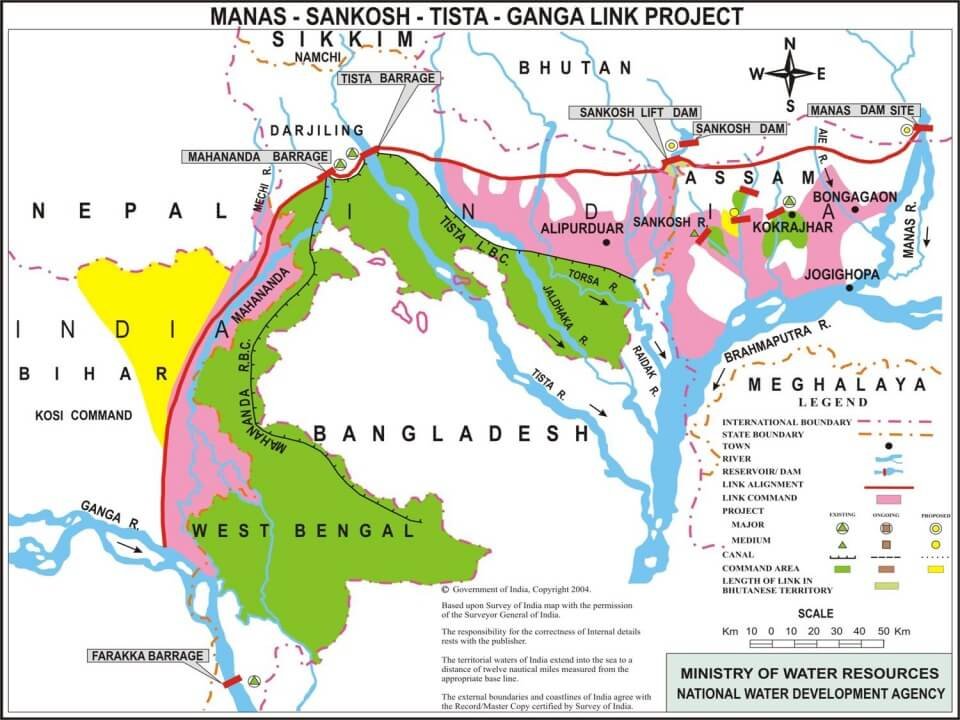
- Transboundary river: The Sankosh flows from Bhutan into India and belongs to the larger Brahmaputra river system, linking Himalayan headwaters with the Assam–Bengal plains.
- Name in Bhutan: Its Bhutanese course is known as Punatsangchhu/Puna Tsang Chhu, while the downstream river in India is called the Sankosh.
- Formation: The Pho Chhu and Mo Chhu, originating in northern Bhutan, meet at Punakha Dzong to form the Punatsangchhu.
- Southward course: It flows through Wangdue Phodrang, Tsirang and Sarpang before entering the Indian plains.
- Boundary role: In India, the Sankosh forms part of the West Bengal–Assam boundary, giving it geographical importance in the eastern Himalayan foothills.
- Lower course: It joins Raidak-II and ultimately drains into the Brahmaputra system in Bangladesh, where the lower channel is known as the Gangadhar.
Physical and Hydrological Features
- Himalayan catchment: Its upper basin is fed by glacial, snowmelt and rainfall sources, making river discharge sensitive to both seasonal precipitation and cryospheric changes.
- Steep upper terrain: Bhutan’s mountainous relief gives the upper river a high gradient, allowing sudden flood pulses to move rapidly downstream.
- Plain-course transition: On entering India, the gradient decreases; slower flow and sediment deposition increase the exposure of low-lying floodplains during high discharge.
- Transboundary hydrology: Because most of the catchment lies upstream in Bhutan, flood conditions in India can be strongly influenced by rainfall and glacial events across the international boundary.
GLOF and Current Relevance
- GLOF mechanism: A Glacial Lake Outburst Flood occurs when stored water escapes suddenly from a glacial lake, creating a rapid downstream flood wave.
- 2026 event: The Shintaphu Lake outburst released about 7.4 million cubic metres of water, according to information shared through Bhutan’s NCHM and India’s Central Water Commission; the Sankosh accommodated the surge without major inundation in North Bengal.
- Downstream risk: The event demonstrates how a high-altitude hazard in Bhutan can quickly threaten settlements and infrastructure in West Bengal and Assam.
- Early-warning value: Cross-border hydrological information, glacial-lake monitoring and timely evacuation are therefore critical for reducing transboundary GLOF risk. India has separately strengthened Himalayan GLOF preparedness through monitoring and early-warning measures.
FAQs
Q1. Sankosh belongs to which major river system?
The Brahmaputra river system.
Q2. What is Sankosh called in Bhutan?
It is known as the Punatsangchhu/Puna Tsang Chhu.
Q3. Which rivers form the Punatsangchhu?
The Pho Chhu and Mo Chhu.
Q4. Which Indian States does the Sankosh separate in part of its lower course?
West Bengal and Assam.
Q5. Why was Sankosh River in news in 2026?
A glacial lake outburst in Bhutan caused a downstream flood surge and precautionary evacuations in North Bengal.