Context
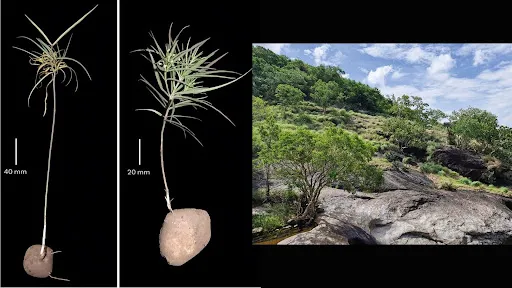
Botanists from the Botanical Survey of India (BSI) recently discovered and described a new plant species, Ceropegia tamilnaduensis, from the Nellai Wildlife Sanctuary in Tamil Nadu.
About Ceropegia tamilnaduensis
- Type: Perennial herb (a plant that lives for more than two years).
- Location: Hill slopes of Nellai Wildlife Sanctuary, Tamil Nadu.
- Habitat: Found at an elevation of approximately 380 metres, near a stream surrounded by evergreen forest.
- Distinctive Features
- Flowers: Solitary flowers emerge from the leaf axils, with drooping stems.
- Corona: The central corona, a structure inside the flower, is hairless (glabrous).
- Pollinia: Its pollinial corpusculum, a structure involved in pollen transfer, has lateral wings.
- Seeds: Produces unusually large seeds, reaching up to 14 mm in length.
- Similarity to other species: It resembles Ceropegia annamacharyae in flower structure and Ceropegia swarupa in its narrow leaves and overall form.
About Nellai Wildlife Sanctuary
- Location: Tamil Nadu, in the southern Western Ghats.
- Declared: 2015.
- Landscape: Characterised by mountainous terrain, forests, streams and rich biodiversity.
- Important Peaks: Sivagiri Mala (1,748 m), Totti Malai, Kalli Malai and Aruitalai Mottai.
- Rivers and Drainage: The sanctuary lies within the wider southern Western Ghats landscape, which supports several important river systems. The Tamirabarani River system is particularly relevant to this region.
- Flora: Important plant groups and species include Sandalwood (Santalum album), Sal-related forest species (Shorea), Teak (Tectona grandis), Shola forest vegetation, Mangroves in suitable coastal habitats and Neelakurinji (Strobilanthes kunthiana).
- Fauna: Important wildlife species associated with the sanctuary and the surrounding Western Ghats landscape include Nilgiri Tahr, Bengal Tiger, Asian Elephant, Lion-tailed Macaque, Grizzled Giant Squirrel, Gaur and Sloth Bear.
Frequently Asked Questions (FAQs)
Q1. What is Ceropegia tamilnaduensis?
It is a newly discovered perennial herb identified by botanists from the Botanical Survey of India in Nellai Wildlife Sanctuary, Tamil Nadu.
Q2. What are the distinctive features of Ceropegia tamilnaduensis?
It has solitary flowers with a hairless corona, lateral wings on the pollinial corpusculum and unusually large seeds measuring up to 14 mm.
Q3. At what altitude and habitat was the Ceropegia tamilnaduensis species discovered?
It was found at approximately 380 metres above sea level, on a hill slope near a stream surrounded by evergreen forest.
Q4. Where is Nellai Wildlife Sanctuary located, and when was it declared?
It is located in the southern Western Ghats of Tamil Nadu and was declared a wildlife sanctuary in 2015.