Context
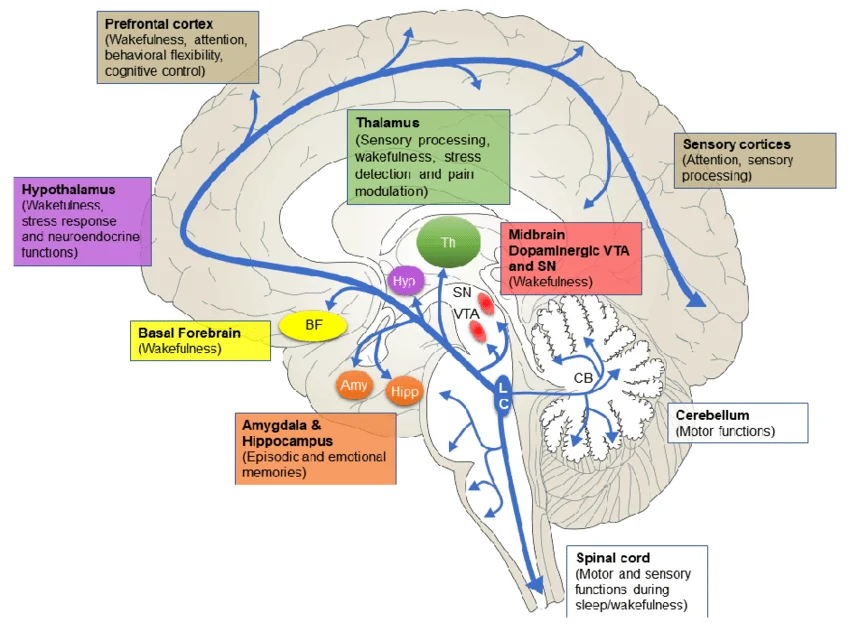
- A 2026 study in mice found that the locus coeruleus (LC) does not simply send one uniform norepinephrine signal across the brain.
- Instead, different groups of LC neurons follow distinct pathways, suggesting a more specialised role in learning, attention and behaviour.
What is the Locus Coeruleus?
- The locus coeruleus is a small cluster of nerve cells located in the dorsal pons of the brainstem.
- It is a major source of norepinephrine (noradrenaline) across the central nervous system.
- The name means “blue place”, referring to the bluish pigmentation of its neurons.
- The LC helps regulate arousal, attention, learning, memory, sleep-wake cycles and stress responses.
- Its widespread connections make it an important neuromodulatory centre, influencing activity across the brain and spinal cord.
What Did the New Study Find?
- Earlier models often viewed the LC as a broad broadcast system that released similar norepinephrine signals across the brain.
- The new study found that LC neurons are topographically organised, with different groups projecting to different regions.
- Dorsal LC neurons preferentially connect with the forebrain and cerebral cortex, while ventral LC neurons project more toward the brainstem and spinal cord.
- Cortex-projecting neurons showed activity linked with choice changes and reward-prediction signals during learning.
- The findings therefore suggest that LC signalling is pathway-specific rather than uniformly distributed.
Significance of the Discovery
- Revised understanding: The LC appears to function as a collection of specialised circuits rather than as one uniform signalling system.
- Functional precision: Different pathways may allow norepinephrine to influence specific behaviours and cognitive processes according to the situation.
- Neuroscience value: Mapping these circuits improves understanding of how neuromodulatory systems coordinate complex behaviour.
- Therapeutic potential: Better knowledge of LC pathways could eventually support treatments that target selected circuits instead of affecting the entire norepinephrine system.
Relevance to Brain Disorders
- ADHD, anxiety and depression: Norepinephrine is involved in attention, mood and stress regulation, making LC pathways relevant to these conditions.
- Alzheimer’s disease: The LC is among the earliest brain regions to show Alzheimer-related pathological changes and neuronal degeneration.
- Loss of LC neurons can disturb norepinephrine signalling and may contribute to cognitive and behavioural disturbances.
- However, the latest pathway-specific evidence comes from mice, so its direct clinical relevance to humans still requires further research.
FAQs
Q1. Where is the locus coeruleus located?
In the dorsal pons of the brainstem.
Q2. Which neurotransmitter is mainly associated with the LC?
Norepinephrine (noradrenaline).
Q3. What are the major functions of the LC?
It helps regulate attention, arousal, learning, memory, sleep and stress responses.
Q4. What did the 2026 study reveal about the LC?
That different LC neuron groups follow distinct pathways with specialised roles.
Q5. Why is the LC important in Alzheimer’s disease?
It is among the earliest regions to show Alzheimer-related pathological changes and neuronal degeneration.