Context
- The Department of Social Justice and Empowerment recently reported that 1,87,305 candidates were trained and 96,162 placed under PM-DAKSH during 2020–21 to 2023–24.
- From 2024–25, PM-DAKSH was subsumed under PMKVY to avoid duplication in skill-training programmes.
Scheme Design and Eligibility
- Pradhan Mantri Dakshata Aur Kushalta Sampann Hitgrahi (PM-DAKSH) was launched in 2020–21 as a Central Sector Scheme of the Ministry of Social Justice and Empowerment.
- Its objective was to provide free, quality skill training that could improve access to wage employment or self-employment.
- Beneficiaries included SCs, OBCs, EWSs, De-notified Tribes, Safai Karamcharis and waste pickers.
- Eligible candidates were generally 18–45 years old. OBC and EWS candidates required annual family income below ₹3 lakh, while no income ceiling applied to SCs, DNTs and Safai Karamcharis/waste pickers.
- Implementation was carried out through NSFDC, NBCFDC and NSKFDC, corporations under the Department of Social Justice and Empowerment.
Training and Employment Mechanism
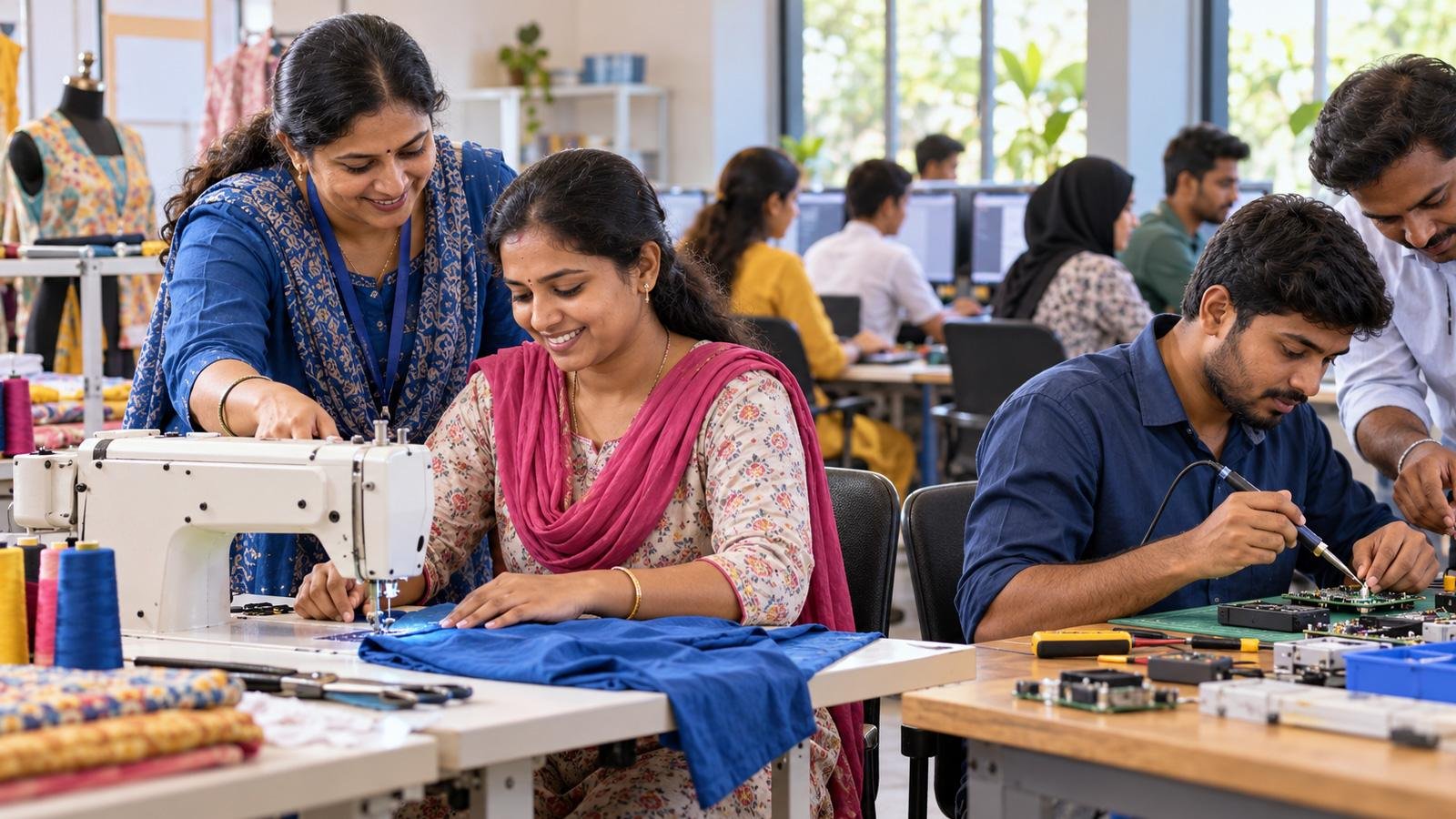
- Training covered Short-Term Training, Up-skilling/Re-skilling and Entrepreneurship Development Programmes.
- Courses were NSQF-compliant and selected according to market demand, geographical conditions and sector-specific skill requirements, improving their local employment relevance.
- Under Short-Term Training, institutes were required to ensure wage or self-employment for at least 70% of trained candidates; failure could lead to forfeiture of the final 30% instalment of training cost.
- Implementing corporations also provided eligible beneficiaries with loan assistance and handholding support, linking skilling with entrepreneurship and self-employment.
Performance and Current Status
- Between 2020–21 and 2023–24, 1.87 lakh candidates were trained and 96,162 placed, indicating substantial employment linkage, though placement remained below the total number trained.
- An evaluation found that over 90% of beneficiaries considered the training aligned with their career goals and local labour-market needs.
- From 2024–25, the scheme was merged with PMKVY because PM-DAKSH job roles were already drawn from the Skill India Digital Hub and overlapped with PMKVY.
Significance
- Targeted social inclusion: The scheme focused skilling resources on disadvantaged communities that may face weaker access to formal training and employment.
- Outcome-linked skilling: Linking Short-Term Training payments to employment outcomes pushed training institutes towards measurable placement performance.
- Skill-to-enterprise linkage: Credit and handholding support extended the scheme beyond training to self-employment and income generation.
- Policy convergence: Integration with PMKVY reduces overlapping schemes and can create a more coordinated national skilling framework.
FAQs
Q1. Which ministry administered PM-DAKSH?
The Ministry of Social Justice and Empowerment.
Q2. What type of scheme was PM-DAKSH?
A Central Sector Scheme.
Q3. Who were its main beneficiaries?
SCs, OBCs, EWSs, DNTs, Safai Karamcharis and waste pickers.
Q4. Which agencies implemented the scheme?
NSFDC, NBCFDC and NSKFDC.
Q5. What happened to PM-DAKSH from 2024–25?
It was subsumed under PMKVY to reduce duplication in skill-training programmes.