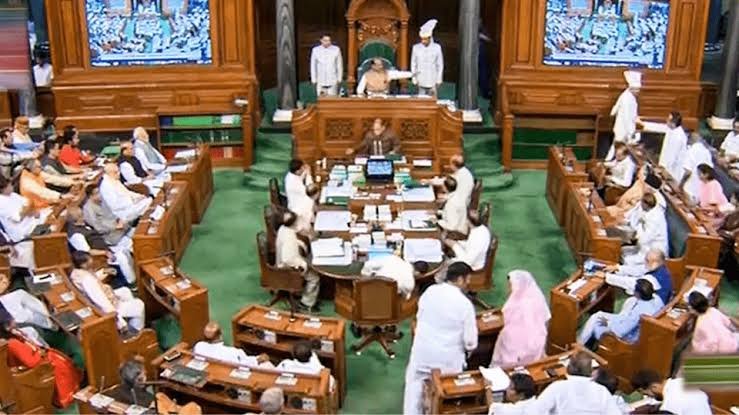
A “Special Session” of Parliament is a unique legislative meeting convened outside the three regular annual sessions (Budget, Monsoon, and Winter) to address urgent matters or mark historic national milestones. Recently, Parliament was convened for a special session to fast-track a 33% reservation for women in legislatures and redraw constituency boundaries (delimitation) before the 2029 general election.
Significance of special session
A special session is a sitting called outside Parliament’s usual Budget, Monsoon and Winter schedule to discuss a specific issue. The Constitution does not formally define the term.
- Bypasses regular calendar: Convened outside normal schedules to focus the country’s attention on urgent national matters.
- Suspends standard business: Eliminates procedural hurdles like Question Hour or Zero Hour to fast-track debated legislation.
- Pushes structural reforms: Used historically for massive constitutional shifts, such as the GST rollout or altering Parliament’s size.
- Pre-defined government agenda: Restricts parliamentary debate strictly to items specified by the ruling Cabinet.
- Signals high stakes: Demonstrates extreme political urgency, forcing rapid voting on critical legal or federal updates.
Constitutional Provisions
- Article 85: The President summons and prorogues Parliament and may dissolve the Lok Sabha. No more than six months may pass between the last sitting of one session and the first sitting of the next.
- No fixed calendar: The Constitution does not prescribe the number of sessions. Parliament usually meets for Budget, Monsoon and Winter Sessions.
- No formal definition: The Constitution and parliamentary rule books do not define a special session or set detailed rules for calling one.
- Article 352: The 44th Amendment (1978) provided for a special sitting that one-tenth of Lok Sabha members can demand to consider rejecting an Emergency proclamation.
- Adjournment vs prorogation: Adjournment sine die ends a sitting without fixing the next date; prorogation formally ends the session by the President’s order.
Parliamentary Sessions in India
India generally holds three regular parliamentary sessions every year:
- Budget Session: Usually begins in late January and continues until April or May. It focuses on the Union Budget, financial matters and legislative business.
- Monsoon Session: Usually held during July and August to discuss legislation, government policies and public issues.
- Winter Session: Generally held during November and December to consider legislative and other parliamentary business.
In 1955, the General Purposes Committee of the Lok Sabha recommended a fixed annual parliamentary calendar. Although the Cabinet agreed to the proposal, it was not implemented.
Historical Precedents of Special Sessions
India has convened special sessions or sittings on several important occasions:
- 1947: Parliament met on the eve of Independence to mark the transfer of power from British rule to India.
- 1962: A special parliamentary sitting was held in the context of Chinese aggression during the India–China War.
- 1992: A midnight sitting was held to commemorate the 50th anniversary of the Quit India Movement.
- 1997: A six-day special session was convened to commemorate the 50th anniversary of India’s Independence.
Key Challenges
- Political differences: Disagreements between the government and opposition may limit meaningful debate.
- Limited deliberation: A short session may not provide sufficient time for detailed examination of complex issues.
- Unclear conventions: The absence of a comprehensive framework for general special sessions may lead to differences over their purpose and timing.
- Possibility of political use: The decision to convene a session may become a subject of political controversy.
Way Forward
- Establish clearer conventions regarding the circumstances in which special sessions may be convened.
- Ensure adequate opportunities for discussion and participation by the opposition.
- Provide sufficient time for examining important legislative proposals.
- Use special sessions to strengthen parliamentary accountability and democratic deliberation.
Conclusion
Special sessions can strengthen parliamentary democracy by enabling deliberation on matters of exceptional importance. Their effectiveness depends on meaningful debate, political consensus and the responsible use of parliamentary institutions.
FAQs
Q1. Is the term “Special Session” explicitly mentioned in the Indian Constitution?
Ans: No. The Constitution does not explicitly define a general special session of Parliament.
Q2. Which Article deals with the summoning of Parliament?
Ans: Article 85 empowers the President to summon Parliament, prorogue its Houses and dissolve the Lok Sabha.
Q3. What is the maximum gap between two sessions of Parliament?
Ans: The gap between the last sitting of one session and the first sitting of the next session must not exceed six months.
Q4. Who summons a special session of Parliament?
Ans: The President summons Parliament on the advice of the Union government.
Q5. How many regular sessions does Parliament usually hold in a year?
Ans: Parliament generally holds three regular sessions: the Budget Session, Monsoon Session and Winter Session.