Context
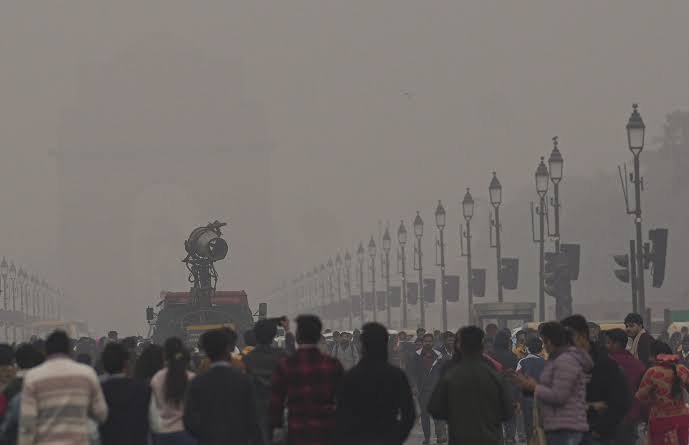
Delhi’s AQI rose from 179 to 244, entering the poor category and prompting the activation of Stage I of GRAP, the emergency framework for controlling air pollution in Delhi-NCR.
About Graded Response Action Plan (GRAP)
- Emergency Framework: A four-stage mechanism coordinated by the Commission for Air Quality Management (CAQM) to control air pollution in Delhi-NCR.
- Cumulative Restrictions: Operates on an incremental mandate where measures from lower stages remain active alongside higher-stage restrictions as the AQI (Air Quality Index)
- Institutional Coordination: The Commission for Air Quality Management (CAQM) coordinates GRAP implementation across Delhi-NCR, involving Delhi, Haryana, Uttar Pradesh and Rajasthan, under the broader framework of judicial directions in C. Mehta v. Union of India.
- AQI Categories and Key GRAP Measures:
| AQI | Category | Stage | Key Measures |
| 201–300 | Poor | I | Mechanised sweeping, water sprinkling, anti-smog guns, construction-dust control, Pollution Under Control (PUC) checks and ban on open waste burning. |
| 301–400 | Very Poor | II | Restrictions on Diesel Generator (DG) sets, higher parking fees, electric heaters for security staff and increased public transport frequency. |
| 401–450 | Severe | III | Restrictions on non-essential Construction and Demolition (C&D) activities and older polluting vehicles; hybrid or online primary classes. |
| Above 450 | Severe+ | IV | Restrictions on non-essential diesel trucks, possible Odd-Even vehicle measures and work-from-home directions. |
Drivers of Winter Air Pollution in Delhi-NCR
- Geographical Basin Effect: Location in the landlocked Indo-Gangetic Plain (IGP) creates a natural topographic bowl that traps transboundary pollution.
- Thermal Inversion & Stagnant Air: Winter cooling creates a thermal inversion layer locking pollutants near the surface, while low wind speeds prevent dispersion.
- Compounding Anthropogenic Sources: Multi-sectoral emissions spike from agricultural stubble burning, vehicular exhaust, industrial activity, C&D (Construction and Demolition) dust, and waste burning.
- Lack of Natural Scavenging: Low winter rainfall reduces wet deposition, limiting the natural removal of airborne particulate matter (PM2.5 and PM10).
Significance of GRAP
- Proactive Interventions: Uses AQI (Air Quality Index) levels and weather forecasts to trigger restrictions in advance, preventing sudden spikes in air pollution.
- Inter-Agency Coordination: Provides a single institutional framework under CAQM (Commission for Air Quality Management) to align multi-state actions in Delhi-NCR.
- Public Health Protection: Delivers targeted, short-term emission cutbacks during extreme smog episodes to minimize toxic exposure.
- Step-by-Step Measures: Avoids complete economic disruption by enforcing progressively stricter measures across its four stages.
Challenges in Implementing GRAP
- Reactive Emergency Tool: Functions as a temporary emergency mechanism rather than a long-term solution, failing to address year-round baseline emissions.
- Uneven Cross-Border Enforcement: Lacks uniform monitoring and compliance across different Delhi-NCR (National Capital Region)
- Heavy Meteorological Dependency: Unfavorable winter weather like thermal inversion can easily override temporary emission rollbacks.
- Unresolved Sectoral Sources: Fails to eliminate persistent pollution sources like vehicular exhaust, industrial emissions, road dust, and stubble burning.
Way Forward
- Airshed Governance: Shift from city-centric measures to regional Airshed Management, uniting Delhi-NCR (National Capital Region) states under a unified atmospheric plan.
- Transit Decarbonization: Scale up EVs (Electric Vehicles), expand public bus fleets, and strictly enforce BS-VI (Bharat Stage VI) vehicle emission standards.
- Crop Residue Management: Address stubble burning via affordable in-situ machinery (Happy Seeder), bio-decomposers, and MSP (Minimum Support Price) backed crop diversification.
- Dust & Industrial Abatement: Mandate continuous real-time monitoring (CEMS), mechanized road sweeping, anti-smog guns, and strict construction dust management.
- Institutional Coordination: Empower CAQM (Commission for Air Quality Management) for cross-state enforcement and targeted public AQI (Air Quality Index)
Additional Information: Commission for Air Quality Management (CAQM)
- Statutory Genesis: Established under the CAQM Act, 2021, permanently replacing earlier executive ordinances.
- Jurisdictional Reach: Covers Delhi-NCR and adjoining areas across Punjab, Haryana, Rajasthan, and Uttar Pradesh affecting NCR’s airshed.
- Institutional Predecessor: Replaced the judicial committee EPCA (Environment Pollution (Prevention and Control) Authority).
- Multi-Member Structure: Comprises a Chairperson, central/state government representatives, technical experts, and NGO members.
- Statutory Enforcement Powers: Issues binding directions, overrides state orders, and enforces closure of polluting industrial units or activities.
- Penal System & Farmer Immunity: Imposes up to 5 years imprisonment, ₹1 crore fine, or both for non-compliance, with statutory exemption for farmers regarding stubble burning.
- Operational Mandate: Serves as the central nodal authority overseeing regional air pollution strategies, including GRAP (Graded Response Action Plan).
FAQs
Q1. What is GRAP?
Ans. GRAP is an emergency framework that introduces progressively stricter measures to control air pollution in Delhi-NCR.
Q2. Which body coordinates GRAP?
Ans. The Commission for Air Quality Management (CAQM) coordinates GRAP implementation across Delhi-NCR.
Q3. What is temperature inversion?
Ans. It is a weather condition in which warmer air lies above colder air near the ground. This restricts vertical air movement and traps pollutants close to the surface.