Context
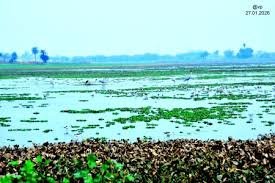
Sukhna Wetland (Chandigarh) and Sauj Jheel (Uttar Pradesh) have been added to the Ramsar List of Wetlands of International Importance, increasing India’s total to 103 Ramsar Sites.
About Sukhna Wetland
- Location: Chandigarh, at the foothills of the Outer Himalayas.
- Features: An urban reservoir that helps regulate water and sediment flows and supports aquatic, shoreline and forest habitats.
- Biodiversity: Provides feeding, breeding and wintering grounds for resident and migratory birds along the Central Asian Flyway.
- Important species:
- Common pochard (Aythya ferina) — Vulnerable.
- Pallas’s fish eagle (Haliaeetus leucoryphus) — Endangered.
- Black pond turtle (Geoclemys hamiltonii) — Endangered.
About Sauj Jheel
- Location: Uttar Pradesh, in the Ganga floodplain, near Saman Bird Sanctuary (Uttar Pradesh).
- Features: A shallow lake surrounded by farmland and connected to nearby wetlands.
- Biodiversity: Supports over 30,000 waterbirds and is recognised as an Important Bird and Biodiversity Area (IBA).
- Vegetation: Sacred lotus (Nelumbo nucifera) and wild sugarcane (Saccharum spontaneum).
- Important species:
- Sarus crane (Grus antigone) —
- Greater spotted eagle (Clanga clanga) —
About the Ramsar Convention
- Adopted: 1971 in Ramsar, Iran; came into force in 1975.
- Objective: To conserve wetlands and promote their wise use, balancing conservation with sustainable human use.
- Secretariat: Gland, Switzerland.
- India’s Membership: India became a Contracting Party in 1982.
- World Wetlands Day: Observed on 2 February, marking the adoption of the Convention.
- Coverage: Includes natural and human-made wetlands such as lakes, rivers, marshes, mangroves, peatlands, coral reefs, reservoirs, and rice fields.
- Ramsar Site Criteria: A wetland must meet at least one of nine criteria based on unique wetland types, threatened species, biodiversity, and internationally important waterbird or fish populations.
Significance
- Biodiversity conservation: Protects habitats of threatened species and migratory birds.
- Water regulation: Helps control water flows and sediment movement.
- Ecological connectivity: Supports wetland networks and biodiversity in urban and agricultural landscapes
FAQs
Q1. How many Ramsar Sites does India have after these additions?
Ans. India has 103 Ramsar Sites.
Q2. What is the main objective of the Ramsar Convention?
Ans. It promotes wetland conservation and their wise use through national action and international cooperation.
Q3. Which threatened species are associated with Sukhna Wetland?
Ans. The common pochard is Vulnerable, while Pallas’s fish eagle and the black pond turtle are Endangered.
Q4. When is World Wetlands Day observed?
Ans. It is observed on 2 February every year to raise awareness about the importance of wetlands.