Context
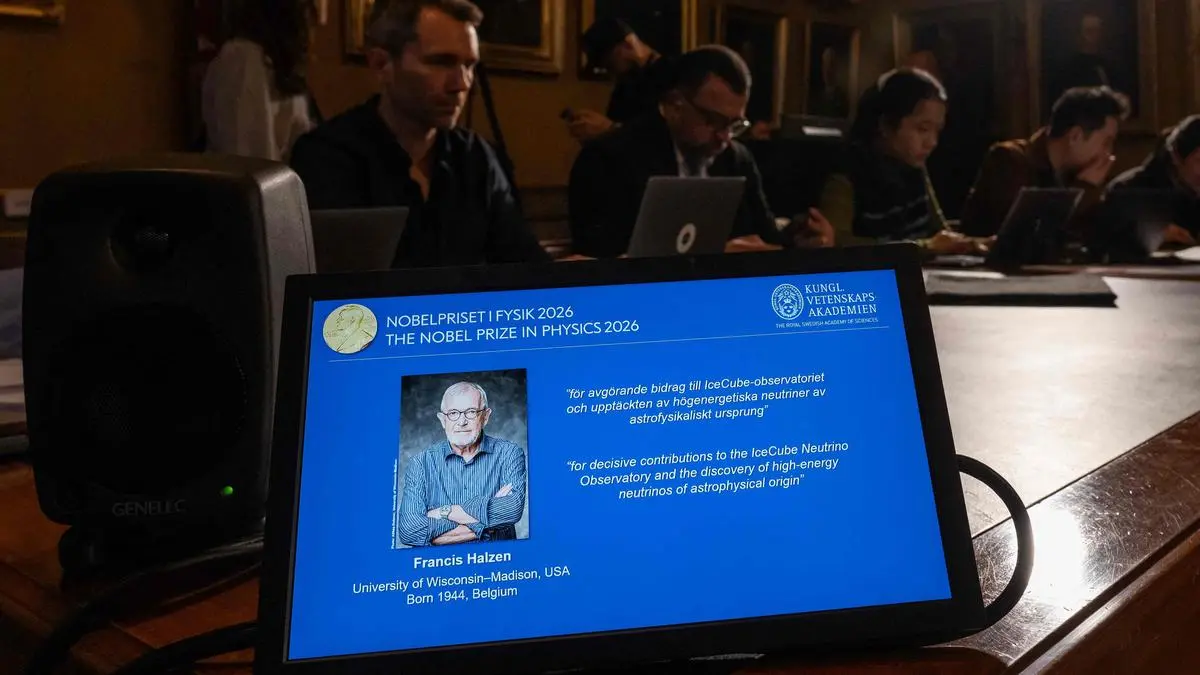
- The 2026 Nobel Prize in Physics was awarded to Francis Halzen for his decisive contribution to the IceCube Neutrino Observatory and the discovery of high-energy neutrinos of astrophysical origin.
Why Neutrinos Matter
- Neutrinos are electrically neutral, nearly massless subatomic particles produced in stellar nuclear reactions, supernovae and other energetic cosmic events.
- They interact extremely weakly with matter, allowing them to travel vast distances with little disturbance.
- Since they carry no electric charge, they are not significantly deflected by electromagnetic fields.
- Unlike photons, which may be scattered or absorbed, neutrinos can escape from dense cosmic regions and carry information about otherwise hidden processes.
- Their weak interaction therefore makes them both difficult to detect and scientifically valuable.
How IceCube Detects Neutrinos
- IceCube is located deep beneath Antarctic ice near the South Pole and uses about one cubic kilometre of ice as a detection medium.
- It contains 5,160 optical sensors embedded deep within the ice.
- When a neutrino rarely interacts with matter, it can produce a charged secondary particle.
- This particle may generate faint blue Cherenkov radiation while travelling through the ice.
- IceCube sensors analyse this light to reconstruct the energy and direction of the incoming neutrino.
- “Deep Antarctic ice provides a large, clear, dark and stable detection medium, while the overlying ice helps shield the detector from surface radiation and background noise.”
What IceCube Changed in Astronomy
- IceCube established the existence of high-energy astrophysical neutrinos, opening a new observational window on the universe.
- These neutrinos help scientists investigate energetic phenomena such as blazars, cosmic-ray accelerators and other violent astrophysical sources.
- Their relatively undisturbed journey helps researchers trace information back towards the source region.
- Neutrino observations complement electromagnetic radiation, cosmic rays and gravitational waves.
- This strengthens multi-messenger astronomy, where the same cosmic phenomenon is studied through different types of signals.
- IceCube therefore shifted neutrinos from a particle-physics curiosity to an important tool of modern astronomy.
India’s Neutrino Research
- India has proposed the India-based Neutrino Observatory (INO) at Pottipuram in Theni district, Tamil Nadu.
- Its proposed Iron Calorimeter (ICAL) is designed primarily to study atmospheric neutrinos and neutrino oscillations.
- The project reflects India’s interest in building domestic capability in particle physics, detector technology and fundamental science.
- IceCube’s success also highlights the importance of sustained investment in large-scale scientific infrastructure and long-term basic research.
FAQs
Q1. Who received the 2026 Nobel Prize in Physics?
Francis Halzen.
Q2. What are neutrinos?
They are electrically neutral, nearly massless subatomic particles that interact very weakly with matter.
Q3. How does IceCube detect neutrinos?
It detects Cherenkov light produced by charged particles generated during rare neutrino interactions in Antarctic ice.
Q4. Why are neutrinos valuable in astronomy?
They can travel from dense and distant cosmic sources with very little scattering or absorption.
Q5. What is India’s proposed neutrino project?
The India-based Neutrino Observatory (INO) in Tamil Nadu.