Context
- Fresh underwater excavations off Poompuhar in Tamil Nadu have yielded new evidence about the ancient port city’s maritime connections.
- The 18-day exploration was carried out by the Tamil Nadu State Department of Archaeology (TNSDA) in collaboration with the Indian Maritime University.
- Major discoveries include a West Asian torpedo jar fragment, four terracotta ring wells and more than 250 ceramic fragments.
- The present exploration is part of a larger effort to understand the extent of the submerged settlement, ancient trade networks and changes in the coastline.
About Poompuhar
- Poompuhar, also known as Kaveripoompattinam or Puhar, is an ancient port settlement in present-day Mayiladuthurai district, Tamil Nadu.
- It lies near the mouth of the Cauvery River, where the river enters the Bay of Bengal, giving it access to both inland and overseas trade routes.
- Poompuhar is associated with the early Cholas and figures prominently in Sangam and post-Sangam literature.
- Archaeological evidence suggests the settlement existed by at least the 5th–4th century BCE.
- Literary accounts describe three major divisions:
- Maruvurppakkam – coastal area
- Pattinappakkam – inland/western sector
- Nalangadi – market zone between them.
Archaeological Evidence of Maritime Trade
- Earlier excavations have identified wharf remains, amphorae, rouletted ware, Sri Lankan pottery, Roman coins and other ceramics, indicating Poompuhar’s role in wider Indian Ocean trade.
- The recently recovered torpedo jar fragment, believed to be of West Asian origin, adds to evidence of contacts with West Asian maritime networks.
- Such jars were generally used to transport liquid commodities such as oil or wine by sea.
- Poompuhar’s location at a major river mouth helped connect the Cauvery hinterland with overseas markets, making it an important gateway for movement of goods, people and ideas.
- Sangam literature and archaeological finds together indicate links extending towards Sri Lanka, Southeast Asia, West Asia and the Mediterranean world.
Urban Features and Submerged Settlement
- The discovery of ring wells, brick structures, pottery and other habitation remains suggests that Poompuhar was not merely a harbour but a developed urban settlement.
- Ring wells were commonly associated with water supply and habitation, while wharf remains point towards organised port infrastructure.
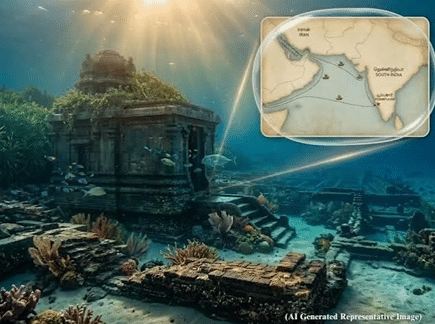
- Underwater surveys have also identified submerged structural anomalies, including previously recorded stone structures and possible shipwreck remains.
Submergence and Coastal Change
- A significant part of ancient Poompuhar is believed to lie beneath the present sea, indicating major long-term changes in the shoreline and coastal landscape.
- Archaeologists are examining factors such as coastal erosion, changes in sea level, shifts in the Cauvery’s course and possible extreme marine events.
- The presence of submerged ring wells may also indicate an ancient palaeochannel, or former river course, associated with earlier habitation.
- The exact extent and cause of Poompuhar’s submergence remain under investigation, and further underwater exploration is planned.
Significance of the Excavations
- Maritime history: The discoveries strengthen evidence of ancient Tamilakam’s participation in extensive Indian Ocean trade networks.
- Urban history: Port structures, habitation remains and water systems help reconstruct the organisation of an early historic coastal city.
- Literature–archaeology link: Material evidence provides an opportunity to examine descriptions of Poompuhar found in Sangam and post-Sangam texts.
- Coastal archaeology: The submerged remains provide valuable evidence for understanding shoreline change, river migration and coastal vulnerability over time.
FAQs
Q1. Where is Poompuhar located?
Poompuhar is located in Mayiladuthurai district, Tamil Nadu, near the mouth of the Cauvery River.
Q2. What were the major recent discoveries at Poompuhar?
They include a West Asian torpedo jar fragment, four terracotta ring wells and more than 250 ceramic fragments.
Q3. Why was Poompuhar historically important?
It was an important early Chola port city connected with regional and long-distance maritime trade.
Q4. What do the archaeological finds indicate about Poompuhar?
They suggest that Poompuhar was a developed urban and maritime centre with port infrastructure, habitation and overseas trade links.
Q5. Why is much of ancient Poompuhar believed to be underwater?
Long-term coastal erosion, shoreline change, river-course shifts, sea-level variation and possible extreme marine events are being studied as contributing factors.