Context
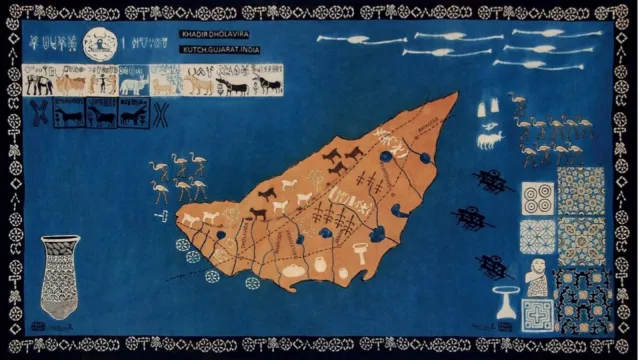
An exhibition in New Delhi has highlighted Maldhari-inspired block prints from Kutch, drawing attention to the relationship between pastoral culture, textile motifs and traditional Ajrakh craftsmanship.
The significance lies in how such textiles preserve not only decorative traditions, but also ecological memory, community identity and regional craft knowledge.
Who Are the Maldharis?
- Maldharis are traditionally pastoral communities associated mainly with Kutch and Saurashtra in Gujarat.
- Their livelihoods historically depended on livestock rearing and seasonal movement.
- Access to water, grazing land and temporary settlements shaped their mobility.
- These experiences influenced the motifs and visual vocabulary of textiles used by pastoral groups.
What Is Ajrakh Printing?
Ajrakh is a traditional form of resist block printing and dyeing practised particularly in Kutch and Sindh.
It is historically associated with Khatri artisan communities, while Maldhari pastoral groups have been important traditional users of such textiles.
Important features include:
- Hand-carved wooden blocks;
- Repeated printing and dyeing;
- Geometric and floral motifs;
- Strong symmetry;
- Extensive use of indigo, red, black and white.
The process involves multiple stages of washing, mordanting, resist printing, dyeing and finishing.
Ajrakhpur and Geographical Identity
Following the 2001 Bhuj earthquake, several Ajrakh artisan families shifted to Ajrakhpur near Bhuj, which emerged as an important centre of the craft.
Kutch Ajrakh Print of Gujarat has received a Geographical Indication (GI) tag.
Motifs as Records of Pastoral Ecology
Maldhari-inspired textiles often reflect elements of everyday pastoral life, including:
- animals;
- water sources;
- desert landscapes;
- migration;
- local architecture.
A stepwell motif, for example, reflects the importance of water in an arid landscape where mobility and settlement historically depended on access to reliable water sources.
Such motifs therefore act as a form of visual ethnography, recording how communities interacted with their environment.
India’s Wider Textile Heritage
India developed many region-specific textile traditions shaped by local fibres, dyes, techniques and cultural practices.
Examples include:
- Pashmina — Kashmir;
- Phulkari — Punjab;
- Chanderi — Madhya Pradesh;
- Patan Patola — Gujarat;
- Paithani — Maharashtra;
- Kanchipuram Silk — Tamil Nadu;
- Bhagalpur Silk — Bihar;
- Muga Silk — Assam.
This diversity shows that Indian textiles evolved as regional knowledge systems, rather than as a single uniform textile tradition.
FAQs
Q1. Who are the Maldharis?
They are traditionally pastoral communities of Gujarat, particularly associated with Kutch and Saurashtra.
Q2. What is Ajrakh?
A traditional resist block-printing and dyeing technique associated particularly with Khatri artisans of Kutch and Sindh.
Q3. Why are water-related motifs important in Maldhari-inspired textiles?
Because access to water historically shaped pastoral mobility and settlement patterns in the arid Kutch region.
Q4. Does Ajrakh directly date back to the Indus Valley Civilisation?
Ancient evidence confirms a very old cotton-textile tradition, but direct continuity of modern Ajrakh for 4,000 years is not conclusively established.
Q5. Why are traditional textile crafts important for UPSC?
They connect art and culture, livelihoods, GI protection, sustainability and regional economic development.