Context
India’s E20 rollout has drawn attention to concerns over fuel efficiency, consumer costs and environmental benefits. The debate highlights the need to assess ethanol blending alongside its impacts on energy and food security.
About E20
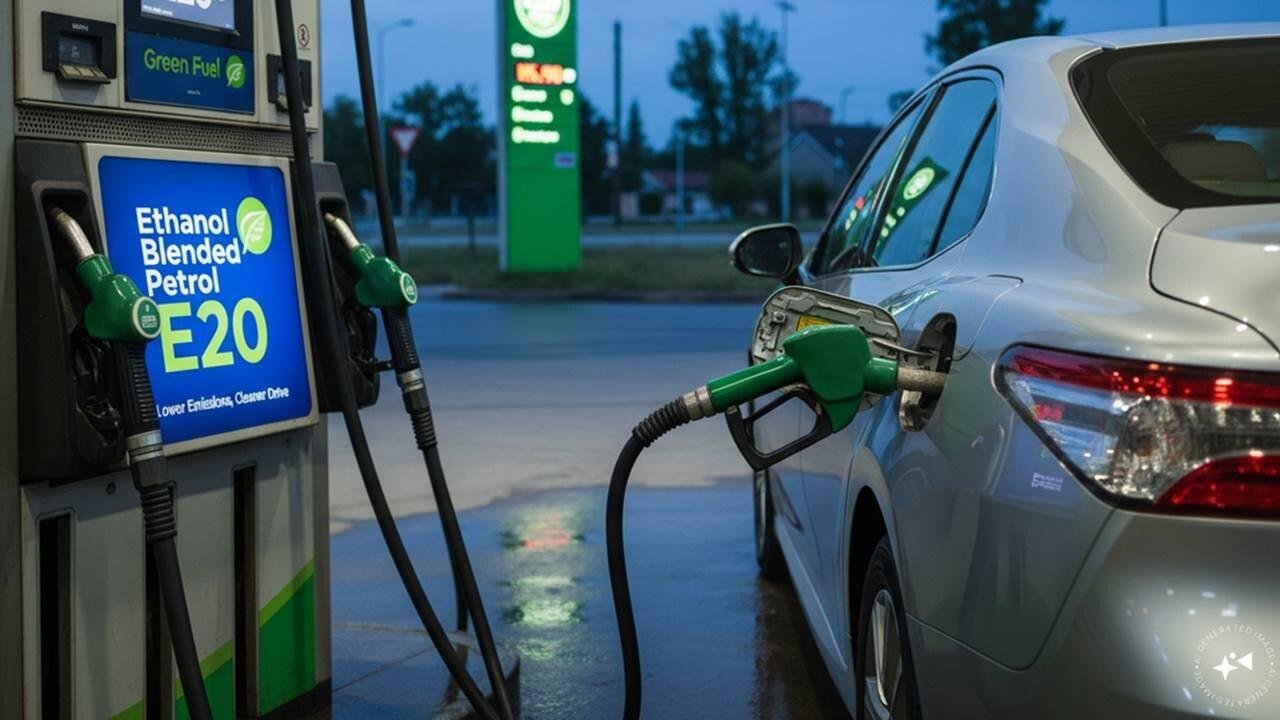
- E20 is petrol containing 20% ethanol and 80% gasoline (petrol) by volume.
- Public-sector Oil Marketing Companies (OMCs) began selling E20 petrol in February 2023 under the Ethanol Blended Petrol (EBP) Programme.
- The E20 target was advanced to Ethanol Supply Year (ESY) 2025–26 under the National Policy on Biofuels.
- E20 can cause a marginal reduction in fuel efficiency in vehicles designed for E10, while engine modifications and tuning can reduce this loss.
- Ministry of Road Transport and Highways (MoRTH) has also notified norms for E20 as a monofuel to support the EBP Programme.
Key Issues
- Energy Security vs Fuel Efficiency: E20 can reduce crude oil imports and import dependence by replacing part of petrol with ethanol. However, lower mileage can increase fuel consumption, partly offsetting these gains.
- Consumer Cost: A lower ethanol price does not necessarily mean a lower cost per kilometre. Reduced fuel efficiency may increase expenses, especially for older vehicles.
- Environmental Impact: Ethanol has lower carbon intensity per litre than petrol. Higher fuel consumption can partly offset these benefits; hence, emissions should be assessed on a life-cycle and per-kilometre basis.
- Food vs Fuel: Greater use of sugarcane and maize for ethanol can compete with food and feed requirements. This may affect food availability and agricultural prices, creating an energy–food security trade-off.
- Foreign Exchange Trade-off: Lower crude imports can generate forex savings. However, diverting crops to domestic ethanol production may reduce their availability for agricultural exports, partly diluting the gains.
- Equity and Vehicle Compatibility: Newer E20-compatible vehicles can adapt better to the blend. Older or non-compatible vehicles may face greater mileage loss and adaptation costs, creating unequal impacts among vehicle owners.
Way Forward
- Phased Transition: Follow a graded and predictable blending pathway based on vehicle readiness and market conditions.
- Vehicle Readiness: Promote E20-compatible vehicles and support adaptation of older vehicles to reduce transition costs.
- Holistic Assessment: Evaluate E20 using cost per kilometre, crude import savings, food security and life-cycle emissions.
- Alternative Feedstocks: Promote non-food and advanced feedstocks to reduce pressure on food crops.
- Balanced Policy: Align ethanol blending with energy security, environmental sustainability, consumer affordability and food security to strengthen India’s energy resilience.
FAQs
Q1. What is E20?
Ans. E20 is a fuel containing 20% ethanol and 80% petrol.
Q2. How can E20 reduce India’s crude oil dependence?
Ans. Ethanol replaces a portion of petrol in the fuel mix, reducing the quantity of petroleum required. This can lower crude oil imports and foreign-exchange expenditure.
Q3. How does E20 create a food-versus-fuel trade-off?
Ans. Greater ethanol production from sugarcane and maize can divert agricultural resources from food and feed uses, potentially affecting their availability and prices.