Context
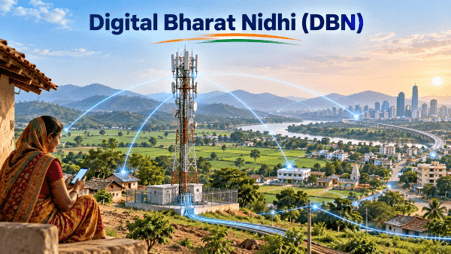
- On 10 September 2026, Digital Bharat Nidhi (DBN) under the Department of Telecommunications signed an agreement for implementation of the Amended BharatNet Programme (ABP) in Jharkhand under the State-led model.
- The development highlights DBN’s role in financing telecom expansion in underserved areas.
What Is Digital Bharat Nidhi?
- Digital Bharat Nidhi is the successor to the Universal Service Obligation Fund (USOF).
- It operates under the Telecommunications Act, 2023.
- It functions under the Department of Telecommunications, Ministry of Communications.
- Its purpose is to support telecom development where normal commercial incentives may be insufficient.
Mandate of DBN
DBN can support:
- Universal telecom access in underserved rural, remote and urban areas.
- Research and development of telecom technologies, services and products.
- Pilot projects and advisory support for new telecom solutions.
- Introduction of new technologies and services requiring public support.
Thus, DBN combines connectivity support with telecom capability-building.
Funding and Administration
- Contributions earmarked for DBN are first credited to the Consolidated Fund of India.
- Parliament appropriates funds for DBN-supported activities.
- The balance available under DBN is non-lapsable, allowing continuity for multi-year projects.
- DBN is managed by an Administrator appointed by the Central Government.
- Project implementers may be selected through competitive bidding, invitation of applications or other prescribed methods.
Link with BharatNet
The Amended BharatNet Programme is a major connectivity programme supported through DBN.
It seeks to:
- upgrade broadband connectivity to Gram Panchayats;
- extend connectivity to uncovered villages;
- improve network capacity and reliability;
- enable wider last-mile service delivery.
Under the State-led model, state agencies take a larger implementation role while DBN provides financial support.
Thus:
DBN finances → BharatNet builds backbone connectivity → Service providers extend access
Why Does DBN Matter?
- Digital inclusion: It helps connect regions that may otherwise remain commercially unattractive to telecom operators.
- Public-service access: Better connectivity supports education, telemedicine, banking and e-governance.
- Rural economic participation: Broadband allows households and enterprises to access digital markets and services.
- Regional equity: Public financing can reduce geographical disparities in access to communication infrastructure.
Key Challenges
- Household-level connectivity: Network expansion does not automatically ensure actual user access.
- Service quality: Rural networks require reliable speed, uptime and maintenance.
- Affordability: Devices and data plans may remain beyond the reach of low-income users.
- Implementation coordination: Multiple agencies must coordinate procurement, rollout and maintenance.
Way Forward
- Measure outcomes, not only assets: Track actual usage, speed, uptime and service adoption.
- Improve affordability: Promote low-cost devices, public Wi-Fi and affordable broadband plans.
- Strengthen maintenance accountability: Build clear responsibility for network upkeep and fault repair.
- Promote meaningful use: Combine connectivity with digital literacy and local-language services.
FAQs
Q1. What was Digital Bharat Nidhi earlier called?
It was earlier known as the Universal Service Obligation Fund (USOF).
Q2. Under which law does DBN operate?
Under the Telecommunications Act, 2023.
Q3. Does DBN fund only rural connectivity?
No. It can also support telecom R&D, pilot projects and introduction of new technologies.
Q4. Does the DBN balance lapse at the end of the financial year?
No. The balance is non-lapsable.
Q5. Who administers DBN?
An Administrator appointed by the Central Government.